• Fri frakt över 249 kr
  • •
  • Snabba leveranser
  • •
  • Billiga böcker
Kundservice

Du är på sajten för privatpersoner.

Företag, bibliotek eller offentlig verksamhet?

Du handlar på classic.bokus.com, där alla dina funktioner finns intakta.
Till classic.bokus.com
Bokus logotyp. Gå till startsidan.
  • Erbjudanden
  • Nyheter
  • Student
  • Topplistor
  • Barn & ungdom
  • Bokus Play
  • E-böcker
  • Pocketböcker
  • Spel & pussel

10% rabatt på allt med kod: NYSTART10 →

Sidfot

Mina sidor

    Hjälp

    • Kundservice
    • Vanliga frågor och svar
    • Frakt och leverans
    • Retur vid ångerrätt
    • Reklamera vara
    • Betalning
    • Köpvillkor
    • Allmänna villkor
    • Information om webbplatsens tillgänglighet

    Om Bokus

    • Om oss
    • Pressrum
    • För studenter
    • För företag
    • För bibliotek och offentlig verksamhet
    • För leverantörer
    • Hållbarhet

    Populärt

    • Aktuella erbjudanden
    • Presentkort
    • Studentlitteratur
    • Nya böcker
    • Topplistor
    • Signerade böcker
    • Engelska böcker

    Inspiration

    • Boktips
    • BookTok
    • Populära bokserier
    • Barnbokskaraktärer
    • Populära författare
    Logotyp för Bokus
    Följ oss på Facebook (extern länk)Följ oss på Instagram (extern länk)Följ oss på YouTube (extern länk)Följ oss på TikTok (extern länk)
    bokus @ CookiesAnpassa cookiesIntegritetspolicyKöpvillkor
    Till Citymail hemsida (extern länk)Till Budbee hemsida (extern länk)Till Postnord hemsida (extern länk)Till Schenker hemsida (extern länk)Till Early Bird hemsida (extern länk)Till Walleys hemsida (extern länk)
    1. Naturvetenskap och teknik
    2. Matematik och naturvetenskap
    3. Kemi

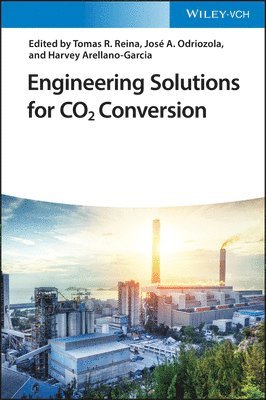
    Engineering Solutions for CO2 Conversion

    AvTomas Ramirez Reina,Tomas Ramirez Reina

    Inbunden, Engelska, 2021

    1 663 kr

    Beställningsvara. Skickas inom 11-20 vardagar. Fri frakt över 249 kr.

    Beskrivning

    A comprehensive guide that offers a review of the current technologies that tackle CO2 emissionsThe race to reduce CO2 emissions continues to be an urgent global challenge. Engineering Solutions for CO2 Conversion offers a thorough guide to the most current technologies designed to mitigate CO2 emissions ranging from CO2 capture to CO2 utilization approaches. With contributions from an international panel representing a wide range of expertise, this book contains a multidisciplinary toolkit that covers the myriad aspects of CO2 conversion strategies. Comprehensive in scope, it explores the chemical, physical, engineering and economical facets of CO2 conversion.Engineering Solutions for CO2 Conversion explores a broad range of topics including linking CFD and process simulations, membranes technologies for efficient CO2 capture-conversion, biogas sweetening technologies, plasma-assisted conversion of CO2, and much more.This important resource: Addresses a pressing concern of global environmental damage, caused by the greenhouse gases emissions from fossil fuelsContains a review of the most current developments on the various aspects of CO2 capture and utilization strategies Incldues information on chemical, physical, engineering and economical facets of CO2 capture and utilizationOffers in-depth insight into materials design, processing characterization, and computer modeling with respect to CO2 capture and conversionWritten for catalytic chemists, electrochemists, process engineers, chemical engineers, chemists in industry, photochemists, environmental chemists, theoretical chemists, environmental officers, Engineering Solutions for CO2 Conversion provides the most current and expert information on the many aspects and challenges of CO2 conversion.

    Produktinformation

    • Utgivningsdatum:2021-03-24
    • Mått:170 x 244 x 28 mm
    • Vikt:1 049 g
    • Format:Inbunden
    • Språk:Engelska
    • Antal sidor:496
    • Förlag:Wiley-VCH Verlag GmbH
    • ISBN:9783527346394

    Utforska kategorier

    • Kemi inom Naturvetenskap och teknik
    • Tillverkningsteknik inom Naturvetenskap och teknik

    Mer om författaren

    Tomas R. Reina, PhD, is a Senior Lecturer in Chemical Engineering and Head of the Catalysis Unit at the University of Surrey, UK.José A. Odriozola, PhD, is Chair of Inorganic Chemistry of the University of Sevilla, Spain.Harvey Arellano-Garcia, PhD, is Director of Research and Professor of Energy and Chemical Engineering at the Department of Process and Plant Technology at BTU-Cottbus, Germany and Chair of Process and Systems Engineering at the Brandenburg University of Technology in Germany.

    Innehållsförteckning

    • 1 CO2 Capture – A Brief Review of Technologies and Its Integration 1Mónica García, Theo Chronopoulos, and Rubén M. Montañés1.1 Introduction: The Role of Carbon Capture 11.2 CO2 Capture Technologies 21.3 Integration of Post-combustion CO2 Capture in the Power Plant and Electricity Grid 171.4 CO2 Capture in the Industrial Sector 211.5 Conclusions 222 Advancing CCSU Technologies with Computational Fluid Dynamics (CFD): A Look at the Future by Linking CFD and Process Simulations 29Daniel Sebastia-Saez, Evgenia Mechleri, and Harvey Arellano-García2.1 Sweep Across the General Simulation Techniques Available 292.2 Multi-scale Approach for CFD Simulation of Amine Scrubbers 322.3 Eulerian, Eulerian–Lagrangian, and Discrete Element Methods for the Simulation of Calcium Looping, Mineral Carbonation, and Adsorption in Other Solid Particulate Materials 382.4 CFD for Oxy-fuel Combustion Technologies: The Application of Single-Phase Reactive Flows and Particle Tracking Algorithms 412.5 CFD for Carbon Storage and Enhanced Oil Recovery (EOR): The Link Between Advanced Imaging Techniques and CFD 412.6 CFD for Carbon Utilization with Chemical Conversion: The Importance of Numerical Techniques on the Study of New Catalysts 442.7 CFD for Biological Utilization: Microalgae Cultivation 462.8 What Does the Future Hold? 473 Membranes Technologies for Efficient CO2 Capture–Conversion 55Sonia Remiro-Buenamañana, Laura Navarrete, Julio Garcia-Fayos, Sara Escorihuela, Sonia Escolastico, and José M. Serra3.1 Introduction 553.2 Polymer Membranes 563.3 Oxygen Transport Membranes for CO2 Valorization 603.4 Protonic Membranes 653.5 Membranes for Electrochemical Applications 693.6 Conclusions and Final Remarks 784 Computational Modeling of Carbon Dioxide Catalytic Conversion 85Javier Amaya Suárez, Elena R. Remesal, Jose J. Plata, Antonio M. Márquez, and Javier Fernández Sanz4.1 Introduction 854.2 General Methods for Theoretical Catalysis Research 854.3 Characterizing the Catalyst and Its Interaction with CO2 Using DFT Calculations 874.4 Microkinetic Modeling in Heterogeneous Catalysis 894.5 New Trends: High-Throughput Screening, Volcano Plots, and Machine Learning 925 An Overview of the Transition to a Carbon-Neutral Steel Industry 105Juan C. Navarro, Pablo Navarro, Oscar H. Laguna, Miguel A. Centeno, and José A. Odriozola5.1 Introduction 1055.2 Global Relevance of the Steel Industry 1065.3 Current Trends in Emission Policies in the World's Leading Countries in Steel Industry 1095.4 Transition to a Carbon-Neutral Production. A Big Challenge for the Steel Industry 1105.5 CO2 Methanation: An Interesting Opportunity for the Valorization of the Steel Industry Emissions 1145.6 Relevant Projects Already Launched for the Valorization of the CO2 Emitted by the Steel Industry 1165.7 Concluding Remarks 1196 Potential Processes for Simultaneous Biogas Upgrading and Carbon Dioxide Utilization 125Francisco M. Baena-Moreno, Mónica Rodríguez-Galán, Fernando Vega, Isabel Malico, and Benito Navarrete6.1 Introduction 1256.2 Overview of Biogas General Characteristics and Upgrading Technologies to Bio-methane Production 1276.3 CCU Main Technologies 1316.4 Potential Processes for Biogas Upgrading and Carbon Utilization 1336.5 Conclusions 1387 Biogas Sweetening Technologies 145Nikolaos D. Charisiou, Savvas L. Douvartzides, and Maria A. Goula7.1 Introduction 1457.2 Biogas Purification Technologies 1467.3 Biogas Upgrading Technologies 1577.4 Conclusions 1668 CO2 Conversion to Value-Added Gas-Phase Products: Technology Overview and Catalysts Selection 175Qi Zhang, Laura Pastor-Pérez, Xiangping Zhang, Sai Gu, and Tomas R Reina8.1 Chapter Overview 1758.2 CO2 Methanation 1768.3 RWGS Reaction 1838.4 CO2 Reforming Reactions 1888.5 Conclusions and Final Remarks 1959 CO2 Utilization Enabled by Microchannel Reactors 205Luis F. Bobadilla, Lola Azancot, and José A. Odriozola9.1 Introduction 2059.2 Transport Phenomena and Heat Exchange in Microchannel Reactors 2079.3 Application of Microreactors in CO2 Capture, Storage, and Utilization Processes 2129.4 Concluding Remarks and Future Perspectives 22110 Analysis of High-Pressure Conditions in CO2 Hydrogenation Processes 227Andrea Álvarez Moreno, Esmeralda Portillo, and Oscar Hernando Laguna10.1 Introduction 22710.2 Thermodynamic Aspects 22910.3 Overview of Some Industrial Approaches Focused on the Production of Valuable Compounds form CO2 Using a Carbon Capture and Utilization (CCU) Approach 23410.4 Techno-Economic Considerations for the Methanol Production from a CCU Approach with the Use of High Pressure 23810.5 Concluding Remarks 24811 Sabatier-Based Direct Synthesis of Methane and Methanol Using CO2 from Industrial Gas Mixtures 253K. Müller, J. Israel, F. Rachow, and D. Schmeißer11.1 Overview 25311.2 Methane Synthesis of Gas Mixtures 25511.3 Applications 26011.4 Methanol Synthesis 27412 Survey of Heterogeneous Catalysts for the CO2 Reduction to CO via Reverse Water Gas Shift 281Thomas Mathew, Simi Saju, and Shiju N. Raveendran12.1 Introduction 28112.2 RWGS Catalysts 28112.3 Mechanism of RWGS Reaction 30613 Electrocatalytic Conversion of CO2 to Syngas 317Manuel Antonio Díaz-Pérez, A. de Lucas Consuegra, and Juan Carlos Serrano-Ruiz13.1 Introduction 31713.2 Production of Syngas 31913.3 Electroreduction of CO2/Water Mixtures to Syngas 32013.4 Conclusions 32914 Recent Progress on Catalyst Development for CO2 Conversion into Value-Added Chemicals by Photo- and Electroreduction 335Luqman Atanda, Mohammad A. Wahab, and Jorge Beltramini14.1 Introduction 33514.2 CO2 Catalytic Conversion by Photoreduction 33614.3 CO2 Catalytic Conversion by Electroreduction 34615 Yolk@Shell Materials for CO2 Conversion: Chemical and Photochemical Applications 361Cameron Alexander Hurd Price, Laura Pastor-Pérez, Tomas Ramirez-Reina, and Jian Liu15.1 Overview 36115.2 Key Benefits of Hierarchical Morphology 36315.3 Materials for Chemical CO2 Recycling Reactions 36615.4 Synthesis Techniques for CS/YS: A Brief Overview 37215.5 Future Advancement 37516 Aliphatic Polycarbonates Derived from Epoxides and CO2 385Sebastian Kernbichl and Bernhard Rieger16.1 Introduction 38516.2 Aliphatic Polycarbonates 38616.3 Catalyst Systems for the CO2/Epoxide Copolymerization 39216.4 Conclusion 40217 Metal–Organic Frameworks (MOFs) for CO2 Cycloaddition Reactions 407Ignacio Campello, Antonio Sepúlveda-Escribano, and Enrique V. Ramos-Fernández17.1 Introduction to MOF 40717.2 MOFs as Catalysts 40717.3 CO2 Cycloadditions 41417.4 Oxidative Carboxylation 42018 Plasma-Assisted Conversion of CO2 429Kevin H. R. Rouwenhorst, Gerard J. van Rooij, and Leon Lefferts18.1 Introduction 42918.2 Plasma-catalytic CO2 Conversion 43718.3 Perspective 44818.4 Conclusion 450References 451Index 463