• Fri frakt över 249 kr
  • •
  • Snabba leveranser
  • •
  • Billiga böcker
Kundservice

Du är på sajten för privatpersoner.

Företag, bibliotek eller offentlig verksamhet?

Du handlar på classic.bokus.com, där alla dina funktioner finns intakta.
Till classic.bokus.com
Bokus logotyp. Gå till startsidan.
  • Erbjudanden
  • Nyheter
  • Student
  • Topplistor
  • Barn & ungdom
  • Bokus Play
  • E-böcker
  • Pocketböcker
  • Spel & pussel

10% rabatt på allt med kod NYSTART10 →

Sidfot

Mina sidor

    Hjälp

    • Kundservice
    • Vanliga frågor och svar
    • Frakt och leverans
    • Retur vid ångerrätt
    • Reklamera vara
    • Betalning
    • Köpvillkor
    • Allmänna villkor
    • Information om webbplatsens tillgänglighet

    Om Bokus

    • Om oss
    • Pressrum
    • För studenter
    • För företag
    • För bibliotek och offentlig verksamhet
    • För leverantörer
    • Hållbarhet

    Populärt

    • Aktuella erbjudanden
    • Presentkort
    • Studentlitteratur
    • Nya böcker
    • Topplistor
    • Signerade böcker
    • Engelska böcker

    Inspiration

    • Boktips
    • BookTok
    • Populära bokserier
    • Barnbokskaraktärer
    • Populära författare
    Logotyp för Bokus
    Följ oss på Facebook (extern länk)Följ oss på Instagram (extern länk)Följ oss på YouTube (extern länk)Följ oss på TikTok (extern länk)
    bokus @ CookiesAnpassa cookiesIntegritetspolicyKöpvillkor
    Till Citymail hemsida (extern länk)Till Budbee hemsida (extern länk)Till Postnord hemsida (extern länk)Till Schenker hemsida (extern länk)Till Early Bird hemsida (extern länk)Till Walleys hemsida (extern länk)
    1. Naturvetenskap och teknik
    2. Teknik och industri
    3. Elektronik och kommunikationer

    Semiconductor Solar Photocatalysts

    Fundamentals and Applications

    AvJiaguo Yu,Jiaguo Yu

    Inbunden, Engelska, 2021

    2 155 kr

    Beställningsvara. Skickas inom 5-8 vardagar. Fri frakt över 249 kr.

    Beskrivning

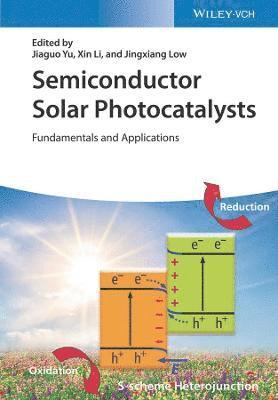
    Provides a timely overview of basic principles and significant advances of semiconductor-based photocatalysts for solar energy conversion Semiconductor Solar Photocatalysts: Fundamentals and Applications presents a systematic, in-depth summary of both fundamental and cutting-edge research in novel photocatalytic systems. Focusing on photocatalysts with vast potential for efficient utilization of solar energy, this up-to-date volume covers heterojunction systems, graphene-based photocatalysts, organic semiconductor photocatalysts, metal sulfide semiconductor photocatalysts, and graphitic carbon nitride-based photocatalysts. Organized into six chapters, the text opens with a detailed introduction to the history, design principles, modification strategies, and performance evaluation methods of solar energy photocatalysis. The remaining chapters provide detailed discussion of various novel photocatalytic systems such as direct Z-scheme and S-scheme photocatalysts, organic polymers, and covalent organic frameworks. This authoritative resource:  Explains the essential concepts of solar energy photocatalysis and heterojunction systems for photocatalysis Reviews interesting structures and new applications of semiconductor photocatalysts Features contributions from an international panel of leading researchers in the field Includes extensive references and numerous tables, figures, and color illustrations  Semiconductor Solar Photocatalysts: Fundamentals and Applications is valuable resource for all catalytic chemists, materials scientists, inorganic and physical chemists, chemical engineers, and physicists working in the semiconductor industry.

    Produktinformation

    • Utgivningsdatum:2021-11-10
    • Mått:175 x 249 x 31 mm
    • Vikt:1 111 g
    • Format:Inbunden
    • Språk:Engelska
    • Antal sidor:512
    • Förlag:Wiley-VCH Verlag GmbH
    • ISBN:9783527349593

    Utforska kategorier

    • Elektronik och kommunikationer inom Naturvetenskap och teknik
    • Maskinteknik och material inom Naturvetenskap och teknik

    Mer om författaren

    Professor Jiaguo Yu received his BS and MS degrees in chemistry from Central China Normal University and Xi'an Jiaotong University, respectively, and his PhD degree in materials science in 2000 from Wuhan University of Technology. In 2000, he became a Professor at Wuhan University of Technology. He was a postdoctoral fellow at the Chinese University of Hong Kong from 2001 to 2004, a visiting scientist from 2005 to 2006 at the University of Bristol, and a visiting scholar from 2007 to 2008 at University of Texas at Austin. His current research interests are semiconductor photocatalysis for energy and environmental applications. He has published more than 600 papers in peer-reviewed international journals, and has been on the lists of Thomson Reuters/Clarivate Analytics Highly-Cited Researchers since 2014. He is Member of Academia Europaea (2020), Fellow of the European Academy of Sciences (2020) and Fellow of the Royal Society of Chemistry (2015). He is an Associate Editor of Chinese journal of Catalysis (since 2020) and Editor of Applied Surface Science (2014-2020), and serves on the editorial board of several international journals.Professor Xin Li received his BS and PhD degrees in Chemical Engineering from Zhengzhou University in 2002 and South China University of Technology in 2007, respectively. He joined South China Agricultural University as a faculty staff member, and became an associate professor of Applied Chemistry in 2011. In 2017, he became a Professor at the South China Agricultural University. During 2012-2013, he was a visiting scholar at the Electrochemistry Center, the University of Texas at Austin, USA. His research interests include photocatalysis, photoelectrochemistry, adsorption, and the development of nanomaterials and devices.Dr. Jingxiang Low obtained his B.Eng (Hons) from Multimedia University, Malaysia in 2011 and master/Ph.D. degree from Wuhan University of Technology in 2018. He is currently working at University of Science and Technology of China. His research interests include the design, synthesis and fabrication of photocatalytic materials for energy and environmental applications. He has published more than 35 papers in renowned journals including Chemical Reviews, Advanced Materials, Journal of the American Chemical Society, etc., with total citations over 10,000 times (H-index: 26). He has won CAS President's International Fellowship Initiative, 2017 top 100,000 ranked scientists (PLOS biology) and China?s 100 most influential SCI papers.

    Innehållsförteckning

    • Chapter 1: The fundamentals of solar energy photocatalysis1.1 Background1.2 History of solar energy photocatalysis1.3 Fundamental principles of solar energy photocatalysis1.3.1 Basic mechanisms for solar energy photocatalysis1.3.2 Thermodynamic requirements for solar energy photocatalysis1.3.3 Dynamics requirements for solar energy photocatalysis1.4 Design, development and modification of semiconductor photocatalysts1.4.1 Design principles of semiconductor photocatalysts1.4.2 Classification of semiconductor photocatalysts1.4.3 Modification strategies of semiconductor photocatalysts1.4.4 Development approaches of novel semiconductor photocatalysts1.5 Processes and evaluation of solar energy photocatalysis1.5.1 Processes of solar energy photocatalysis1.5.1.1 photocatalytic water splitting1.5.1.2 photocatalytic CO2 reduction1.5.1.3 photocatalytic degradation1.5.2 Evaluation of solar energy photocatalysis1.6 The scope of this book Chapter 2: Heterojunction systems for photocatalysis2.1. Introduction2.2. Classification of heterojunction photocatalysts2.2.1. Type-II heterojunction photocatalysts2.2.2. p-n junction photocatalysts2.2.3. Surface junction photocatalysts2.2.4. Direct Z-scheme photocatalysts2.2.5. S-scheme photocatalysts2.3. Evaluation of the heterojunction photocatalysts2.3.1. Band structure2.3.1.1. Light absorption ability2.3.1.2. Reduction and oxidation ability2.3.1.3. Identification of major charge carriers2.3.2. Charge carrier separation efficiency2.3.2.1. Electrochemical test2.3.2.2. Optical spectroscopy2.3.3. Charge carrier migration mechanism2.3.3.1. Metal loading2.3.3.2. Reactive oxygen species trapping2.3.3.3. In situ irradiated XPS2.4. Applications2.4.1. Photocatalytic water splitting2.4.2. Photocatalytic CO2 reduction2.4.3. Photocatalytic N2 fixation2.4.4. Photocatalytic environmental remediation2.4.5. Photocatalytic disinfection2.5. Summary and Future Perspective Chapter 3: Metal sulfide semiconductor photocatalysts3.1. Introduction3.2. General view of metal sulfide photocatalysts3.3. Synthetic strategies of metal sulfide photocatalysts3.3.1. Solution-based method3.3.1.1. Hydrothermal method3.3.1.2. Solvothermal method3.3.2. Chemical bath deposition3.3.3. Template method3.3.4. Ion exchange method3.3.5. Other synthetic methods3.4. CdS-based photocatalysts3.4.1. Crystal structures and morphology3.4.1.1. Zero-dimensional structure3.4.1.2. One-dimensional structure3.4.1.3. Two-dimensional structure3.4.1.4. Three-dimensional structure3.4.2. Construction of CdS based composite photocatalysts3.4.2.1. CdS cocatalyst heterojunctions3.4.2.2. CdS-based type II heterojunctions3.4.2.3. CdS-based Z-scheme heterojunctions3.4.2.4. CdS-based S-scheme heterojunctions3.5. In2S3-based photocatalysts3.5.1. Crystal structure and electronic properties3.5.2. Morphology of In2S3 photocatalyst3.5.2.1. Zero-dimensional structure3.5.2.2. One-dimensional structure3.5.2.3. Two-dimensional structure3.5.2.4. Three-dimensional structure3.5.3. Construction of In2S3-based composite photocatalysts3.5.3.1. In2S3-based type-II heterojunctions3.5.3.2. In2S3-based direct Z-scheme heterojunctions3.5.3.3. In2S3-based indirect Z-scheme heterojunctions3.6. SnS2-based photocatalysts3.6.1. Morphology of SnS2 photocatalysts3.6.2. Construction of SnS2 based composite photocatalyst3.6.2.1. Cocatalyst/SnS2 composites3.6.2.2. SnS2 based type-II composites3.6.2.3. SnS2 based Z-scheme composites3.7. Cu2S-based photocatalysts3.7.1. Morphology of Cu2S photocatalysts3.7.1.1. Zero-dimensional structure3.7.1.2. One-dimensional structure3.7.1.3. Two-dimensional structure3.7.1.4. Three-dimensional structure3.7.2. Construction of Cu2S-based composite photocatalysts3.7.2.1. Cu2S/metal oxide photocatalysts3.7.2.2. Cu2S/metal sulfide photocatalysts3.7.2.3. Cu2S/metal photocatalysts3.8. Other metal sulfide photocatalysts3.9. Environmental and energy applications3.9.1. Photocatalytic H2 production3.9.1.1. Unary metal sulfide photocatalysts3.9.1.2. Binary metal sulfide-based nanocomposite photocatalysts3.9.1.3. Ternary metal sulfide-based nanocomposite photocatalysts3.9.2. Photoreduction of CO23.9.3. Photocatalytic removal of environmental contamination3.9.3.1. Photocatalytic dye degradation3.9.3.2. Photocatalytic reduction of hexavalent chromium3.10. Conclusion and outlook Chapter 4: Graphene-based photocatalysts4.1. Introduction4.2. Graphene and its derivatives4.2.1. Graphene oxide4.2.2. Reduced graphene oxide4.2.3. Graphene quantum dot4.3 General preparation techniques of graphene in photocatalysis4.3.1. Chemical exfoliation4.3.2. Chemical vapor deposition4.4. General advantages of graphene4.4.1. Conductor behavior4.4.2. Photothermal effect4.4.3. Large specific surface area4.4.4. Enhancing photostability4.4.5. Improving nanoparticle dispersion4.5. Characterization methods4.5.1. Transmission electron microscopy4.5.2. Atomic force microscopy4.5.3. Raman spectroscopy4.5.4. X-ray photoelectron spectroscopy4.6. Recent development in graphene-based photocatalysts4.6.1. Metal oxide4.6.2. Metal sulfide4.6.3. Non-metal semiconductor4.6.4. Metal-organic-framework4.7. Summary and concluding remarks Chapter 5: Graphitic carbon nitride-based photocatalysts5.1. Introduction5.2. Structure of g-C3N45.3. Preparation of g-C3N4-based photocatalysts5.3.1. Pure g-C3N45.3.2. g-C3N4-based composite photocatalysts5.4. Main photocatalytic applications of g-C3N4-based photocatalysts5.4.1. Photocatalytic H2O splitting for H2 generation5.4.2. Photocatalytic CO2 reduction for hydrocarbon fuels5.4.3. Photocatalytic N2 fixation for ammonia5.5. Strategies for optimizing photocatalytic performance of g-C3N45.5.1. Morphology design5.5.2. Surface modification5.5.3. Element doping5.5.4. Cocatalyst loading5.5.5. Heterojunction5.5.6. Single-atom deposition5.6. Challenges and prospects Chapter 6: Organic semiconductor photocatalysts6.1. MOFs photocatalysts6.1.1. Synthesis of MOFs photocatalysts6.1.2. MOFs for photocatalytic degradation of pollutants6.1.3. MOFs for photocatalytic organic transformation6.1.4. MOFs for photocatalytic H2 production from water6.1.5. MOFs for photocatalytic reduction of CO26.2. Organic polymers photocatalysts6.2.1. Synthesis of organic polymers photocatalysts6.2.2. Organic polymers for photocatalytic degradation of pollutants6.2.3. Organic polymers for organic transformation.6.2.4. Organic polymers for photocatalytic H2 production from water6.2.5. Organic polymers for photocatalytic reduction of CO26.3. COFs photocatalysts6.3.1. Synthesis of COFs photocatalysts6.3.2. COFs for photocatalytic degradation of pollutants6.3.3. COFs for photocatalytic organic transformation6.3.4. COFs for photocatalytic H2 production from water6.3.5. COFs for photocatalytic reduction of CO2