• Fri frakt över 249 kr
  • •
  • Snabba leveranser
  • •
  • Billiga böcker
Kundservice

Du är på sajten för privatpersoner.

Företag, bibliotek eller offentlig verksamhet?

Du handlar på classic.bokus.com, där alla dina funktioner finns intakta.
Till classic.bokus.com
Bokus logotyp. Gå till startsidan.
  • Erbjudanden
  • Nyheter
  • Student
  • Topplistor
  • Barn & ungdom
  • Bokus Play
  • E-böcker
  • Pocketböcker
  • Spel & pussel

10% rabatt på allt med kod NYSTART10 →

Sidfot

Mina sidor

    Hjälp

    • Kundservice
    • Vanliga frågor och svar
    • Frakt och leverans
    • Retur vid ångerrätt
    • Reklamera vara
    • Betalning
    • Köpvillkor
    • Allmänna villkor
    • Information om webbplatsens tillgänglighet

    Om Bokus

    • Om oss
    • Pressrum
    • För studenter
    • För företag
    • För bibliotek och offentlig verksamhet
    • För leverantörer
    • Hållbarhet

    Populärt

    • Aktuella erbjudanden
    • Presentkort
    • Studentlitteratur
    • Nya böcker
    • Topplistor
    • Signerade böcker
    • Engelska böcker

    Inspiration

    • Boktips
    • BookTok
    • Populära bokserier
    • Barnbokskaraktärer
    • Populära författare
    Logotyp för Bokus
    Följ oss på Facebook (extern länk)Följ oss på Instagram (extern länk)Följ oss på YouTube (extern länk)Följ oss på TikTok (extern länk)
    bokus @ CookiesAnpassa cookiesIntegritetspolicyKöpvillkor
    Till Citymail hemsida (extern länk)Till Budbee hemsida (extern länk)Till Postnord hemsida (extern länk)Till Schenker hemsida (extern länk)Till Early Bird hemsida (extern länk)Till Walleys hemsida (extern länk)
    1. Naturvetenskap och teknik
    2. Matematik och naturvetenskap
    3. Kemi
    4. Fysikalisk kemi

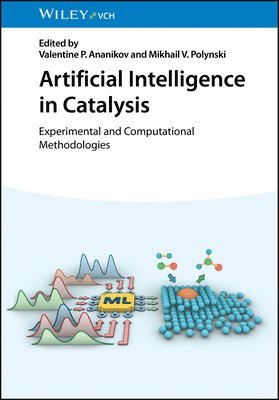
    Artificial Intelligence in Catalysis

    Experimental and Computational Methodologies

    AvValentine P. Ananikov,Valentine P. Ananikov

    Inbunden, Engelska, 2025

    1 561 kr

    Beställningsvara. Skickas inom 5-8 vardagar. Fri frakt över 249 kr.

    Beskrivning

    Enables researchers and professionals to leverage machine learning tools to optimize catalyst design and chemical processes Artificial Intelligence in Catalysis delivers a state-of-the-art overview of artificial intelligence methodologies applied in catalysis. Divided into three parts, it covers the latest advancements and trends for catalyst discovery and characterization, reaction predictions, and process optimization using machine learning, quantum chemistry, and cheminformatics. Written by an international team of experts in the field, with each chapter combining experimental and computational knowledge, Artificial Intelligence in Catalysis includes information on: Artificial intelligence techniques for chemical reaction monitoring and structural analysisApplication of artificial neural networks in the analysis of electron microscopy dataConstruction of training datasets for chemical reactivity prediction through computational meansCatalyst optimization and discovery using machine learning modelsPredicting selectivity in asymmetric catalysis with machine learningArtificial Intelligence in Catalysis is a practical guide for researchers in academia and industry interested in developing new catalysts, improving organic synthesis, and minimizing waste and energy use.

    Produktinformation

    • Utgivningsdatum:2025-08-27
    • Mått:170 x 244 x 15 mm
    • Vikt:680 g
    • Format:Inbunden
    • Språk:Engelska
    • Antal sidor:272
    • Förlag:Wiley-VCH Verlag GmbH
    • ISBN:9783527353859

    Utforska kategorier

    • Fysikalisk kemi inom Naturvetenskap och teknik
    • Artificiell intelligens inom Data och IT

    Mer om författaren

    Valentine P. Ananikov is a Professor and Laboratory Head at the Zelinsky Institute of Organic Chemistry at the Russian Academy of Sciences in Moscow, Russia. His research interests are focused on the development of new concepts in transition metal and nanoparticle catalysis, sustainable organic synthesis, and new methodologies for mechanistic studies of complex chemical transformations.Mikhail V. Polynski is a Senior Research Fellow at the National University of Singapore. His current research focuses on the automation of computational chemistry, machine learning for chemical applications, Born-Oppenheimer molecular dynamics modeling, and the theory of catalysis.

    Innehållsförteckning

    • Preface: Shaping the Future of Catalysis Research with Artificial Intelligence xiValentine P. Ananikov and Mikhail V. PolynskiPart I Machine Learning Applications in Structural Analysis and Reaction Monitoring 11 Computer Vision in Chemical Reaction Monitoring and Analysis 3Marc Reid1.1 Introduction 31.2 Fundamentals of Computer Vision in Chemistry 41.2.1 Color Theory 41.2.2 Digital Photography Basics 101.3 Computer Vision and Machine Learning in Chemistry 191.3.1 Single Image Applications 191.3.2 Video Analysis Applications 271.4 Summary and Conclusion 312 Machine Learning Meets Mass Spectrometry: A Focused Perspective 35Daniil A. Boiko and Valentine P. Ananikov2.1 Introduction 352.2 Mass Spectrometry in the Machine Learning Era 362.3 Mass Spectrometry Methods Landscape and Their Potential for Machine Learning Applications 382.4 Representative Mass Spectrometry Applications of Machine Learning 412.4.1 Sample Preparation 412.4.2 Data Acquisition 422.4.3 Data Preprocessing 432.4.4 Data Analysis 432.5 Protocol for Solving General Problems in Mass Spectrometry Using Machine Learning 452.5.1 Data Source 452.5.2 Spectra Representation 462.5.3 Algorithm Development 472.5.4 Metric Selection 482.6 Summary and Conclusion 483 Application of Artificial Neural Networks in the Analysis of Microscopy Data 55Anna V. Matveev, Anna G. Okunev, and Anna V. Nartova3.1 Introduction 553.2 Deep Machine Learning for Image Analysis 573.2.1 STM Image analysis 573.2.2 TEM Image Analysis 603.2.3 Comparison of Different Neural Networks 623.3 iOk Platform for Automatic Image Analysis 623.3.1 Web-service ParticlesNN 633.3.2 Chat Bot DLgram 653.3.3 No Code ML 683.3.4 Comparison of iOk Platform Services with Other Products 703.4 Analysis of TEM Images of Heterogeneous Catalyst by iOk Platform 713.4.1 Automated Analysis of Supported Catalyst TEM Images 713.4.2 High-resolution TEM Images 723.4.3 Single Site Analysis 743.5 Practical Summary 763.6 Future Prospects 773.7 Acknowledgments 78Part II Quantum Chemical Methods Meet Machine Learning 814 Construction of Training Datasets for Chemical Reactivity Prediction Through Computational Means 83Thijs Stuyver and Javier Alfonso-Ramos4.1 Introduction 834.2 Oracle Design 844.2.1 Compute Time - Accuracy Trade-off 854.2.2 Implications of Optimizing for Multiple Criteria Simultaneously 874.2.3 Benchmarking 884.2.4 Reproducibility 904.3 Sampling the Search Space 914.4 Active Learning Strategies 934.5 Automation Software for Accelerated Oracle Design 944.5.1 autodE 944.5.2 RMSD-PP-TS 954.5.3 TS-tools 974.6 Summary and Conclusion 995 Machine Learned Force Fields: Fundamentals, Their Reach, and Challenges 105Carlos A. Vital-José, Román J. Armenta-Rico and Huziel E. Sauceda5.1 Introduction 1055.2 Fundamentals of Machine Learning 1075.3 Introduction to Neural Networks 1105.3.1 The Perceptron 1105.3.2 Multilayer Perceptron 1125.3.3 The Architecture of a Neural Network 1125.3.4 Optimization Algorithms 1135.4 Introduction to Kernel Methods 1145.5 Machine Learning in Chemical Reactions and Catalysis 1155.5.1 Selectivity Prediction 1165.5.2 Catalyst Design and Discovery 1165.5.3 Experimental Condition Optimizations 1175.5.4 Active Site Determination 1175.6 Overview and Trends in MLFFs 1185.6.1 Neural Network-based FF 1185.6.2 Kernel-based FF 1195.7 Neural Network-based Force Fields: The SchNet Case 1205.7.1 Atom-type Embeddings 1205.7.2 Interaction Blocks 1215.7.3 The Explicit SchNet Model for T = 2 1225.8 Kernel-based Force Fields: The GDML Framework 1245.9 Summary and Concluding Remarks 126Part III Catalyst Optimization and Discovery with Machine Learning 1316 Optimization of Catalysts Using Computational Chemistry, Machine Learning, and Cheminformatics 133David Dalmau and Juan V. Alegre-Requena6.1 Introduction 1336.2 Molecular Descriptors 1356.3 Databases 1366.4 Cheminformatics 1396.5 Automation of QM Protocols 1416.6 Automation of ML Protocols 1436.7 Concluding Remarks 1457 Predicting Reactivity with Machine Learning 157Lauriane Jacot-Descombes and Kjell Jorner7.1 Introduction 1577.2 Yield 1607.3 Activation Energy and Rate Constant 1667.4 Selectivity 1727.5 Turnover Frequency and Volcano Plots 1797.6 Summary and Conclusion 1808 Predicting Selectivity in Asymmetric Catalysis with Machine Learning 195Pavel Sidorov8.1 Introduction 1958.2 Particularities of Enantioselectivity Modeling 1968.2.1 Enantioselectivity as a Target Property 1968.2.2 Enantioselectivity Data 1978.2.3 Principles of Reaction Modeling 1988.3 Models for Enantioselectivity 2018.3.1 Models Using 2D Descriptors 2018.3.2 Models Using 3D Descriptors 2048.4 Summary and Outlook 2079 Artificial Intelligence-assisted Heterogeneous Catalyst Design, Discovery, and Synthesis Utilizing Experimental Data 213Rasika Jayarathna, Seyed Majid Ghoreishian, Rahat Javaid, Azadeh Mehrani, Thossaporn Onsree, and Jochen Lauterbach9.1 Introduction 2139.2 Machine Learning Process 2169.2.1 Data Generation 2169.2.2 Machine Learning Model Development 2219.3 AI-assisted Catalyst Design 2229.3.1 Design Rule Extraction via Data Analysis 2239.3.2 Design Rule Extraction via Model Interpretation 2249.4 AI-assisted Catalyst Discovery 2289.4.1 Initial Machine Learning Model 2299.4.2 Search Space Determination 2309.4.3 Catalyst Recommendation 2309.4.4 Catalyst Synthesis and Testing 2329.4.5 Iterative Process 2329.4.6 Selected Use Cases from the Literature 2339.5 AI-assisted Catalyst Synthesis 2359.6 Summary and Conclusion 238References 239Index 249