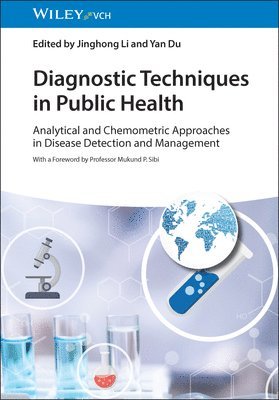
Diagnostic Techniques in Public Health
Analytical and Chemometric Approaches in Disease Detection and Management
1 897 kr
Beställningsvara. Skickas inom 5-8 vardagar. Fri frakt över 249 kr.
Beskrivning
Produktinformation
- Utgivningsdatum:2026-04-22
- Mått:170 x 244 x 15 mm
- Vikt:680 g
- Format:Inbunden
- Språk:Engelska
- Antal sidor:496
- Förlag:Wiley-VCH Verlag GmbH
- ISBN:9783527354092
Utforska kategorier
Mer om författaren
Dr. Jinghong Li is an Academician at the Chinese Academy of Sciences and a Cheung Kong Professor in the Department of Chemistry at Tsinghua University, China. He is also the Director of the Academic Committee in the Department of Chemistry at Tsinghua University. Dr. Yan Du is Professor at Changchun Institute of Applied Chemistry, Chinese Academy of Sciences (CAS, China). She has been working on biosensing and molecular diagnosis for more than 20 years.
Innehållsförteckning
- Preface xiii1 Analytical and Chemometric Approaches in Public Health Emergencies: Global Significance, Challenges, and Disease Detection Strategies 1Yan Du and Jinghong li1.1 Beyond Infectious Threats: Expanding the Horizons of Global Health Challenges 21.1.1 Introduction to Global Health Challenges 21.1.2 Determinants Influencing the Spread and Management of Diseases 21.2 Tracing the Seven Public Health Emergencies of International Concern Announcements by the World Health Organization: From H1N1 to Monkeypox 31.2.1 Overview of the World Health Organization’s Criteria for Declaring a Public Health Emergency of International Concern 31.2.2 List of Public Health Emergencies of International Concern Declarations with Dates and Brief Descriptions 31.2.2.1 H1N1 Influenza Pandemic (2009) 31.2.2.2 Poliovirus (2014) 41.2.2.3 Ebola Virus Disease Outbreak in West Africa (2014) 41.2.2.4 Zika Virus (2016) 41.2.2.5 Ebola Virus Disease Outbreak in the Democratic Republic of Congo (2019) 41.2.2.6 COVID-19 Pandemic (2020) 41.2.2.7 Monkeypox (2022) 51.2.3 Comparative Analysis of the Responses to Each Public Health Emergency of International Concern and the Evolution of Global Health Security Measures 51.3 A Close Look at Smallpox, Severe Acute Respiratory Syndrome, and Influenza Variations 51.3.1 Eradication Effort and Lessons Learned from Smallpox 61.3.2 Etiology, Transmission, and the Global Response of Severe Acute Respiratory Syndrome 61.3.3 Evolution of Influenza Strains and Their Implications for Global Pandemics 61.4 Analytical and Chemometric Approaches in Major Public Health Emergencies 61.4.1 Severe Acute Respiratory Syndrome Virus Antigen Immunoassay 71.4.2 Rapid Detection of COVID-19 and Its Variants 71.4.2.1 High-Sensitivity Rapid Detection of COVID- 19 71.4.2.2 Single-Base Resolution Identification and Rapid Screening of COVID- 19Variants 81.4.2.3 Single-Base Resolution Nucleic Acid Rapid Detection Technology Assisting Vaccine Development and Drug Screening 91.4.3 Genetic Evolution Monitoring of the Monkeypox Virus 101.5 Conclusion and Discussion 12References 132 Mastering Clinical Diagnostics: Modern Strategies for PHEIC Responses 19XinxinShenandXuejunMa2.1 Clinical Evaluation Comprehensive Pathway: From Cutting-edge Laboratory Analysis 192.2 Recombinase-aided Isothermal Amplification of Nucleic Acids: A New Dawn in Detection and Analysis 202.2.1 Introduction 202.2.2 Principle of the Recombinase-aided Amplification 212.2.3 The Detection of the RAA Products 222.2.4 Applications of Recombinase-aided Amplification 252.2.5 Advantages and Limitations of Recombinase-aided Amplification 282.2.6 Recent Advances of Recombinase-aided Amplification 292.2.7 Summary 412.3 Summary 41References 423 Diving into the ELISA Technique: Its Role and Innovations in Public Health 45Xin Wang, Nan Cheng, and Juewen Liu3.1 Introduction to ELISA and Its Components 453.2 Recognition Molecules 473.2.1 Antibodies 473.2.2 Aptamers 493.2.3 Molecularly Imprinted Polymers 513.3 Signaling Molecules, Enzymes, and Nanozymes 513.3.1 Enzyme/Antibody Conjugates 523.3.2 Nanozymes and Nanozyme/Antibody Conjugates 533.3.3 Some Common Substrates in ELISA 543.4 Different Assay Formats 553.5 ELISA for Viral Detection: SARS-CoV-2 as an Example 583.5.1 SARS-CoV-2 Antigen Detection 583.5.2 SARS-CoV-2 Antibody Detection 613.6 ELISA for Bacterial Identification 623.7 ELISA in Microfluidic Devices and Other Advanced Applications 643.7.1 Microfluidic-Integrated ELISA 643.7.2 Paper-Based Microfluidic ELISA 673.8 ELISA Using Aptamers 673.9 Conclusions and Future Directions 69References 704 Metallic Nanomaterials for Plasmonic Biosensors and Flexible Bioelectronics 77Heng Zhang, Yi Chen, Cheng Yang, Yiyi Liu, and Wenlong Cheng4.1 Introduction 774.2 Overview of Plasmonic Nanostructures 784.2.1 Optical Properties of Plasmonic Nanoparticles 794.2.2 Nanoplasmonic Building Blocks (“Meta-atoms”) 804.2.3 Plasmonic “Meta-molecules” 814.3 Plasmonic “Meta-crystals” 854.4 Plasmonic Biosensors 884.4.1 Plasmonic-based SERS Sensors 894.4.2 LSPR Colorimetric Sensors 964.5 Soft Bioelectronics 1014.5.1 Materials and Design 1024.5.2 Flexible Biosensors 1074.5.2.1 Chemical Biomarkers 1084.5.2.2 Physical Biomarkers 1094.5.3 Soft Wearable Electrochemical Biosensors 1114.5.4 Plasmonics-enhanced Electrochemical Sensors 1134.5.5 Plasmonic-FET Biosensors 1164.6 Challenges and Future Perspectives 119References 1215 Deciphering Pathogens: The Power of Genomic Sequencing in Public Health 139Hai-Yan Wang5.1 Introduction 1395.2 DNA Sequencing Technology 1495.2.1 History of DNA Sequencing Technology 1495.2.1.1 The Invention of First-Generation DNA Sequencing Technology 1495.2.1.2 The Second Generation of DNA Sequencing Technology 1505.2.1.3 The Third Generation of DNA Sequencing 1515.3 Nanopore Sequencing Technology, Bioinformatics and Applications in Genomic Sequencing 1545.3.1 The Principle and History of Nanopore Sequencing 1545.3.2 Nanopore Technology Used in Genomic Sequencing 1605.3.3 Nanopore Technology Used in Pathogen Diagnosis 1625.4 Conclusion and Perspective 164References 1666 The Art of Molecular Diagnosis: Techniques and Implications for Public Health 181Lu Gao, Zhiyin Wang, Pengkun Yin, Sitong Lv, Ye Peng, Yao liu, and Feng li6.1 Introduction 1816.2 Criteria for Developing Molecular Diagnostic Technologies 1846.2.1 Robustness and Reliability 1846.2.2 Specificity 1846.2.3 Sensitivity 1856.2.4 Speed 1856.3 Amplifying the Invisible: PCR’s Pivotal Role in Genetic Detection 1856.3.1 Overview of PCR 1856.3.2 Types of PCR 1866.3.2.1 Reverse Transcription PCR 1866.3.2.2 Asymmetric PCR 1866.3.2.3 Nested PCR 1886.3.2.4 Arms Pcr 1886.3.3 Quantitative PCR 1886.3.3.1 Dye-Based qPCR 1896.3.3.2 Molecular Beacon-Based qPCR 1906.3.3.3 TaqMan Probe-Based qPCR 1906.3.4 Digital PCR 1916.3.4.1 Droplet-Based Microfluidic Technology and Chip-Based Microfluidic Technology 1926.3.5 Portable PCR for Point-of-Care Testing 1976.4 Isothermal Amplification: Revolutionizing Molecular Diagnostics with Constant Temperature 2026.4.1 Loop-Mediated Isothermal Amplification 2026.4.1.1 Integration of LAMP with Various Detection Technologies 2036.4.1.2 Integration of LAMP with Various Detection Equipments 2056.4.2 Recombinase Polymerase Amplification 2086.4.3 Strand Displacement Amplification 2116.4.4 Nucleic Acid Sequence-Based Amplification 2116.4.5 Exponential Amplification Reaction 2156.4.6 Rolling Circle Amplification 2166.5 Isothermal and Enzyme-Free Nucleic Acid Amplification 2206.6 Summary and Outlook 223References 2247 CRISPR-Based Molecular Diagnostics: A Revolution in Detection and Management of Diseases 235Bang-Ce Ye, Pei-Qiang Ma, and Zhen-Ping Zou7.1 Dissecting CRISPR: Its Classification, Tools, and Mechanisms 2367.1.1 The Classification of CRISPR/Cas Systems 2367.1.1.1 Class 1 CRISPR/Cas Systems 2397.1.1.2 Class 2 CRISPR/Cas Systems 2427.1.2 CRISPR/Cas Tools for Diagnostic Implications 2447.1.3 Detection Mechanism 2467.1.3.1 Nucleic Acid Detection 2467.1.3.2 Non-nucleic Acid Targets Detection 2517.2 Pinpoint Accuracy: Utilizing CRISPR/Cas Systems for Pathogen Detection 2547.2.1 CRISPR System for Viral Infection Diagnosis 2547.2.2 CRISPR System for Bacterial Infection Diagnosis 2577.2.3 CRISPR System for Parasites and Fungi Diagnosis 2597.2.4 CRISPR System for Non-infectious Disease Diagnosis 2617.3 The CRISPR-Based Diagnosis: Opportunities and Challenges 264References 2658 Precision and Speed: The Rise of High-Throughput Microfluidic Systems in Diagnostics of Infectious Diseases 279Jinlu Tang, Yuehe lin, and Zhaohui li8.1 Introduction 2798.2 The Origins and Developments of Microfluidics 2808.2.1 Inception Phase 2808.2.2 Early Research in Microfluidics 2818.2.3 μTAS Concept 2828.2.4 DARPA and the Human Genome Project 2828.2.5 Pdms 2838.2.6 Droplet Microfluidics and Digital Microfluidics 2848.2.7 Paper Microfluidics 2868.2.8 Open Microfluidics 2868.2.9 Organ-on-a-Chip 2878.2.10 3D-Printed Microfluidics 2898.2.11 CRISPR-based Microfluidics 2918.2.12 AI-Assisted Microfluidics 2948.3 Applications of Microfluidic Technology in the Detection of Public Infectious Diseases 2958.3.1 SARS-CoV-2 Detection 2958.3.1.1 Paper Microfluidic Devices for the Detection of SARS-CoV- 2 2978.3.1.2 Droplet/Digital Microfluidic Devices for the Detection of SARS-CoV- 2 3028.3.1.3 Other Integrated Microfluidic Platforms for the Detection of SARS-CoV- 2 3078.3.2 Microfluidic Systems for Zika Virus and Dengue Virus Detection 3118.3.2.1 Paper Microfluidic Devices for the Detection of DENV or ZIKV 3128.3.2.2 Other Integrated Microfluidic Platforms for the Detection of DENV or Zikv 3138.3.3 Microfluidic Systems for Ebola Virus Detection 3158.3.3.1 Paper Microfluidic Devices for the Detection of EBOV 3178.3.3.2 Other Microfluidic Devices for the Detection of EBOV 3188.4 Limitations, Current Trends, and Future Prospects 321References 3249 The Future of Detection: Instrumentation and Techniques on the Horizon 343Tingting Zheng, Limin Zhang, and Yang Tian9.1 The Electrifying World of Detection: New-Age Electrochemical Methods 3439.1.1 Highly Selective Electrochemical Strategies Using Double-Recognition Molecular Probes 3439.1.2 More Accurate Electrochemical Sensors with Self-Calibration Ability 3469.1.3 Highly Stable Assembled Surfaces with Anti-Biofouling for Long-Term Measurement 3489.1.4 Iontronics Based on Electrochemistry at Liquid/Liquid Interfacial 3519.1.5 New In Vivo Electrochemical Measurement without External Power Support 3539.1.6 Summary and Outlook 3589.2 Probing the Minuscule: SERS In Enhanced Vibrational Spectroscopy 3589.2.1 Raman Instruments 3589.2.1.1 The Basic Principles of Raman Scattering 3589.2.1.2 Laser Raman Spectrometer 3599.2.1.3 Portable Raman Spectrometer 3619.2.1.4 Stimulated Raman Scattering Microscopy 3619.2.2 The Principles of SERS-Based Detection 3639.2.2.1 Electromagnetic Enhancement 3649.2.2.2 Chemical Enhancement 3649.2.2.3 SERS Substrate 3669.2.3 Advancements in SERS Technology for Public Health Emergency Response 3669.2.3.1 SERS Technology for Detection of RNA Viruses 3679.2.3.2 SERS Technology for Detection of DNA Viruses 3689.2.3.3 SERS Technology for the Detection of Bacteria 3709.2.4 Summary and Outlook 3719.3 Sensor Synthesis: Merging Technologies for Superior Diagnostic Proficiency 3729.3.1 Electrochemical-SERS Hybrid Systems 3729.3.2 Microfluidic Integration in SERS 3749.3.3 SERS-Fluorescence Dual-Mode Detection 3759.3.4 Advanced SERS Instrumentation and AI Analytics 3809.3.5 Challenges and Future Horizons 380References 38310 Redefining Point-of-Care Testing: Rapid Diagnostic Innovations 389Ryan Amini, Jian Xiao Ma, Cheryl Tong, and Yingfu li10.1 A New Wave in POCT: Tracking the Advances in Instruments and Methods 39110.1.1 Chemometric and Analytical Diagnostic Detection Methods 39210.1.1.1 Colorimetric Detection Methods 39210.1.1.2 Fluorescence Detection Methods 39310.1.1.3 Chemiluminescence Detection Methods 39410.1.1.4 Electrochemical Detection Methods 39410.1.1.5 Surface Plasmon Resonance and Surface-Enhanced Raman Spectroscopy-Based Detection Methods 39510.1.2 Chemometric and Analytical Diagnostic Detection Instruments and Devices 39810.1.2.1 Lateral Flow Devices 39810.1.2.2 Lab-on-a-Chip (LOC) Devices 40010.1.2.3 Lab-on-a-Disc (LOAD) Devices 40110.1.2.4 Miniaturized PCR Devices 40410.1.2.5 Isothermal Nucleic Acid Amplification Devices 40510.1.3 Integration of Artificial Intelligence (AI) into POCT 40710.2 Enhancing the Existing: Integrating Viral Detection in Current POCT Platforms 40810.2.1 Human Immunodeficiency Virus (HIV) 40910.2.1.1 Background 40910.2.1.2 Current Methods for Diagnosing HIV and Monitoring Disease Progression 40910.2.1.3 Improving Antigen Detection 41010.2.1.4 Isothermal Nucleic Acid Amplification Tests 41010.2.1.5 CD4 Cell Count 41310.2.2 Covid- 19 41410.2.2.1 Background 41410.2.2.2 Current Commercial Methods for the Detection of SARS-CoV- 2 41410.2.2.3 New Methods for the Detection of SARS-CoV- 2 41510.3 Challenges in POCT 42210.3.1 Sensitivity and Specificity Challenges 42310.3.2 Multiplexing 42410.3.3 Awareness/Distrust of POCT 42510.3.4 Mass Production Issues 42510.4 Conclusion and Future Perspectives 426References 42711 Looking Forward: Perspectives on the Future of Diagnostic Techniques 443Yan Du and Jinghong li11.1 Introduction: The Evolution of Diagnostic Techniques 44411.1.1 The Demand for Precision and Accessibility in Diagnostics 44411.1.2 Transforming Public Health Surveillance and Clinical Diagnostics 44511.1.3 The Role of Chemometric Approaches in Optimizing Diagnostic Accuracy and Automation 44611.2 The Paradigm Shift in Molecular Diagnostics 44711.2.1 Beyond PCR: The Rise of Isothermal and CRISPR-Based Methods 44711.2.1.1 Limitations of Traditional PCR-Based Diagnostics 44711.2.1.2 Isothermal Amplification Methods: Overcoming PCR Limitations 44711.2.1.3 CRISPR-based Diagnostics: A Disruptive Technology for POCT 44811.2.2 Next-Generation Sequencing (NGS) and Genomic Surveillance 44811.2.2.1 The Increasing Role of Metagenomic Sequencing in Pathogen Detection 44811.2.2.2 Real-Time Sequencing and AI-Driven Genomic Analysis 44911.3 Advancements in Biosensing and Bioelectronics 45011.3.1 Plasmonic and Nano-Enabled Biosensors 45011.3.2 Microfluidic Platforms for High-Throughput Analysis 45111.3.3 Flexible Bioelectronics and Wearable Diagnostics 45211.4 The Fusion of Chemometric Approaches with AI-Driven Approaches in Future Diagnostics 45311.4.1 Data-Driven Precision Diagnostics 45311.4.2 Standardization, Interoperability, and Global Data Sharing 45311.5 Outlook: Challenges and Future Directions in Diagnostic Techniques 45411.5.1 Overcoming Barriers to Accessibility and Scalability 45511.5.2 Addressing Ethical and Regulatory Challenges in AI and Genomic Diagnostics 45611.5.3 Strategic Implementation for Global Health Impact 457References 458Index 463
Du kanske också är intresserad av
Hydrogen Generation, Storage and Utilization
Jin Zhong Zhang, Jinghong Li, Yat Li, Yiping Zhao
Inbunden, 2014
1 406 kr
Decision-making Analysis and Optimization Modeling of Emergency Warnings for Major Accidents
Yunfeng Deng, Yan Du, Wenmei Gai
1 413 kr
Hydrogen Generation, Storage and Utilization
Yiping Zhao, Yat Li, Jinghong Li, Jin Zhong Zhang
1 629 kr
Hydrogen Generation, Storage and Utilization
Yiping Zhao, Yat Li, Jinghong Li, Jin Zhong Zhang
1 625 kr