• Fri frakt över 249 kr
  • •
  • Snabba leveranser
  • •
  • Billiga böcker
Kundservice

Du är på sajten för privatpersoner.

Företag, bibliotek eller offentlig verksamhet?

Du handlar på classic.bokus.com, där alla dina funktioner finns intakta.
Till classic.bokus.com
Bokus logotyp. Gå till startsidan.
  • Erbjudanden
  • Student
  • Topplistor
  • Barn & ungdom
  • Bokus Play
  • E-böcker
  • Ljudböcker
  • Pocketböcker
  • Spel och pussel

Pocketfynda! Hundratals böcker för 49 kr/st →

Sidfot

Mina sidor

    Hjälp

    • Kundservice
    • Vanliga frågor och svar
    • Frakt och leverans
    • Retur vid ångerrätt
    • Reklamera vara
    • Betalning
    • Köpvillkor
    • Allmänna villkor
    • Information om webbplatsens tillgänglighet

    Om Bokus

    • Om oss
    • Pressrum
    • För studenter
    • För företag
    • För bibliotek och offentlig verksamhet
    • För leverantörer
    • Hållbarhet

    Populärt

    • Aktuella erbjudanden
    • Presentkort
    • Studentlitteratur
    • Nya böcker
    • Topplistor
    • Signerade böcker
    • Engelska böcker

    Inspiration

    • Boktips
    • BookTok
    • Barnbokskaraktärer
    • Populära författare
    Logotyp för Bokus
    Följ oss på Facebook (extern länk)Följ oss på Instagram (extern länk)Följ oss på YouTube (extern länk)Följ oss på TikTok (extern länk)
    bokus @ CookiesAnpassa cookiesIntegritetspolicyKöpvillkor
    Till Citymail hemsida (extern länk)Till Budbee hemsida (extern länk)Till Postnord hemsida (extern länk)Till Schenker hemsida (extern länk)Till Early Bird hemsida (extern länk)Till Walleys hemsida (extern länk)
    1. Naturvetenskap och teknik
    2. Matematik och naturvetenskap
    3. Matematik

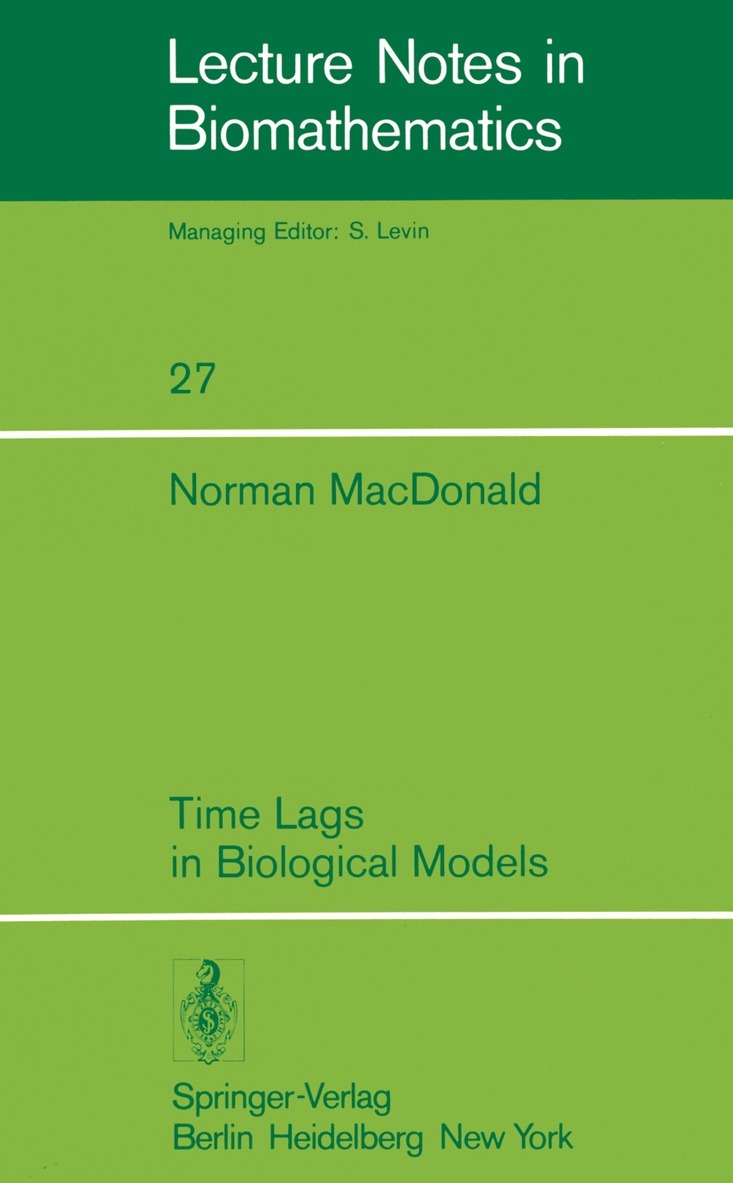
    Time Lags in Biological Models

    AvN. MacDonald

    Häftad, Engelska, 1978

    Del 27 i serien Lecture Notes in Biomathematics

    543 kr

    Beställningsvara. Skickas inom 10-15 vardagar. Fri frakt över 249 kr.

    Fler format och utgåvor

    E-bok

    710 kr

    Beskrivning

    In many biological models it is necessary to allow the rates of change of the variables to depend on the past history, rather than only the current values, of the variables. The models may require discrete lags, with the use of delay-differential equations, or distributed lags, with the use of integro-differential equations. In these lecture notes I discuss the reasons for including lags, especially distributed lags, in biological models. These reasons may be inherent in the system studied, or may be the result of simplifying assumptions made in the model used. I examine some of the techniques available for studying the solution of the equations. A large proportion of the material presented relates to a special method that can be applied to a particular class of distributed lags. This method uses an extended set of ordinary differential equations. I examine the local stability of equilibrium points, and the existence and frequency of periodic solutions. I discuss the qualitative effects of lags, and how these differ according to the choice of discrete or distributed lag. The models studied are drawn from the population dynamiCS of single species (logistic growth, the chemostat) and of interacting pairs of species (predation, mutualism), from cell population dynamiCS (haemopoiesis) and from biochemical kinetics (the Goodwin oscillator). The last chapter is devoted to a population model employing difference equations. All these models include non-linear terms.

    Produktinformation

    • Utgivningsdatum:1978-11-05
    • Mått:170 x 244 x 8 mm
    • Vikt:236 g
    • Format:Häftad
    • Språk:Engelska
    • Serie:Lecture Notes in Biomathematics
    • Antal sidor:114
    • Förlag:Springer-Verlag Berlin and Heidelberg GmbH & Co. KG
    • ISBN:9783540090922

    Utforska kategorier

    • Matematik inom Naturvetenskap och teknik

    Innehållsförteckning

    • 1. Introduction.- a. Discrete and Distributed Lag.- b. Origin of Lags in Biological Models.- c. Lag as an Alternative to Age Structure.- d. Lag as an Alternative to Spatial Structure.- e. The Effects of Lag.- f. Lags and Stochastic Models.- 2. Stability Analysis.- a. The Linear Chain Trick.- b. Instantaneous Models.- c. Models with a Single Discrete Lag.- d. Models with a Single Distributed Lag.- e. An Inequality for Distributed Lag.- f. The Monod Chemostat Model.- g. May’s Model of Obligate Mutualism.- 3. Periodic Solutions.- a. Periodic Solutions of the Linear Chain Equations.- b. The Method of Hastings, Tyson and Webster.- c. Hopf Bifurcation.- d. Numerical Integration.- 4. Logistic Growth of a Single Species.- a. Discrete Lag.- b. Distributed Lag in a Model of a Self-poisoning Population.- c. Linear Chain Calculations.- d. Hopf and H.T.W. Methods.- e. Constant Harvesting of a Population in the Presence of Lag.- f. Poincaré-Lindstedt Method for Discrete Lag.- g. An Epidemic Model Related to the Logistic Equation.- 5. Biochemical Oscillator Model.- a. The Goodwin Model.- b. Necessary Condition for Instability.- c. Expanding the Set of Equations.- d. A Single Goodwin Equation with Lag.- e. Discrete Lag in the Goodwin Equation.- 6. Models of Haemopoiesis.- a. Wheldon’s Model of Chronic Granulocytic Leukemia.- b. Two-lag Models of Cyclical Neutropenia.- c. Time Lag with Attrition; a Model of Cyclical Pancytopenia.- 7. Predation Models of the Volterra Type.- 8. Difference Equation Models.- a. Stability Analysis.- b. Conditions under which Spreading the Lag does not affect Local Stability.- c. Chaos in Discrete Dynamical Systems.- d. Extended Diapause in a Single Species Population Model.- e. Analogous Treatment of a Functional Differential Equation.- SupplementaryBibliography.- References.