• Fri frakt över 249 kr
  • •
  • Snabba leveranser
  • •
  • Billiga böcker
Kundservice

Du är på sajten för privatpersoner.

Företag, bibliotek eller offentlig verksamhet?

Du handlar på classic.bokus.com, där alla dina funktioner finns intakta.
Till classic.bokus.com
Bokus logotyp. Gå till startsidan.
  • Erbjudanden
  • Nyheter
  • Student
  • Topplistor
  • Barn & ungdom
  • Bokus Play
  • E-böcker
  • Pocketböcker
  • Spel & pussel

10% rabatt på allt med kod: NYSTART10 →

Sidfot

Mina sidor

    Hjälp

    • Kundservice
    • Vanliga frågor och svar
    • Frakt och leverans
    • Retur vid ångerrätt
    • Reklamera vara
    • Betalning
    • Köpvillkor
    • Allmänna villkor
    • Information om webbplatsens tillgänglighet

    Om Bokus

    • Om oss
    • Pressrum
    • För studenter
    • För företag
    • För bibliotek och offentlig verksamhet
    • För leverantörer
    • Hållbarhet

    Populärt

    • Aktuella erbjudanden
    • Presentkort
    • Studentlitteratur
    • Nya böcker
    • Topplistor
    • Signerade böcker
    • Engelska böcker

    Inspiration

    • Boktips
    • BookTok
    • Populära bokserier
    • Barnbokskaraktärer
    • Populära författare
    Logotyp för Bokus
    Följ oss på Facebook (extern länk)Följ oss på Instagram (extern länk)Följ oss på YouTube (extern länk)Följ oss på TikTok (extern länk)
    bokus @ CookiesAnpassa cookiesIntegritetspolicyKöpvillkor
    Till Citymail hemsida (extern länk)Till Budbee hemsida (extern länk)Till Postnord hemsida (extern länk)Till Schenker hemsida (extern länk)Till Early Bird hemsida (extern länk)Till Walleys hemsida (extern länk)
    1. Ekonomi och Ledarskap
    2. Nationalekonomi
    3. Internationell ekonomi

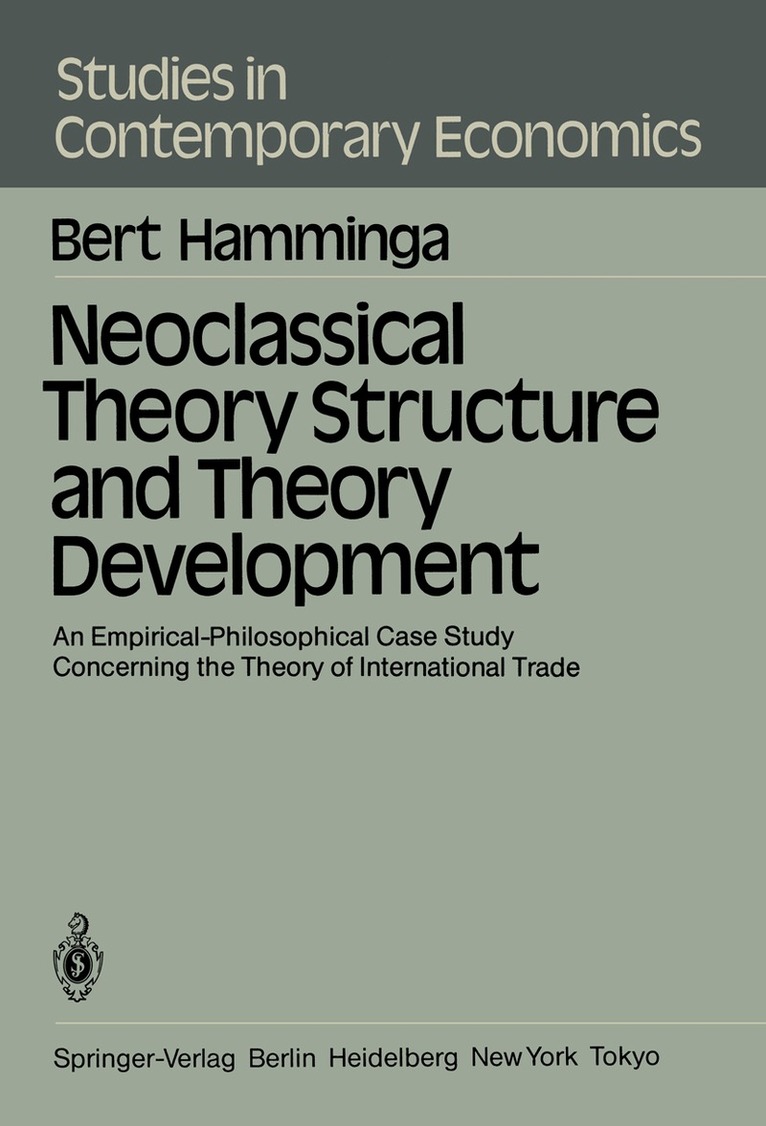
    Neoclassical Theory Structure and Theory Development

    An Empirical-Philosophical Case Study Concerning the Theory of International Trade

    AvB. Hamminga

    Häftad, Engelska, 1983

    Del i serien Studies in Contemporary Economics

    1 118 kr

    Beställningsvara. Skickas inom 10-15 vardagar. Fri frakt över 249 kr.

    Fler format och utgåvor

    E-bok

    1 459 kr

    Beskrivning

    There are quite a lot of recent books on the methodology of economics, but all proceed from one or more of the following three fundamental assumptions: 1) Meta-apriorism: it is a priori believed that the results of the philosophy of science of the past decades, associated with the names of Popper, Kuhn and Lakatos, yield conceptual frameworks that can be used to describe the product of the economist's endeavours. 2) Synchronism: it is believed that the inspection of a "theory" of economics, the presentation of some economic belief at a point in time, reveals its logical structure and ipso facto the "method" by which the "theory" is constructed. 3) CreduZity: it is believed that what economists themselves say on their own methods is true, or at least of primary relevance. In this book, I endeavour to show that these assumptions are false. First, the philosophies of science by Popper, Kuhn and Lakatos did not succeed in constructing a conceptual framework capable of describing theory development in economics. Secondly, this can only be seen as soon as not Zogic but history is taken to be the referee judging the adequacy of metatheories (diachronism). Thirdly the results of metaempiricaZ (not-meta-aprioristic), diachronic (not-synchronic) research reveals that even economists themselves turn out frequently to have inadequate metatheories upon which it is dangerous to rely (suspicion instead of credulity) .

    Produktinformation

    • Utgivningsdatum:1983-08-01
    • Mått:170 x 244 x 11 mm
    • Vikt:335 g
    • Format:Häftad
    • Språk:Engelska
    • Serie:Studies in Contemporary Economics
    • Antal sidor:176
    • Förlag:Springer-Verlag Berlin and Heidelberg GmbH & Co. KG
    • ISBN:9783540128168

    Utforska kategorier

    • Internationell ekonomi inom Ekonomi och Ledarskap

    Innehållsförteckning

    • 1. Introduction for philosophers of science.- 2. On the cause of fruitless methodology (an introduction for economists).- 3. Aims and set-up of this study.- A. Two central theses in the theory of international trade and their place in the economists’ world view.- A.1. The neoclassical economists’ world view: neoclassical foundations of economic analysis.- A.2. The effects of international trade through the economists’ spectacles: comparative statics.- A.3. Two central theses in the theory of international trade.- A.4. Why are the theorems “interesting”.- B. The emergence of interesting theorems.- B.1. Introduction.- B.2. The Stolper-Samuelson Exposition.- B.3. Questions arising in connection with the S&S-exposition.- C. Economic “normal science” centred around interesting theorems.- C.1. Introduction.- C.2. Some central concepts in informal symbolism.- C.3. Examples of research centred around the S&S-theorem.- C.4. Research centred around the factor price equalization theorem.- C.5. Summary.- D. Consolidation: metatheory on theory structure and theory development in the Ohlin-Samuelson research programme.- E. The hypothesis of the plausibility strategy.- E.1. The “plausibility strategy”: a first approach.- E.2. Initial explanatory power of the hypothesis.- E.3. Elementary plausibility.- E.4. SEPC, the enigma.- F. Problems of econometrics. The mutal independency thesis.- F.1. Identification problems.- F.2. Anchoring problems.- F.3. How these problems arise from the nature of theory development in the Ohlin-Samuelson programme.- F.4. The mutual independency thesis.- G. Conclusion: results and relevance.- G.1. Summary of the metatheory.- G.2. Some concluding remarks on the relationship between theory development and plausibilism.- G.3. Some beliefs aboutthe generality of the metatheory.- G.4. The merits and problems of other metatheories if applied to neoclassical general equilibrium research programmes.- G.5. Vice, Virtue and Rationality.- H. Appendix: a scheme for formalization of the link between theory development and plausibilism.- I. Appendix: the irrefutability of the Samuelson-type meaningfull theorems.- J. Appendix: The Friedman controversy and its consensus.- K. Appendix: Ricardian versus neoclassical FEA.- L. References.- M. Index.