• Fri frakt över 249 kr
  • •
  • Snabba leveranser
  • •
  • Billiga böcker
Kundservice

Du är på sajten för privatpersoner.

Företag, bibliotek eller offentlig verksamhet?

Du handlar på classic.bokus.com, där alla dina funktioner finns intakta.
Till classic.bokus.com
Bokus logotyp. Gå till startsidan.
  • Erbjudanden
  • Nyheter
  • Student
  • Topplistor
  • Barn & ungdom
  • Bokus Play
  • E-böcker
  • Pocketböcker
  • Spel & pussel

10% rabatt på allt med kod: NYSTART10 →

Sidfot

Mina sidor

    Hjälp

    • Kundservice
    • Vanliga frågor och svar
    • Frakt och leverans
    • Retur vid ångerrätt
    • Reklamera vara
    • Betalning
    • Köpvillkor
    • Allmänna villkor
    • Information om webbplatsens tillgänglighet

    Om Bokus

    • Om oss
    • Pressrum
    • För studenter
    • För företag
    • För bibliotek och offentlig verksamhet
    • För leverantörer
    • Hållbarhet

    Populärt

    • Aktuella erbjudanden
    • Presentkort
    • Studentlitteratur
    • Nya böcker
    • Topplistor
    • Signerade böcker
    • Engelska böcker

    Inspiration

    • Boktips
    • BookTok
    • Populära bokserier
    • Barnbokskaraktärer
    • Populära författare
    Logotyp för Bokus
    Följ oss på Facebook (extern länk)Följ oss på Instagram (extern länk)Följ oss på YouTube (extern länk)Följ oss på TikTok (extern länk)
    bokus @ CookiesAnpassa cookiesIntegritetspolicyKöpvillkor
    Till Citymail hemsida (extern länk)Till Budbee hemsida (extern länk)Till Postnord hemsida (extern länk)Till Schenker hemsida (extern länk)Till Early Bird hemsida (extern länk)Till Walleys hemsida (extern länk)
    1. Naturvetenskap och teknik
    2. Matematik och naturvetenskap
    3. Kemi

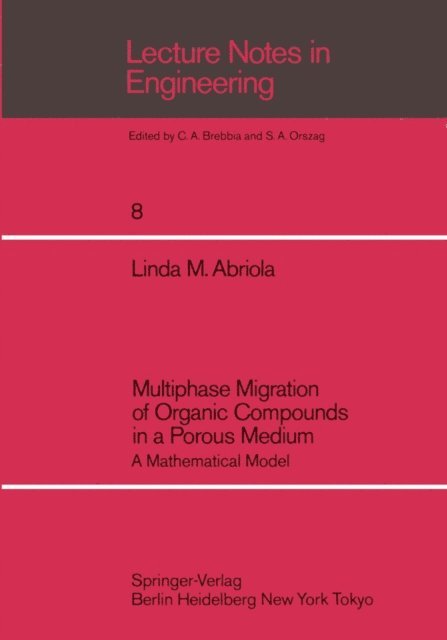
    Multiphase Migration of Organic Compounds in a Porous Medium

    A Mathematical Model

    AvLinda M. Abriola

    Häftad, Engelska, 1984

    Del 8 i serien Lecture Notes in Engineering

    547 kr

    Beställningsvara. Skickas inom 10-15 vardagar. Fri frakt över 249 kr.

    Fler format och utgåvor

    E-bok

    710 kr

    Beskrivning

    Groundwater has long been one of the world's most important resources. It accounts for approximately 96% of all fresh water in the United States and supplies more than 50% of the population with potable water. Historically, this water source has generally been regarded as pristine. However, in recent years, contamination of ground water by industrial products has become a problem of growing concern. During the past four decades, the variety and quantity of organic chemicals produced in the U. S. has steadily increased. Currently, more than 40,000 different organic compounds are being manufactured, trans­ ported, used and eventually disposed of in the environment (Wilson, et !l (1981». Production and consumption of petroleum products has also risen in this same time period. Many of these industrial compounds are highly toxic and slightly water soluble. Thus, they pose a poten­ tial threat to large volumes of groundwater if they are somehow intro­ duced into the subsurface. Increased production of chemicals implies the increased risk of accidental spills or leakage to the soil, and indeed, the literature abounds with contamination case histories. 2 Incidences of petroleum contamination of groundwater have been documented by many authors. For example, see: Schwi11e (1967); Toms (1971); Guenther (1972); McKee, et!l (1912); Williams and Wilder (1971); Van100cke, et ~]-

    Produktinformation

    • Utgivningsdatum:1984-10-01
    • Mått:170 x 244 x 14 mm
    • Vikt:435 g
    • Format:Häftad
    • Språk:Engelska
    • Serie:Lecture Notes in Engineering
    • Antal sidor:234
    • Förlag:Springer-Verlag Berlin and Heidelberg GmbH & Co. KG
    • ISBN:9783540136941

    Utforska kategorier

    • Kemi inom Naturvetenskap och teknik
    • Biovetenskap inom Naturvetenskap och teknik
    • Geografi inom Naturvetenskap och teknik

    Innehållsförteckning

    • I — Introduction.- II — Equation Development.- 2.1-Presentation of the Balance Laws.- 2.2-Soil Species Equation.- 2.3-Water Equation.- 2.4-Inert Chemical Species Equation.- 2.5-Air Species Equation.- 2.6-Species 2 Equation.- 2.7-Partitioning of Mass.- 2.8-Equation Summary.- III — Development of the 1-D Simulator.- 3.1-Background.- 3.2-Formation of the Difference Equations.- 3.3-Incorporation of Boundary and Initial Conditions.- 3.4-Evaluation of Coefficients.- 3.5-Solution of the Nonlinear Matrix Equations.- IV — Computer Simulations in One Dimension.- 4.1-Oil Contamination Simulations.- 4.2-TCE Simulations.- V — The Two-Dimensional Simulator.- 5.1-Extension to Two Space Dimensions.- 5.2-Matrix Equation Structure and Solution.- 5.3-Example Simulations.- Summary and Conclusions.- References.- Appendices.- Appendix A — Derivation of the Macroscopic Mass Balance Equation.- Appendix B.1 — Properties of the Difference Operator and its Solutions.- Appendix B.2 — Analysis of Truncation Terms.- Appendix B.3 — The Newton-Raphson Iteration Method.- Appendix C.1 — Matrix Coefficients for the 1-D Model.- Appendix C.2 — Newton-Raphson Matrix Coefficients for the 1-D Model.