• Fri frakt över 249 kr
  • •
  • Snabba leveranser
  • •
  • Billiga böcker
Kundservice

Du är på sajten för privatpersoner.

Företag, bibliotek eller offentlig verksamhet?

Du handlar på classic.bokus.com, där alla dina funktioner finns intakta.
Till classic.bokus.com
Bokus logotyp. Gå till startsidan.
  • Erbjudanden
  • Student
  • Topplistor
  • Barn & ungdom
  • Bokus Play
  • E-böcker
  • Ljudböcker
  • Pocketböcker
  • Spel och pussel

Pocketfynda! Hundratals böcker för 49 kr/st →

Sidfot

Mina sidor

    Hjälp

    • Kundservice
    • Vanliga frågor och svar
    • Frakt och leverans
    • Retur vid ångerrätt
    • Reklamera vara
    • Betalning
    • Köpvillkor
    • Allmänna villkor
    • Information om webbplatsens tillgänglighet

    Om Bokus

    • Om oss
    • Pressrum
    • För studenter
    • För företag
    • För bibliotek och offentlig verksamhet
    • För leverantörer
    • Hållbarhet

    Populärt

    • Aktuella erbjudanden
    • Presentkort
    • Studentlitteratur
    • Nya böcker
    • Topplistor
    • Signerade böcker
    • Engelska böcker

    Inspiration

    • Boktips
    • BookTok
    • Barnbokskaraktärer
    • Populära författare
    Logotyp för Bokus
    Följ oss på Facebook (extern länk)Följ oss på Instagram (extern länk)Följ oss på YouTube (extern länk)Följ oss på TikTok (extern länk)
    bokus @ CookiesAnpassa cookiesIntegritetspolicyKöpvillkor
    Till Citymail hemsida (extern länk)Till Budbee hemsida (extern länk)Till Postnord hemsida (extern länk)Till Schenker hemsida (extern länk)Till Early Bird hemsida (extern länk)Till Walleys hemsida (extern länk)
    1. Data och IT
    2. Systemvetenskap och AI
    3. Artificiell intelligens

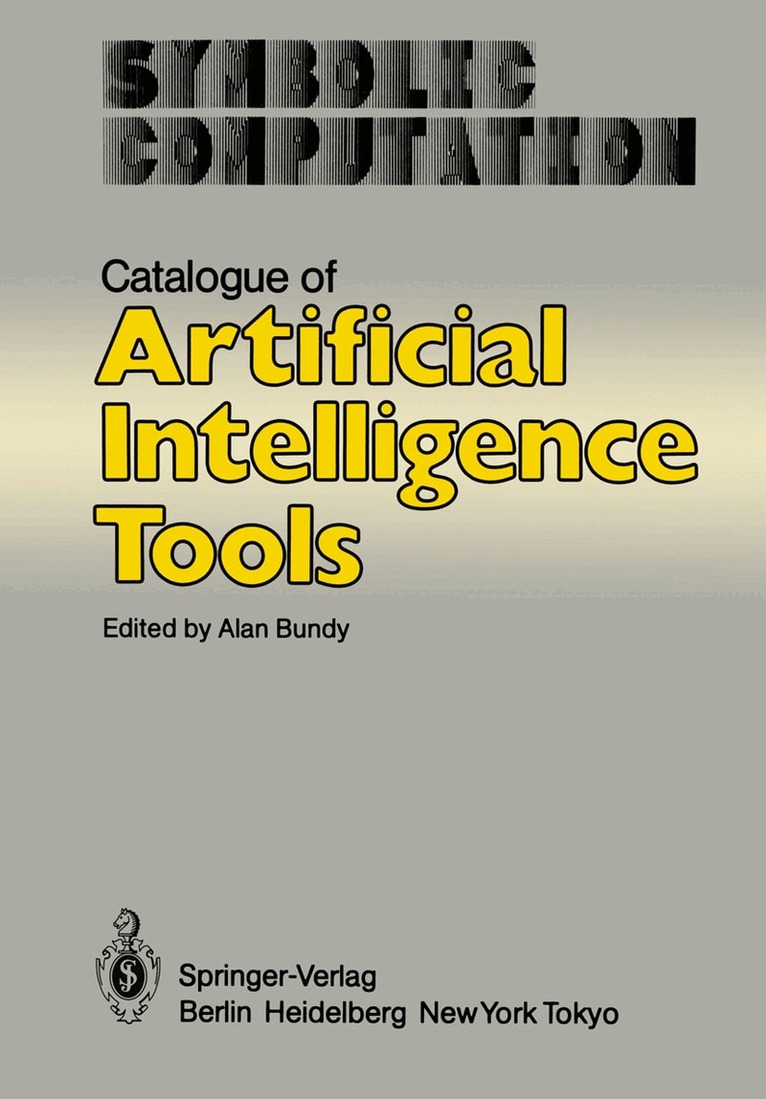
    Catalogue of Artificial Intelligence Tools

    AvA. Bundy

    Häftad, Engelska, 1984

    Del i serien Symbolic Computation

    1 477 kr

    Beställningsvara. Skickas inom 5-8 vardagar. Fri frakt över 249 kr.

    Beskrivning

    The purpose of this catalogue is to promote interaction between members of the AI' community. It will do this by announcing the existence of Ai techniques and portable software. and acting as a pOinter into the literature. Thus the AI community wili have access to a common. extensional definition of the field. which will: promote a common terminology. discourage the reinvention of wheels. and act as a clearing house for ideas and software. The cataiogue is a reference work providing a quick guide to the AI tools available for different jobs. It is not intended to be a textbook like the Artificial Intelligence Handbook. It. intentionally. only provides a brief description of each tool. with no extended discussion of the historical origin of the tool or how it has been used in particular AI programs, The focus is on techniques abstracted from their historical origins. The original version of the catalogue. was hastily built in 1983 as part of the UK SERC-Dol. IKBS. Architecture Study [lKBS Architecture Study 831. it has now been adopted by the SERC Specially Promoted Programme in IKBS and is kept as an on­ line document undergoing constant revision and refinement and published as a paperback by Springer Verlag.

    Produktinformation

    • Utgivningsdatum:1984-11-01
    • Mått:170 x 244 x undefined mm
    • Vikt:322 g
    • Format:Häftad
    • Språk:Engelska
    • Serie:Symbolic Computation
    • Antal sidor:150
    • Förlag:Springer-Verlag Berlin and Heidelberg GmbH & Co. KG
    • ISBN:9783540139386

    Utforska kategorier

    • Artificiell intelligens inom Data och IT
    • Tillämpad datateknik inom Data och IT

    Innehållsförteckning

    • 1. 2 1/2-D Sketch.- 2. A* Algorithm.- 3. ACLS: Analogue Concept Learning System.- 4. Actors.- 5. AGE.- 6. ALICE.- 7. Alpha/Beta Pruning.- 8. AL/X.- 9. AMORD.- 10. Analogical Problem Solving.- 11. APES.- 12. ARBY.- 13. Associative Database.- 14. Augmented Transition Network.- 15. B* Algorithm.- 16. Bandpass Filter.- 17. Bayesian Inference.- 18. Bidirectional Search.- 19. Blackboard.- 20. Bottom-Up Parsing.- 21. Boundary Detection.- 22. Boyer-Moore Theorem Prover.- 23. Branch-and-Bound Algorithms.- 24. Breadth-First Parsing.- 25. Breadth-First Search.- 26. Cambridge LISP.- 27. Cascaded Augmented Transition Network.- 28. Case Frames.- 29. Cellular Arrays.- 30. Chart Parsing.- 31. CHI.- 32. Classification.- 33. Clausal Form.- 34. Common LISP.- 35. Computer Audiometry.- 36. Conceptual Dependency.- 37. Connection Machine.- 38. CONNIVER.- 39. Constraint Satisfaction and Propagation.- 40. Constructive Solid Geometry.- 41. Context-Free Grammar.- 42. Contour Generator.- 43. Contradiction Backtracing.- 44. Contrast Sensitivity Function.- 45. Convolution.- 46. DADO.- 47. Data-Directed Control.- 48. Default Reasoning.- 49. Definite Clause Grammars.- 50. Delayed Evaluation.- 51. Demon.- 52. Dempster-Shafer Theory.- 53. Dependency Directed Backtracking.- 54. Depth-First Parsing.- 55. Depth-First Search.- 56. Deterministic Parsing.- 57. Difference of Gaussians.- 58. Discrimination Learning.- 59. Discrimination Net.- 60. Distance Transform.- 61. Distributed Problem Solving.- 62. Dynamic Programming.- 63. Dynamic Time Warping.- 64. Earleys Algorithm.- 65. Edge Detection.- 66. EMYCIN.- 67. Envisioning.- 68. Expert.- 69. Fast Pattern Recognition Techniques.- 70. Finding Common Paths.- 71. Flynn Classification.- 72. Focussing.- 73. Formant.- 74. Formant Synthesis.- 75. FORTRAN.- 76. Forward/Bacward Search.- 77. Frame.- 78. FRL.- 79. Functional Data Model.- 80. Functional Grammar.- 81. Fuzzy Relational Products.- 82. Fuzzy Set Theory.- 83. Generalised Cylinders.- 84. Generalised Hough Transform.- 85. Generative Capacity.- 86. Goal Structure.- 87. Golay Neighbourhoods.- 88. Gradient Space.- 89. Grey-Level Image.- 90. Heterarchy.- 91. Hearsay-III.- 92. Heuristic Search.- 93. Hierarchical Planning.- 94. High-Emphasis Filtering.- 95. Hook.- 96. Hope.- 97. Horn Clauses.- 98. Image Data Structures.- 99. Image Segmentation.- 100. Inference Engine Toolkit.- 101. Inferno.- 102. Interactions Between Sub-Goals.- 103. Interlisp-D.- 104. Intern Demons.- 105. Intrinsic Images.- 106. Invariant Queues.- 107. Invariant Violation Demons.- 108. ISA Hierarchy.- 109. Island Parsing.- 110. Junction Dictionary.- 111. KAS: Knowleoge Acquisition System.- 112. Kinematics.- 113. KL-ONE/KL-TWO.- 114. KRC.- 115. KRL.- 116. Laplacian.- 117. LCF.- 118. Learning from Solution Paths.- 119. Lexical Access.- 120. LIFER.- 121. Line Finding.- 122. Line Labelling.- 123. Linear Predictive Coding.- 124. Lispkit.- 125. LM.- 126. LM-GEO.- 127. Local Grey-Level Operations.- 128. Logic Machine Architecture.- 129. LOGLISP.- 130. LOGO.- 131. LOOPS.- 132. MACLISP.- 133. Macro Operators.- 134. MACSYMA.- 135. Markgraf Karl Refutation Procedure.- 136. MBASE.- 137. MDL.- 138. Means/Ends Analysis.- 139. Meta-Level Inference.- 140. Meta-Planning.- 141. Meta-Rules.- 142. Micro Expert.- 143. Micro-PLANNER.- 144. Micro-PROLOG.- 145. Minimax.- 146. ML.- 147. Model Directed Search.- 148. Modulation Transfer Function.- 149. Morphographemics.- 150. MProlog.- 151. Multi-Actor System.- 152. Multi-Pulse LPC.- 153. Natural Deduction.- 154. Negation as Failure.- 155. Neighbourhood Parallelism.- 156. NIAL (Nested Interactive Array Language).- 157. NIL.- 158. Non-Linear Planning.- 159. Non-Monotonic Reasoning.- 160. Numerically-Controlled Machine Tools.- 161. Object-Centred Co-Ordinates.- 162. One-Then-Best Backtracking.- 163. Operator Table.- 164. Operators.- 165. Opportunistic Search.- 166. OPS5.- 167. Optical Flow.- 168. Optimistic Plan Execution.- 169. Overloaded Operators.- 170. Paramodulation.- 171. Partial Evaluation.- 172. Partitioned Semantic Net.- 173. Pattern Directed Retrieval/Invocation.- 174. Pattern Matching.- 175. Perceptrons.- 176. Photometric Stereo.- 177. Pipelining.- 178. Pitch Extraction.- 179. Plan Recognition.- 180. Plan Structure.- 181. POP-2.- 182. POP-11.- 183. POPLOG.- 184. Portable Standard LISP.- 185. Postulating Intrinsic Properties.- 186. Precondition Analysis.- 187. Predictive Parsing.- 188. Procedural Attachment.- 189. Predicate Calculus.- 190. Preference Semantics.- 191. Primal Sketch.- 192. Production Rule System.- 193. Program Synthesis.- 194. Program Transformation.- 195. Programming Cliche.- 196. PROLOG.- 197. Propagation in Cellular Arrays.- 198. Property Lists.- 199. Propositional Constraint Propagation.- 200. Protocol Analysis.- 201. PSI.- 202. Pyramids/Resolution Cones.- 203. QLISP/QA4.- 204. Quad Trees.- 205. RAPT.- 206. Reflectance Map.- 207. Refutation Proof.- 208. Region Finding.- 209. Relational Database Query Formulation.- 210. Relaxation Labelling.- 211. Remote Procedure Calls.- 212. Resolution.- 213. Rewrite Rules.- 214. RLL.- 215. ROBMOD.- 216. Robot Dynamics.- 217. Robot Programming.- 218. ROSIE.- 219. RUP.- 220. SAGE.- 221. SAIL.- 222. SASL.- 223. SCRIPT.- 224. Semantic Binary Relationship Model.- 225. Semantic Checking.- 226. Semantic Grammar.- 227. Semantic Net.- 228. Semantic Primitives.- 229. Sensory Feedback and Compliance.- 230.Shape Analysis.- 231. Shape From Shading.- 232. Shape from Texture.- 233. Situation Calculus.- 234. Skeletonisation.- 235. Skolemization.- 236. SmallTalk.- 237. Spatial Differentiation.- 238. Spatial Frequency Channels.- 239. Spelling Correction.- 240. State Space.- 241. Stereopsis.- 242. Structured Induction.- 243. Subgoaling.- 244. SYNICS.- 245. Table of Multiple Effects.- 246. Template Matching.- 247. Time Complexity of Recognition.- 248. Top-Down Parsing.- 249. T-PROLOG.- 250. Truth Maintenance System.- 251. Typed Preconditions.- 252. Unification.- 253. Units.- 254. The UT Theorem Prover.- 255. Variable-Valued Logic.- 256. Version Space.- 257. Viewer-centred Co-ordinates.- 258. Vocoder Representation.- 259. VOLE.- 260. Vowel Quadrilateral.- 261. Zero-Crossings.- 262. ZETALISP.- 263. ZMOB.- 264. ZOG.- Index of Definitions.