• Fri frakt över 249 kr
  • •
  • Snabba leveranser
  • •
  • Billiga böcker
Kundservice

Du är på sajten för privatpersoner.

Företag, bibliotek eller offentlig verksamhet?

Du handlar på classic.bokus.com, där alla dina funktioner finns intakta.
Till classic.bokus.com
Bokus logotyp. Gå till startsidan.
  • Erbjudanden
  • Student
  • Topplistor
  • Barn & ungdom
  • Bokus Play
  • E-böcker
  • Ljudböcker
  • Pocketböcker
  • Spel & pussel

10% rabatt på allt med kod NYSTART10 →

Sidfot

Mina sidor

    Hjälp

    • Kundservice
    • Vanliga frågor och svar
    • Frakt och leverans
    • Retur vid ångerrätt
    • Reklamera vara
    • Betalning
    • Köpvillkor
    • Allmänna villkor
    • Information om webbplatsens tillgänglighet

    Om Bokus

    • Om oss
    • Pressrum
    • För studenter
    • För företag
    • För bibliotek och offentlig verksamhet
    • För leverantörer
    • Hållbarhet

    Populärt

    • Aktuella erbjudanden
    • Presentkort
    • Studentlitteratur
    • Nya böcker
    • Topplistor
    • Signerade böcker
    • Engelska böcker

    Inspiration

    • Boktips
    • BookTok
    • Populära bokserier
    • Barnbokskaraktärer
    • Populära författare
    Logotyp för Bokus
    Följ oss på Facebook (extern länk)Följ oss på Instagram (extern länk)Följ oss på YouTube (extern länk)Följ oss på TikTok (extern länk)
    bokus @ CookiesAnpassa cookiesIntegritetspolicyKöpvillkor
    Till Citymail hemsida (extern länk)Till Budbee hemsida (extern länk)Till Postnord hemsida (extern länk)Till Schenker hemsida (extern länk)Till Early Bird hemsida (extern länk)Till Walleys hemsida (extern länk)
    1. Naturvetenskap och teknik
    2. Matematik och naturvetenskap
    3. Matematik
    4. Kombinatorik och grafteori

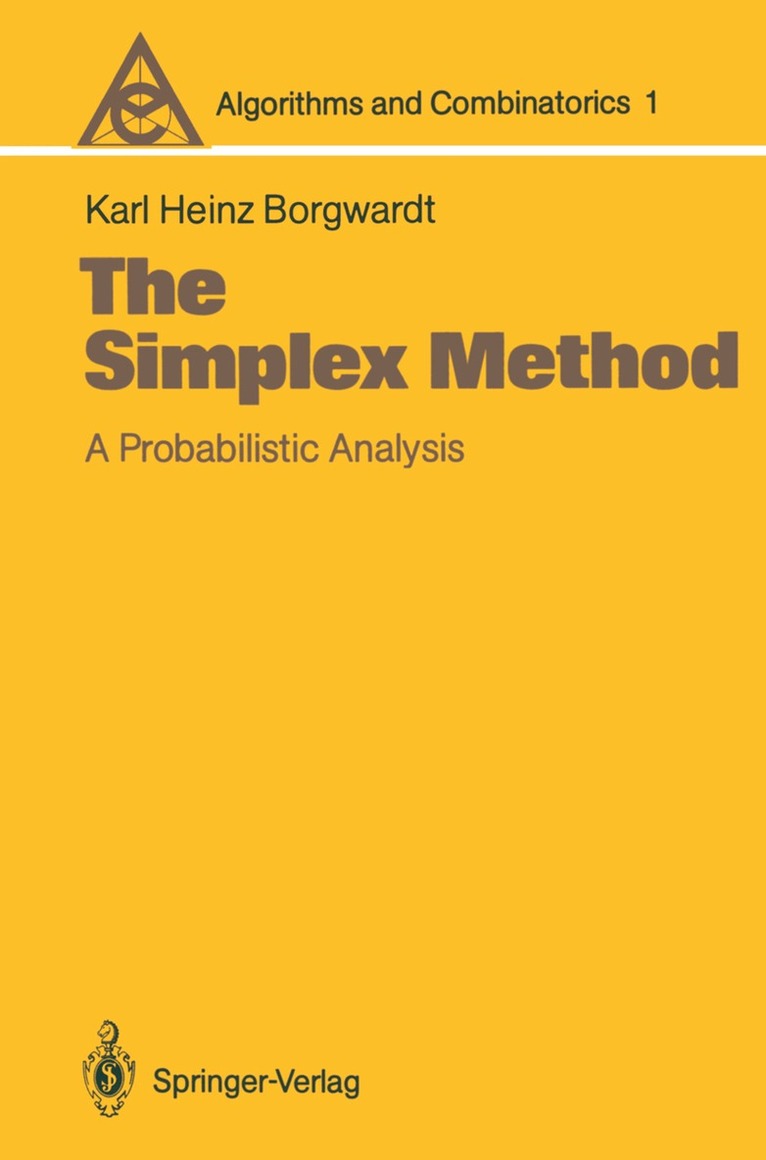
    Simplex Method

    A Probabilistic Analysis

    AvKarl Heinz Borgwardt

    Häftad, Engelska, 1986

    Del i serien Algorithms and Combinatorics

    546 kr

    Beställningsvara. Skickas inom 10-15 vardagar. Fri frakt över 249 kr.

    Fler format och utgåvor

    E-bok

    710 kr

    Beskrivning

    For more than 35 years now, George B. Dantzig's Simplex-Method has been the most efficient mathematical tool for solving linear programming problems. It is proba­ bly that mathematical algorithm for which the most computation time on computers is spent. This fact explains the great interest of experts and of the public to understand the method and its efficiency. But there are linear programming problems which will not be solved by a given variant of the Simplex-Method in an acceptable time. The discrepancy between this (negative) theoretical result and the good practical behaviour of the method has caused a great fascination for many years. While the "worst-case analysis" of some variants of the method shows that this is not a "good" algorithm in the usual sense of complexity theory, it seems to be useful to apply other criteria for a judgement concerning the quality of the algorithm. One of these criteria is the average computation time, which amounts to an anal­ ysis of the average number of elementary arithmetic computations and of the number of pivot steps. A rigid analysis of the average behaviour may be very helpful for the decision which algorithm and which variant shall be used in practical applications. The subject and purpose of this book is to explain the great efficiency in prac­ tice by assuming certain distributions on the "real-world" -problems. Other stochastic models are realistic as well and so this analysis should be considered as one of many possibilities.

    Produktinformation

    • Utgivningsdatum:1986-11-01
    • Mått:155 x 235 x 16 mm
    • Vikt:435 g
    • Format:Häftad
    • Språk:Engelska
    • Serie:Algorithms and Combinatorics
    • Antal sidor:270
    • Förlag:Springer-Verlag Berlin and Heidelberg GmbH & Co. KG
    • ISBN:9783540170969

    Utforska kategorier

    • Kombinatorik och grafteori inom Naturvetenskap och teknik

    Innehållsförteckning

    • 0 Introduction.- Formulation of the problem and basic notation.- 1 The problem.- A Historical Overview.- 2 The gap between worst case and practical experience.- 3 Alternative algorithms.- 4 Results of stochastic geometry.- 5 The results of the author.- 6 The work of Smale.- 7 The paper of Haimovich.- 8 Quadratic expected number of steps for sign-invariance model.- Discussion of different stochastic models.- 9 What is the “Real World Model”?.- Outline of Chapters 1–5.- 10 The basic ideas and the methods of this book.- 11 The results of this book.- 12 Conclusion and conjectures.- 1 The Shadow-Vertex Algorithm.- 1 Primal interpretation.- 2 Dual interpretation.- 3 Numerical realization of the algorithm.- 4 The algorithm for Phase I.- 2 The Average Number of Pivot Steps.- 1 The probability space.- 2 An integral formula for the expected number of S.- 3 A transformation of coordinates.- 4 Generalizations.- 3 The Polynomiality of the Expected Number of Steps.- 1 Comparison of two integrals.- 2 An application of Cavalieri’s Principle.- 3 The influence of the distribution.- 4 Evaluation of the quotient.- 5 The average number of steps in our complete Simplex-Method.- 4 Asymptotic Results.- 1 An asymptotic upper bound in integral form.- 2 Asymptotic results for certain classes of distributions.- 3 Special distributions with bounded support.- 4 Asymptotic bounds under uniform distributions.- 5 Asymptotic bounds under Gaussian distribution.- 5 Problems with Nonnegativity Constraints.- 1 The geometry.- 2 The complete solution method.- 3 A simplification of the boundary-condition.- 4 Explicit formulation of the intersection-condition.- 5 Componentwise sign-independence and the intersection condition.- 6 The average number of pivot steps.- 6 Appendix.- 1 Gammafunction andBetafunction.- 2 Unit ball and unit sphere.- 3 Estimations under variation of the weights.- References.