• Fri frakt över 249 kr
  • •
  • Snabba leveranser
  • •
  • Billiga böcker
Kundservice

Du är på sajten för privatpersoner.

Företag, bibliotek eller offentlig verksamhet?

Du handlar på classic.bokus.com, där alla dina funktioner finns intakta.
Till classic.bokus.com
Bokus logotyp. Gå till startsidan.
  • Erbjudanden
  • Student
  • Topplistor
  • Barn & ungdom
  • Bokus Play
  • E-böcker
  • Ljudböcker
  • Pocketböcker
  • Spel och pussel

5% studentrabatt – använd koden KURSBOK27 →

Sidfot

Mina sidor

    Hjälp

    • Kundservice
    • Vanliga frågor och svar
    • Frakt och leverans
    • Retur vid ångerrätt
    • Reklamera vara
    • Betalning
    • Köpvillkor
    • Allmänna villkor
    • Information om webbplatsens tillgänglighet

    Om Bokus

    • Om oss
    • Pressrum
    • För studenter
    • För företag
    • För bibliotek och offentlig verksamhet
    • För leverantörer
    • Hållbarhet

    Populärt

    • Aktuella erbjudanden
    • Presentkort
    • Studentlitteratur
    • Nya böcker
    • Topplistor
    • Signerade böcker
    • Engelska böcker

    Inspiration

    • Boktips
    • BookTok
    • Barnbokskaraktärer
    • Populära författare
    Logotyp för Bokus
    Följ oss på Facebook (extern länk)Följ oss på Instagram (extern länk)Följ oss på YouTube (extern länk)Följ oss på TikTok (extern länk)
    bokus @ CookiesAnpassa cookiesIntegritetspolicyKöpvillkor
    Till Citymail hemsida (extern länk)Till Budbee hemsida (extern länk)Till Postnord hemsida (extern länk)Till Schenker hemsida (extern länk)Till Early Bird hemsida (extern länk)Till Walleys hemsida (extern länk)
    1. Naturvetenskap och teknik
    2. Teknik och industri
    3. Teknik: allmänt

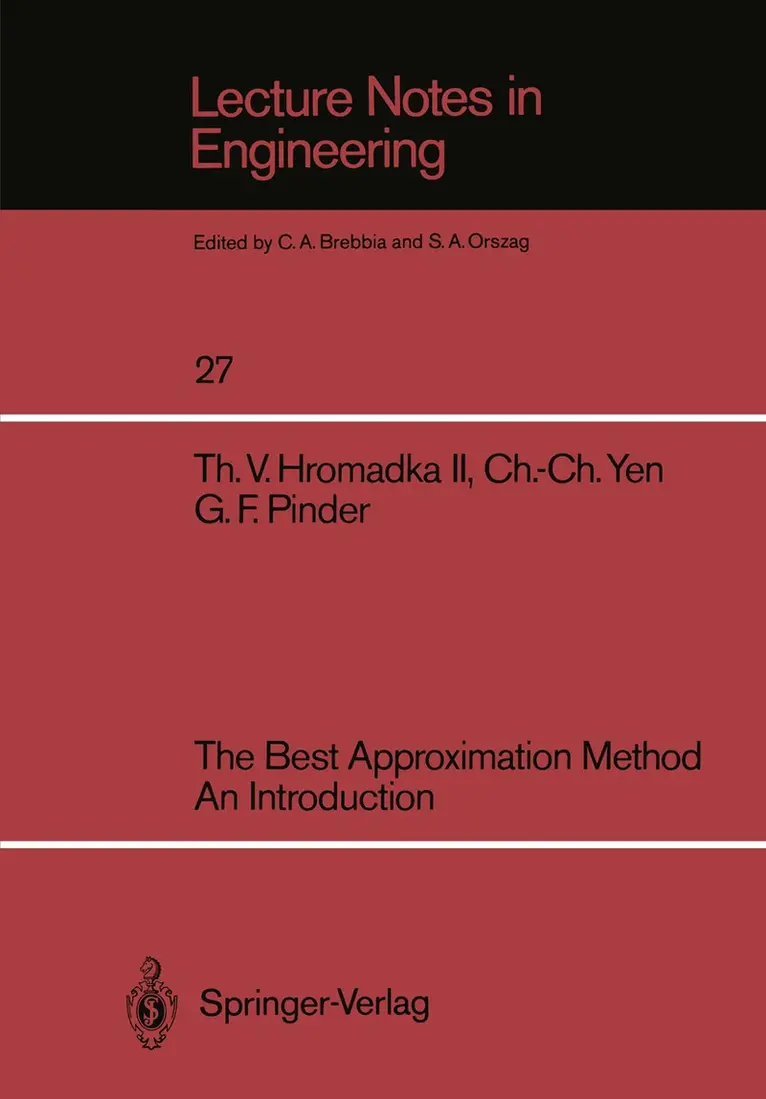
    Best Approximation Method An Introduction

    AvTheodore V. II Hromadka,Chung-Cheng Yen

    Häftad, Engelska, 1987

    Del 27 i serien Lecture Notes in Engineering

    1 078 kr

    Beställningsvara. Skickas inom 10-15 vardagar. Fri frakt över 249 kr.

    Beskrivning

    The most commonly used numerical techniques in solving engineering and mathematical models are the Finite Element, Finite Difference, and Boundary Element Methods. As computer capabilities continue to impro':e in speed, memory size and access speed, and lower costs, the use of more accurate but computationally expensive numerical techniques will become attractive to the practicing engineer. This book presents an introduction to a new approximation method based on a generalized Fourier series expansion of a linear operator equation. Because many engineering problems such as the multi­ dimensional Laplace and Poisson equations, the diffusion equation, and many integral equations are linear operator equations, this new approximation technique will be of interest to practicing engineers. Because a generalized Fourier series is used to develop the approxi­ mator, a "best approximation" is achieved in the "least-squares" sense; hence the name, the Best Approximation Method. This book guides the reader through several mathematics topics which are pertinent to the development of the theory employed by the Best Approximation Method. Working spaces such as metric spaces and Banach spaces are explained in readable terms. Integration theory in the Lebesque sense is covered carefully. Because the generalized Fourier series utilizes Lebesque integration concepts, the integra­ tion theory is covered through the topic of converging sequences of functions with respect to measure, in the mean (Lp), almost uniformly IV and almost everywhere. Generalized Fourier theory and linear operator theory are treated in Chapters 3 and 4.

    Produktinformation

    • Utgivningsdatum:1987-03-31
    • Mått:170 x 244 x 11 mm
    • Vikt:335 g
    • Format:Häftad
    • Språk:Engelska
    • Serie:Lecture Notes in Engineering
    • Antal sidor:172
    • Förlag:Springer-Verlag Berlin and Heidelberg GmbH & Co. KG
    • ISBN:9783540175728

    Utforska kategorier

    • Teknik: allmänt inom Naturvetenskap och teknik

    Innehållsförteckning

    • 1. Work Spaces.- 1.1. Metric Spaces.- 1.2. Linear Spaces.- 1.3. Normed Linear Spaces.- 1.4. Banach Spaces.- 2. Integration Theory.- 2.0. Introduction.- 2.1. The Riemann and Lebesgue Integrals: Step and Simple Functions.- 2.2. Lebesque Measure.- 2.3. Measurable Functions.- 2.4. The Lebesgue Integral.- 2.5. Key Theorems in Integration Theory.- 2.6. Lp Spaces.- 2.7. The Metric Space, Lp.- 2.8. Convergence of Sequences.- 2.9. Capsulation.- 3: Hilbert Space and Generalized Fourier Series.- 3.0 Introduction.- 3.1. Inner Product and Hilbert Space (Finite Dimension Spaces).- 3.2. Infinite Dimension Spaces.- 3.3. Approximations in L2(E).- 3.4. Vector Space Representation for Approximations: An Application.- 4. Linear Operators.- 4.0. Introduction.- 4.1. The Derivative as a Linear Operator.- 4.2. Linear Operators.- 4.3. Examples of Linear Operators in Engineering.- 4.4. Linear Operator Norms.- 5. The Best Approximation Method.- 5.0. Introduction.- 5.1. An Inner Product for the Solution of Linear Operator Equations.- 5.2. Orthonormalization Process.- 5.3. Generalized Fourier Series.- 5.4. Approximation Error Evaluation.- 5.5. The Weighted Inner Product.- 6. The Best Approximation Method: Applications.- 6.0. Introduction.- 6.1. Sensitivity of Computational Results to Variation in the Inner Product Weighting Factor.- 6.2. Solving Two-Dimensional Potential Problems.- 6.3. Application to Other Linear Operators.- 6.4. Computer Program: Two-Dimensional Potential Problems Using Real Variable Basis Functions.- 7. Coupling the Best Approximation and Complex Variable Boundary Element Methods.- 7.0. Introduction.- 7.1. The Complex Variable Boundary Element Method.- 7.2. Mathematical Development.- 7.3. The CVBEM and W?.- 7.4. The Space W?A.- 7.5. Applications.- 7.6. Computer Program:Two-Dimensional Potential Problems Using Analytic Basis Functions (CVBEM).- References.- Appendix A: Derivation of CVBEM Approximation Function.- Appendix B: Convergence of CVBEM Approximator.