• Fri frakt över 249 kr
  • •
  • Snabba leveranser
  • •
  • Billiga böcker
Kundservice

Du är på sajten för privatpersoner.

Företag, bibliotek eller offentlig verksamhet?

Du handlar på classic.bokus.com, där alla dina funktioner finns intakta.
Till classic.bokus.com
Bokus logotyp. Gå till startsidan.
  • Erbjudanden
  • Nyheter
  • Student
  • Topplistor
  • Barn & ungdom
  • Bokus Play
  • E-böcker
  • Pocketböcker
  • Spel & pussel

10% rabatt på allt med kod: NYSTART10 →

Sidfot

Mina sidor

    Hjälp

    • Kundservice
    • Vanliga frågor och svar
    • Frakt och leverans
    • Retur vid ångerrätt
    • Reklamera vara
    • Betalning
    • Köpvillkor
    • Allmänna villkor
    • Information om webbplatsens tillgänglighet

    Om Bokus

    • Om oss
    • Pressrum
    • För studenter
    • För företag
    • För bibliotek och offentlig verksamhet
    • För leverantörer
    • Hållbarhet

    Populärt

    • Aktuella erbjudanden
    • Presentkort
    • Studentlitteratur
    • Nya böcker
    • Topplistor
    • Signerade böcker
    • Engelska böcker

    Inspiration

    • Boktips
    • BookTok
    • Populära bokserier
    • Barnbokskaraktärer
    • Populära författare
    Logotyp för Bokus
    Följ oss på Facebook (extern länk)Följ oss på Instagram (extern länk)Följ oss på YouTube (extern länk)Följ oss på TikTok (extern länk)
    bokus @ CookiesAnpassa cookiesIntegritetspolicyKöpvillkor
    Till Citymail hemsida (extern länk)Till Budbee hemsida (extern länk)Till Postnord hemsida (extern länk)Till Schenker hemsida (extern länk)Till Early Bird hemsida (extern länk)Till Walleys hemsida (extern länk)
    1. Naturvetenskap och teknik
    2. Teknik och industri
    3. Maskinteknik och material

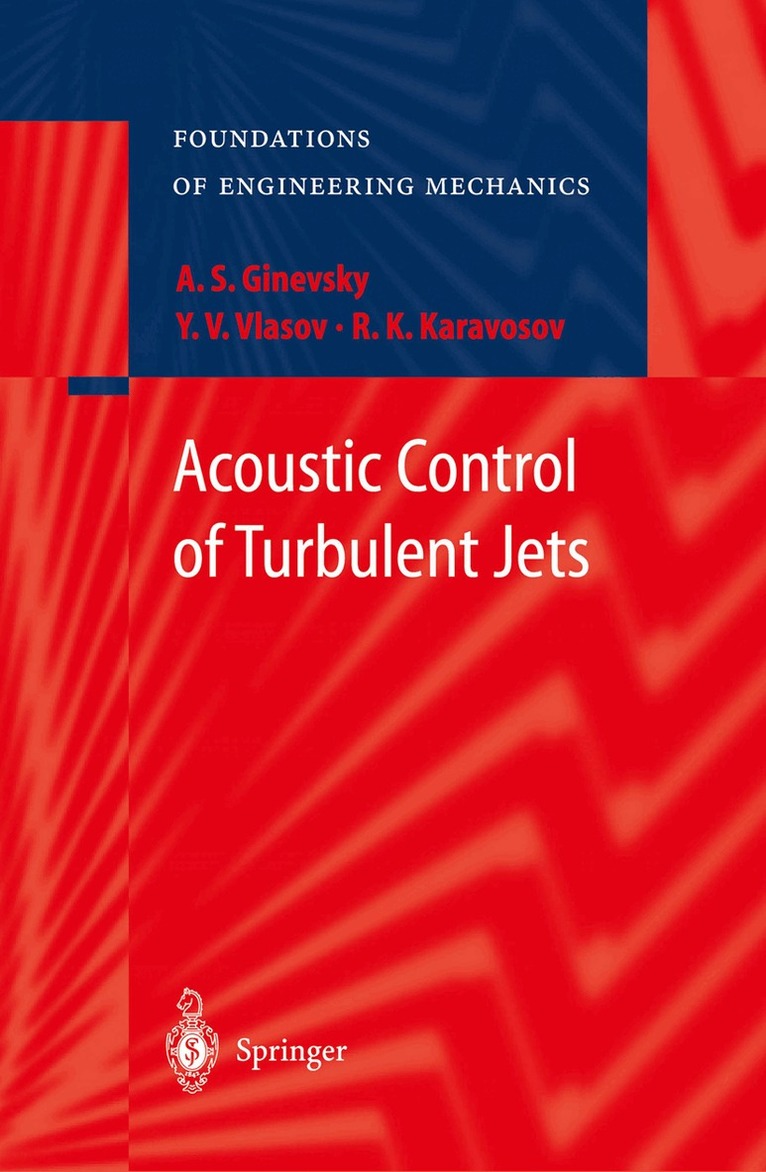
    Acoustic Control of Turbulent Jets

    AvA.S. Ginevsky,Y.V. Vlasov

    Inbunden, Engelska, 2004

    Del i serien Foundations of Engineering Mechanics

    1 626 kr

    Beställningsvara. Skickas inom 10-15 vardagar. Fri frakt över 249 kr.

    Fler format och utgåvor

    Häftad

    1 626 kr

    Beskrivning

    Results of experimental research on aerodynamic and acoustic control of subsonic turbulent jets by acoustic excitation are presented. It was demonstrated that these control methods, originated by authors, not only can intensify mixing (by acoustic irradiation at low frequency), but also notably ease it (at high-frequency irradiation). This research monograph presents the updated results of the authors supplemented by other investigations conducted in USA, Germany and Great Britain. The methods for the numerical simulation of subsonic turbulent jets under acoustic excitation are described in detail, and examples are reviewed of practical applications, including reduction of turbojet engine noise and acoustic control of self-sustained oscillations in wind tunnels.

    Produktinformation

    • Utgivningsdatum:2004-01-22
    • Mått:156 x 234 x 19 mm
    • Vikt:547 g
    • Format:Inbunden
    • Språk:Engelska
    • Serie:Foundations of Engineering Mechanics
    • Antal sidor:235
    • Upplaga:2004
    • Förlag:Springer-Verlag Berlin and Heidelberg GmbH & Co. KG
    • ISBN:9783540201434

    Utforska kategorier

    • Maskinteknik och material inom Naturvetenskap och teknik

    Innehållsförteckning

    • 1. Subsonic Turbulent Jets.- 1.1. Aerodynamic Characteristics of Turbulent Jets. Coherent Structures.- 1.2. Coherent Structures and Hydrodynamic Instability.- 1.3. Acoustic Characteristics of Subsonic Turbulent Jets.- 1.4. Initial Conditions of Turbulent Jet Issue.- 1.4.1. Aerodynamic and Acoustical Parameters Characterizing the Issue Initial Conditions for Subsonic Submerged and Accompanying Turbulent Jets.- 1.4.2. Geometrical Parameters Determining the Issue Initial Conditions.- 1.5. Approaches to Turbulent Jet Control.- References.- 2. Control of Aerodynamic Characteristics of Subsonic Turbulent Jets.- 2.1. Susceptibility of Turbulent Jets to Weak Harmonic Acoustical Disturbances. Effect of Excitation Frequency.- 2.2. Effects of Acoustic Excitation Level.- 2.3. Effect on the Flow Regime in the Boundary Layer at the Nozzle Edge.- 2.4. Influence of Flow Initial Turbulence on the Efficiency of Jet Acoustical Excitation.- 2.5. Deformation of Jet Cross-Sections under Transversal Acoustical Excitation.- 2.6. Acoustical Excitation of a Jet Issuing from an Orifice with Sharp Edges.- 2.7. Vibration Excitation of a Turbulent Jet.- 2.8. Acoustic Excitation of High-Speed Jets.- 2.9. Changes in the Mode Composition on Turbulent Pulsations for a Jet under Acoustical Excitation. Localization of Pairing and Decay of Coherent Structures for a Jet under Acoustical Excitation. Mechanisms of the Jet Acoustical Excitation.- 2.10. Coflowing Stream Effect on Turbulent Mixing Intensification in Jets under Low-Frequency Acoustical Excitation.- 2.11. Tone Acoustical Excitation of Anisothermic Gas Jets.- 2.12. Effect of Two Opposite in Direction Sources of Transversal Acoustical Excitation of Identical Frequency in Phase and Antiphase.- 2.13. Effect of Acoustic Disturbances of Higher Azimutal Modes.- 2.14. Two-Frequency Acoustical Excitation of Jets. Subharmonic Resonance.- 2.15. Multi-Frequency Acoustical Excitation of Turbulent Jets.- 2.16. Acoustical Excitation of Noncircular Jets.- 2.17. Effect of the Nozzle Edge Sharp on Sensitivity of Jets to Acoustical Exitation.- References.- 3. Control of Acoustic Characteristics of Subsonic Turbulent Jets.- 3.1. Acoustic Characteristics of Near and Far Fields of Turbulent Jets under Acoustical Excitation.- 3.1.1. The Near Acoustical Field and Pressure Pulsations in a Jet.- 3.1.2. The Far Acoustical Field of a Jet.- 3.2. Acoustical Excitation on Anisothermic Jets.- 3.3. Acoustical Excitation of Jets in Coflowing Streams and Coaxial Jets.- 3.4. On Mechanisms of Noise Generation by Subsonic Turbulent Jets.- References.- 4. Effect of Intensive Acoustic Disturbances on Subsonic Jets.- 4.1. High-Amplitude Low-Frequency Periodical Excitation of a Circular Jet and Plane Mixing Layer.- 4.2. Flow Visualization in a Subsonic Circular Jet under Longitudinal and Transversal High-Amplitude Acoustical Excitation.- References.- 5. Self-Excitation of Turbulent Jet Flows..- 5.1. Self-excitation Schemes of Turbulent Jet Flows.- 5.2. Normal and Oblique Impingement of a Transonic Jet on a Baffle.- 5.2.1. Coherent Structures in Impact Jets.- 5.2.2. A Near-Wall Radial Jet.- 5.2.3. Suppression of Self-Excited Oscillations.- 5.3. Self-Excited Oscillations in Wind Tunnels with the Open Test Sections.- References.- 6. Numerical Simulation of Periodical Excitation of Subsonic Turbulent Jets.- 6.1. Direct Numerical Simulation of Turbulent Motion in the Initial Region of an Axisymmetric Jet under Low-Frequency Harmonic Excitation.- 6.2. Simulation of Plane and Circular Turbulent Jets under Low- and High-Frequency Harmonic Excitation Using the Method of Discrete Vortices.- 6.2.1. The Method of Discrete Vortices Simulates Plane and Circular Turbulent Jets for the Case of Ideal Incompressible Fluid.- 6.2.2. The metod of Discrete Vortices Simulates Round Turbulent Jets.- 6.3. Numerical Simulation of a Turbulent Mixing Layer on the Basis of the Nonstationary Reynolds Equations Closed by the Differential Model of Turbulence.- 6.4. Numerical Simulation of a Turbulent Jet Flows on the Basis of the Generalized Reynolds Equations (the Three- Term Extension). The Effects of Low- and High- Frequency Harmonic Excitation.- 6.5. An Interesting Analogy.- References.- 7. Supersonic Nonisobaric Turbulent Jets. Control of Aerodynamic and Acoustical Characteristics.- 7.1. Aerodynamic Characteristics of Supersonic Turbulent Jets.- 7.2. Mechanism of Noise Generation. Broadband Noise and Discrete Components.- 7.3. Acoustical Excitation of Supersonic Jets. Active Control.- 7.4. Control of Jet Parameters Using Jet Noise Screening. Passive Control.- References.- 8. Reduction of Turbojet Engine Noise.- 8.1. The Acoustical Silencer of Turbojet Noise.- 8.1.1. Model Tests of Cold Jets. Far Field.- 8.1.2. Model Tests of Hot Jets. Far Field.- 8.1.3. Full-Scale Tests of Turbojet Engines. Far and Near Fields.- 8.2. The Jet System for Reduciton of Supersonic Jet Noise. Suppression of the Discrete Component.- 8.3. Reduction of Turbojet Excess Noise Caused by Aeroacoustic Interaction.- References.- 9. Acoustical Approaches to Control of Self-Sustained Oscillations in Wind Tunnels with the Open Test Section.- 9.1. The Problem Statement and Measured Parameters.- 9.2. Suppression of Self-Oscillations under High-Frequency Acoustical Excitation of the Mixing Layer.- 9.2.1. Return Channel Loudspeacer Location.- 9.2.2. Injection/Suction Through a Narrow Slot Near the Nozzle Cut-off.- 9.3. Generation of Self-Oscillations and Creation of Homogeneous Pulsing Flow in the Wind Tunnel Test Section under Low- Frequency Excitation of the Mixing Layer.- 9.4. Suppression of Self-Sustained Oscillations Using Antinoise.- References.- 10. Interaction of a Mixing Layer with a Cavity.- 10.1. Separated Flow over a Cavity.- 10.2. Near-Wall Pressure Pulsations in a Cavity Flow and Approaches to Their Reduction.- 10.3. Pressure Pulsations in Transonic Wind Tunnels with the Closed Test Sections and Approaches to Their Reduction.- 10.4. Suppression of Self-Sustained Oscillations in Deadlock Branches of Gas Pipelines.- 10.5. Acoustical Control of Flows in Cavities.- References.