• Fri frakt över 249 kr
  • •
  • Snabba leveranser
  • •
  • Billiga böcker
Kundservice

Du är på sajten för privatpersoner.

Företag, bibliotek eller offentlig verksamhet?

Du handlar på classic.bokus.com, där alla dina funktioner finns intakta.
Till classic.bokus.com
Bokus logotyp. Gå till startsidan.
  • Erbjudanden
  • Nyheter
  • Student
  • Topplistor
  • Barn & ungdom
  • Bokus Play
  • E-böcker
  • Pocketböcker
  • Spel & pussel

10% rabatt på allt med kod: NYSTART10 →

Sidfot

Mina sidor

    Hjälp

    • Kundservice
    • Vanliga frågor och svar
    • Frakt och leverans
    • Retur vid ångerrätt
    • Reklamera vara
    • Betalning
    • Köpvillkor
    • Allmänna villkor
    • Information om webbplatsens tillgänglighet

    Om Bokus

    • Om oss
    • Pressrum
    • För studenter
    • För företag
    • För bibliotek och offentlig verksamhet
    • För leverantörer
    • Hållbarhet

    Populärt

    • Aktuella erbjudanden
    • Presentkort
    • Studentlitteratur
    • Nya böcker
    • Topplistor
    • Signerade böcker
    • Engelska böcker

    Inspiration

    • Boktips
    • BookTok
    • Populära bokserier
    • Barnbokskaraktärer
    • Populära författare
    Logotyp för Bokus
    Följ oss på Facebook (extern länk)Följ oss på Instagram (extern länk)Följ oss på YouTube (extern länk)Följ oss på TikTok (extern länk)
    bokus @ CookiesAnpassa cookiesIntegritetspolicyKöpvillkor
    Till Citymail hemsida (extern länk)Till Budbee hemsida (extern länk)Till Postnord hemsida (extern länk)Till Schenker hemsida (extern länk)Till Early Bird hemsida (extern länk)Till Walleys hemsida (extern länk)
    1. Data och IT
    2. Informationsteknik: allmänt

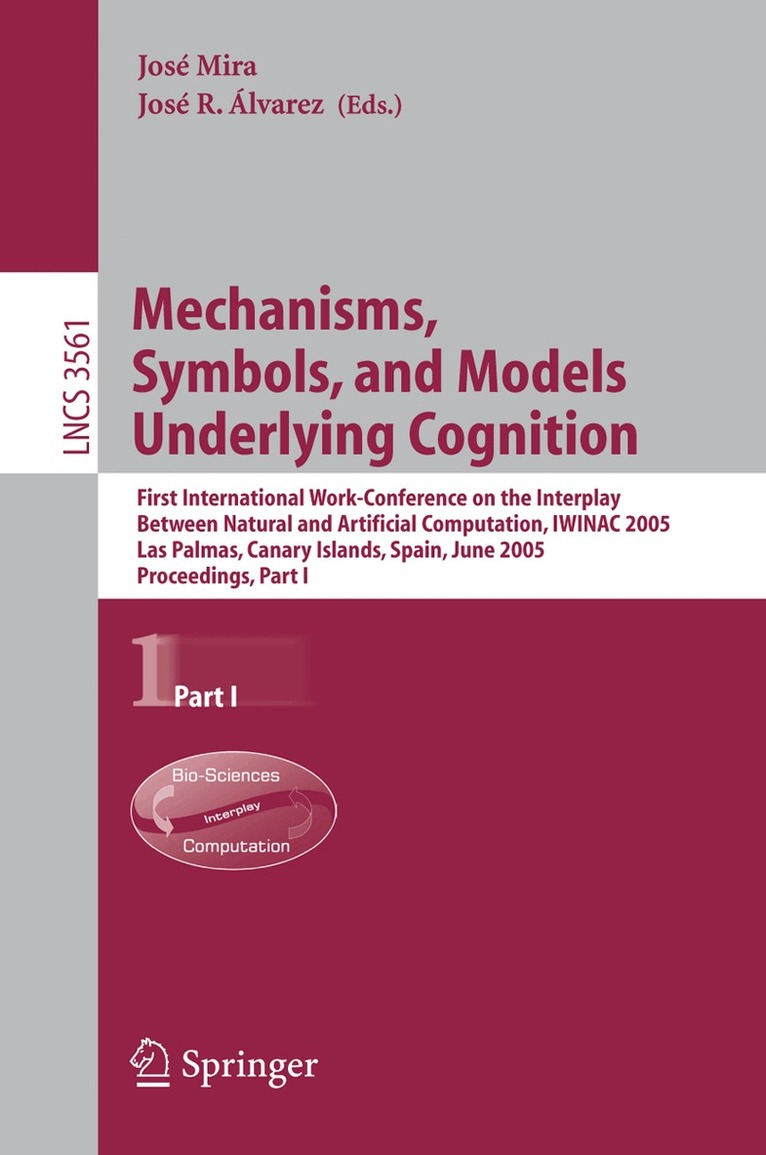
    Mechanisms, Symbols, and Models Underlying Cognition

    First International Work-Conference on the Interplay Between Natural and Artificial Computation, IWINAC 2005, Las Palmas, Canary Islands, Spain, June 15-18, 2005, Proceedings, Part I

    AvJosé Mira,José R. Álvarez

    Häftad, Engelska, 2005

    Del i serien Lecture Notes in Computer Science

    563 kr

    Beställningsvara. Skickas inom 10-15 vardagar. Fri frakt över 249 kr.

    Beskrivning

    The computational paradigm considered here is a conceptual, theoretical and formal framework situated above machines and living creatures (two instant- tions), su?ciently solid, and still non-exclusive, that allows us: 1. tohelpneuroscientiststoformulateintentions,questions,experiments,me- ods and explanation mechanisms assuming that neural circuits are the p- chological support of calculus; 2. to help scientists and engineers from the ?elds of arti?cial intelligence (AI) and knowledge engineering (KE) to model, formalize and program the c- putable part of human knowledge; 3. to establish an interaction framework between natural system computation (NSC) and arti?cial system computation (ASC) in both directions, from ASC to NSC (in computational neuroscience), and from NSC to ASC (in bioinspired computation). With these global purposes, we organized IWINAC 2005, the 1st International Work Conference on the Interplay Between Natural and Arti?cial Computation, whichtookplaceinLasPalmasdeGranCanaria,CanaryIslands(Spain),during June 15-18, 2005, trying to contribute to both directions of the interplay: I: From Arti?cial to Natural Computation. What can computation, arti?cial intelligence (AI) and knowledge engineering (KE) contribute to the und- standing of the nervous system, cognitive processes and social behavior?This is the scope of computational neuroscience and cognition, which uses the computational paradigm to model and improve our understanding of natural science.

    Produktinformation

    • Utgivningsdatum:2005-06-09
    • Mått:155 x 235 x 30 mm
    • Vikt:838 g
    • Format:Häftad
    • Språk:Engelska
    • Serie:Lecture Notes in Computer Science
    • Antal sidor:532
    • Upplaga:2005
    • Förlag:Springer-Verlag Berlin and Heidelberg GmbH & Co. KG
    • ISBN:9783540262985

    Utforska kategorier

    • Informationsteknik: allmänt inom Data och IT

    Innehållsförteckning

    • Computational Neuroscience.- On the Use of the Computational Paradigm in Neurophysiology and Cognitive Science.- Modules, Layers, Hierarchies, and Loops Where Artificial Intelligence Meets Ethology and Neuroscience – In Context of Action Selection.- A Unified Perspective on Explaining Dynamics by Anticipatory State Properties.- A Novel Intrinsic Wave Phenomenon in Low Excitable Biological Media.- Conceptual Idea of Natural Mechanisms of Recognition, Purposeful Thinking and Potential of Its Technical Application.- Simulation of Orientation Contrast Sensitive Cell Behavior in TiViPE.- Formulation and Validation of a Method for Classifying Neurons from Multielectrode Recordings.- Gap-Junctions Promote Synchrony in a Network of Inhibitory Interneurons in the Presence of Heterogeneities and Noise.- A Conceptual Model of Amphibian’s Tectum Opticum with Probabilistic Coded Outputs.- Realistic Stimulation Through Advanced Dynamic-Clamp Protocols.- Interacting Slow and Fast Dynamics in Precise Spiking-Bursting Neurons.- An Integral Model of Spreading Depression: From Neuron Channels to Field Potentials.- Separation of Extracellular Spikes: When Wavelet Based Methods Outperform the Principle Component Analysis.- Structural Statistical Properties of the Connectivity Could Underlie the Difference in Activity Propagation Velocities in Visual and Olfactory Cortices.- Rules and Roles of Dendritic Spikes in CA1 Pyramidal Cells: A Computational Study.- Slow Conductances Encode Stimulus History into Spike Shapes.- Comparison of Plasticity of Self-optimizing Neural Networks and Natural Neural Networks.- Evaluation of Neuronal Firing Densities via Simulation of a Jump-Diffusion Process.- Gaussian Processes and Neuronal Modeling.- On the Moments of Firing Numbers in Diffusion NeuronalModels with Refractoriness.- Fluctuation Dynamics in Electroencephalogram Time Series.- Modelling of Dysfunctions in the Neuronal Control of the Lower Urinary Tract.- Coding Strategies in Early Stages of the Somatosensory System.- Auditory Nerve Encoding of High-Frequency Spectral Information.- Multielectrode Analysis of Information Flow Through Cat Primary Visual Cortex.- Bioinspired Computation.- Towards Evolutionary DNA Computing.- A Linear Solution of Subset Sum Problem by Using Membrane Creation.- A Study of the Robustness of the EGFR Signalling Cascade Using Continuous Membrane Systems.- A Tool for Implementing and Exploring SBM Models: Universal 1D Invertible Cellular Automata.- Network of Evolutionary Processors with Splicing Rules.- Network of Evolutionary Processors with Splicing Rules and Forbidding Context.- A Multiplexed Current Source Portable Stimulator Architecture for a Visual Cortical Neuroprosthesis.- An Augmented Reality Visual Prothesis for People Affected by Tunneling Vision.- Eye Tracking in Coloured Image Scenes Represented by Ambisonic Fields of Musical Instrument Sounds.- Tasks Modelling at the Knowledge Level.- Avoidance Behavior Controlled by a Model of Vertebrate Midbrain Mechanisms.- Transition Cells and Neural Fields for Navigation and Planning.- Spatial Navigation Based on Novelty Mediated Autobiographical Memory.- Vision and Grasping: Humans vs. Robots.- Evolved Neural Reflex-Oscillators for Walking Machines.- A Haptic System for the Lucs Haptic Hand I.- Action-Based Cognition: How Robots with No Sensory System Orient Themselves in an Open Field Box.- A Robotics Inspired Method of Modeling Accessible Open Space to Help Blind People in the Orientation and Traveling Tasks.- A Scientific Point of View on Perceptions.- Reasoning by Assumption: Formalisation and Analysis of Human Reasoning Traces.- Aligning Reference Terminologies and Knowledge Bases in the Health Care Domain.- Predicting Mortality in the Intensive Care Using Episodes.- A Fuzzy Temporal Diagnosis Algorithm and a Hypothesis Discrimination Proposal.- Spatial Reasoning Based on Rules.- Key Aspects of the Diagen Conceptual Model for Medical Diagnosis.- Connectionist Contribution to Building Real-World Ontologies.- Self Assembling Graphs.- Knowledge Modeling for the Traffic Sign Recognition Task.- Interval-Valued Neural Multi-adjoint Logic Programs.