• Fri frakt över 249 kr
  • •
  • Snabba leveranser
  • •
  • Billiga böcker
Kundservice

Du är på sajten för privatpersoner.

Företag, bibliotek eller offentlig verksamhet?

Du handlar på classic.bokus.com, där alla dina funktioner finns intakta.
Till classic.bokus.com
Bokus logotyp. Gå till startsidan.
  • Erbjudanden
  • Nyheter
  • Student
  • Topplistor
  • Barn & ungdom
  • Bokus Play
  • E-böcker
  • Pocketböcker
  • Spel & pussel

10% rabatt på allt med kod NYSTART10 →

Sidfot

Mina sidor

    Hjälp

    • Kundservice
    • Vanliga frågor och svar
    • Frakt och leverans
    • Retur vid ångerrätt
    • Reklamera vara
    • Betalning
    • Köpvillkor
    • Allmänna villkor
    • Information om webbplatsens tillgänglighet

    Om Bokus

    • Om oss
    • Pressrum
    • För studenter
    • För företag
    • För bibliotek och offentlig verksamhet
    • För leverantörer
    • Hållbarhet

    Populärt

    • Aktuella erbjudanden
    • Presentkort
    • Studentlitteratur
    • Nya böcker
    • Topplistor
    • Signerade böcker
    • Engelska böcker

    Inspiration

    • Boktips
    • BookTok
    • Populära bokserier
    • Barnbokskaraktärer
    • Populära författare
    Logotyp för Bokus
    Följ oss på Facebook (extern länk)Följ oss på Instagram (extern länk)Följ oss på YouTube (extern länk)Följ oss på TikTok (extern länk)
    bokus @ CookiesAnpassa cookiesIntegritetspolicyKöpvillkor
    Till Citymail hemsida (extern länk)Till Budbee hemsida (extern länk)Till Postnord hemsida (extern länk)Till Schenker hemsida (extern länk)Till Early Bird hemsida (extern länk)Till Walleys hemsida (extern länk)
    1. Data och IT
    2. Informationsteknik: allmänt

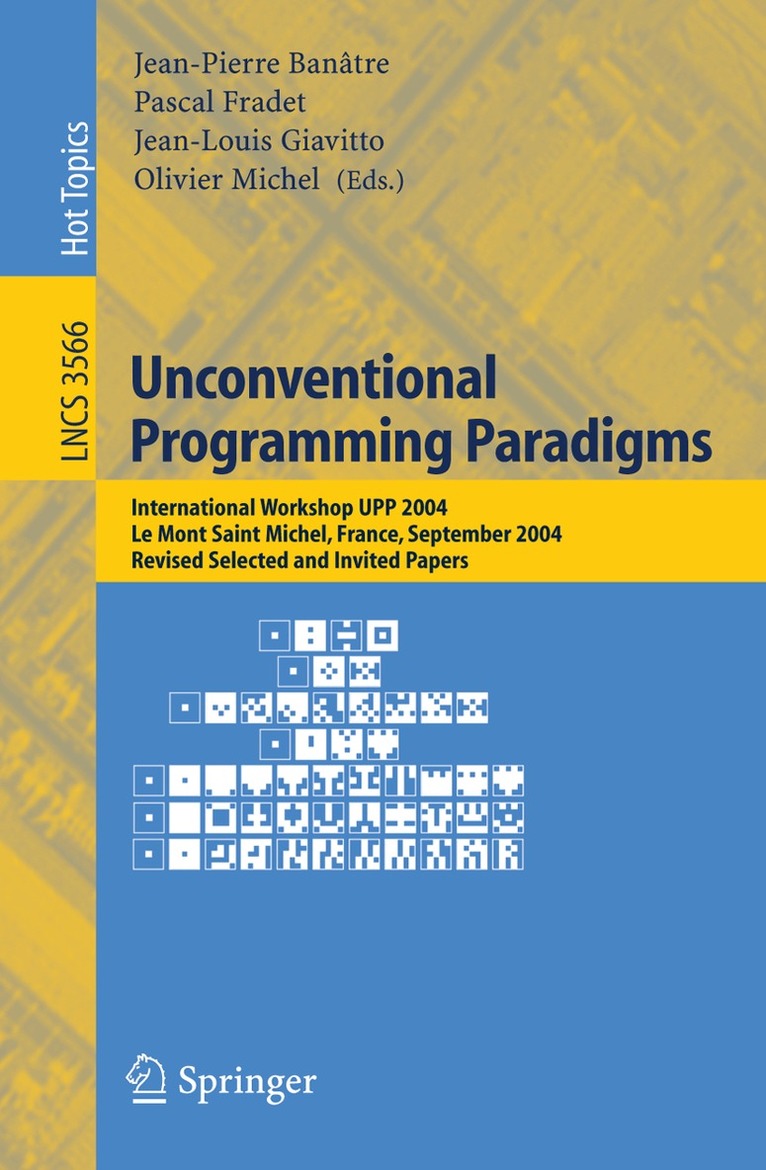
    Unconventional Programming Paradigms

    International Workshop UPP 2004, Le Mont Saint Michel, France, September 15-17, 2004, Revised Selected and Invited Papers

    AvJean-Pierre Banâtre,Pascal Fradet

    Häftad, Engelska, 2005

    Del i serien Lecture Notes in Computer Science

    563 kr

    Beställningsvara. Skickas inom 10-15 vardagar. Fri frakt över 249 kr.

    Beskrivning

    Nowadays, developers have to face the proliferation of hardware and software environments, the increasing demands of the users, the growing number of p- grams and the sharing of information, competences and services thanks to the generalization ofdatabasesandcommunication networks. Aprogramisnomore a monolithic entity conceived, produced and ?nalized before being used. A p- gram is now seen as an open and adaptive frame, which, for example, can - namically incorporate services not foreseen by the initial designer. These new needs call for new control structures and program interactions. Unconventionalapproachestoprogramminghavelongbeendevelopedinv- iousnichesandconstituteareservoirofalternativewaystofacetheprogramming languages crisis. New models of programming (e. g. , bio-inspired computing, - ti?cialchemistry,amorphouscomputing,. . . )arealsocurrentlyexperiencinga renewed period of growth as they face speci?c needs and new application - mains. These approaches provide new abstractions and notations or develop new ways of interacting with programs. They are implemented by embedding new sophisticated data structures in a classical programming model (API), by extending an existing language with new constructs (to handle concurrency, - ceptions, open environments, . . . ), by conceiving new software life cycles and program executions (aspect weaving, run-time compilation) or by relying on an entire new paradigm to specify a computation. They are inspired by theoretical considerations (e. g. , topological, algebraic or logical foundations), driven by the domain at hand (domain-speci?c languages like PostScript, musical notation, animation, signal processing, etc. ) or by metaphors taken from various areas (quantum computing, computing with molecules, informationprocessing in - ological tissues, problem solving from nature, ethological and social modeling).

    Produktinformation

    • Utgivningsdatum:2005-07-15
    • Mått:155 x 235 x 21 mm
    • Vikt:581 g
    • Format:Häftad
    • Språk:Engelska
    • Serie:Lecture Notes in Computer Science
    • Antal sidor:367
    • Upplaga:2005
    • Förlag:Springer-Verlag Berlin and Heidelberg GmbH & Co. KG
    • ISBN:9783540278849

    Utforska kategorier

    • Informationsteknik: allmänt inom Data och IT

    Innehållsförteckning

    • Invited Talk.- From Quantum Physics to Programming Languages: A Process Algebraic Approach.- Chemical Computing.- Chemical Computing.- Programming Reaction-Diffusion Processors.- From Prescriptive Programming of Solid-State Devices to Orchestrated Self-organisation of Informed Matter.- Relational Growth Grammars – A Graph Rewriting Approach to Dynamical Systems with a Dynamical Structure.- A New Programming Paradigm Inspired by Artificial Chemistries.- Higher-Order Chemical Programming Style.- Amorphous Computing.- to Amorphous Computing.- Abstractions for Directing Self-organising Patterns.- Programming an Amorphous Computational Medium.- Computations in Space and Space in Computations.- Bio-inspired Computing.- Bio-inspired Computing Paradigms (Natural Computing).- Inverse Design of Cellular Automata by Genetic Algorithms: An Unconventional Programming Paradigm.- Design, Simulation, and Experimental Demonstration of Self-assembled DNA Nanostructures and Motors.- Membrane Systems: A Quick Introduction.- Cellular Meta-programming over Membranes.- Modelling Dynamically Organised Colonies of Bio-entities.- P Systems: Some Recent Results and Research Problems.- Outlining an Unconventional, Adaptive, and Particle-Based Reconfigurable Computer Architecture.- Autonomic Computing.- Autonomic Computing: An Overview.- Enabling Autonomic Grid Applications: Dynamic Composition, Coordination and Interaction.- Grassroots Approach to Self-management in Large-Scale Distributed Systems.- Autonomic Runtime System for Large Scale Parallel and Distributed Applications.- Generative Programming.- Towards Generative Programming.- Overview of Generative Software Development.- A Comparison of Program Generation with Aspect-Oriented Programming.- Generative Programming from a PostObject-Oriented Programming Viewpoint.