• Fri frakt över 249 kr
  • •
  • Snabba leveranser
  • •
  • Billiga böcker
Kundservice

Du är på sajten för privatpersoner.

Företag, bibliotek eller offentlig verksamhet?

Du handlar på classic.bokus.com, där alla dina funktioner finns intakta.
Till classic.bokus.com
Bokus logotyp. Gå till startsidan.
  • Erbjudanden
  • Student
  • Topplistor
  • Barn & ungdom
  • Bokus Play
  • E-böcker
  • Ljudböcker
  • Pocketböcker
  • Spel och pussel

Pocketfynda! Hundratals böcker för 49 kr/st →

Sidfot

Mina sidor

    Hjälp

    • Kundservice
    • Vanliga frågor och svar
    • Frakt och leverans
    • Retur vid ångerrätt
    • Reklamera vara
    • Betalning
    • Köpvillkor
    • Allmänna villkor
    • Information om webbplatsens tillgänglighet

    Om Bokus

    • Om oss
    • Pressrum
    • För studenter
    • För företag
    • För bibliotek och offentlig verksamhet
    • För leverantörer
    • Hållbarhet

    Populärt

    • Aktuella erbjudanden
    • Presentkort
    • Studentlitteratur
    • Nya böcker
    • Topplistor
    • Signerade böcker
    • Engelska böcker

    Inspiration

    • Boktips
    • BookTok
    • Barnbokskaraktärer
    • Populära författare
    Logotyp för Bokus
    Följ oss på Facebook (extern länk)Följ oss på Instagram (extern länk)Följ oss på YouTube (extern länk)Följ oss på TikTok (extern länk)
    bokus @ CookiesAnpassa cookiesIntegritetspolicyKöpvillkor
    Till Citymail hemsida (extern länk)Till Budbee hemsida (extern länk)Till Postnord hemsida (extern länk)Till Schenker hemsida (extern länk)Till Early Bird hemsida (extern länk)Till Walleys hemsida (extern länk)
    1. Data och IT
    2. Systemvetenskap och AI
    3. Artificiell intelligens

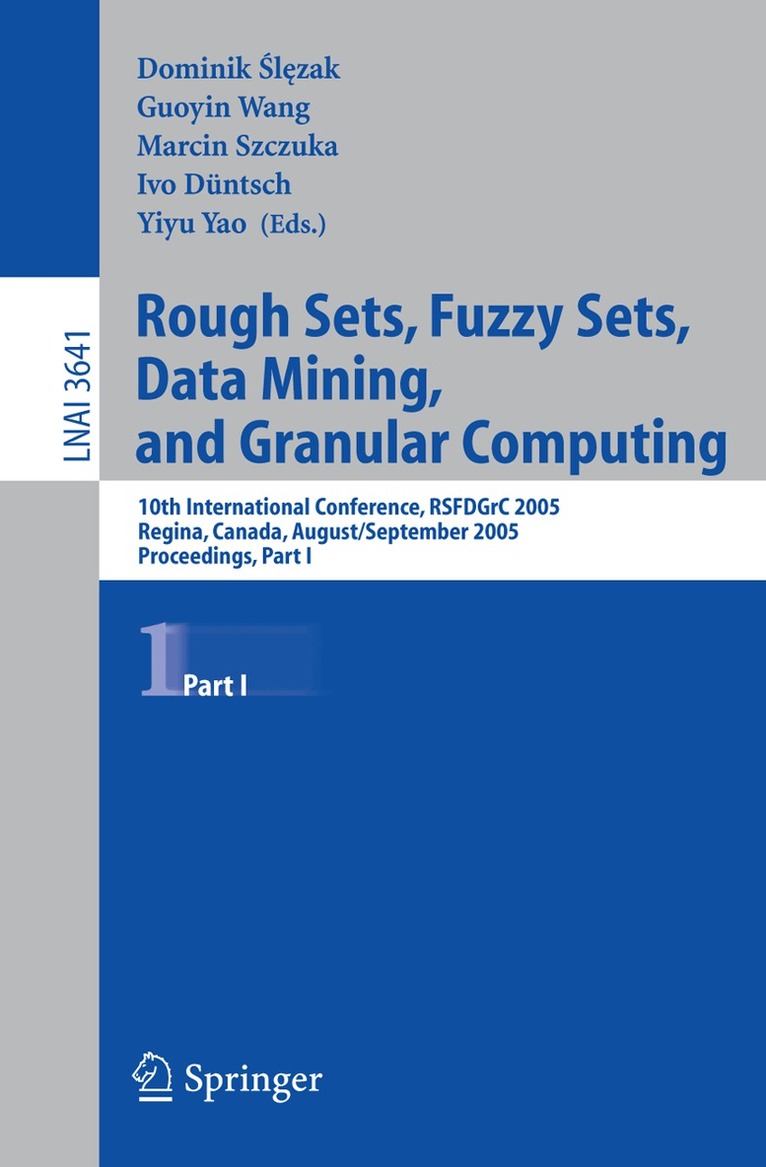
    Rough Sets, Fuzzy Sets, Data Mining, and Granular Computing

    10th International Conference, RSFDGrC 2005, Regina, Canada, August 31 - September 3, 2005, Proceedings, Part I

    AvDominik Slezak,Marcin Szczuka

    Häftad, Engelska, 2005

    Del i serien Lecture Notes in Computer Science

    1 110 kr

    Beställningsvara. Skickas inom 10-15 vardagar. Fri frakt över 249 kr.

    Beskrivning

    This volume contains the papers selected for presentation at the 10th Int- national Conference on Rough Sets, Fuzzy Sets, Data Mining, and Granular Computing, RSFDGrC 2005, organized at the University of Regina, August 31st–September 3rd, 2005. This conference followed in the footsteps of inter- tional events devoted to the subject of rough sets, held so far in Canada, China, Japan,Poland,Sweden, and the USA. RSFDGrC achievedthe status of biennial international conference, starting from 2003 in Chongqing, China. The theory of rough sets, proposed by Zdzis law Pawlak in 1982, is a model of approximate reasoning. The main idea is based on indiscernibility relations that describe indistinguishability of objects. Concepts are represented by - proximations. In applications, rough set methodology focuses on approximate representation of knowledge derivable from data. It leads to signi?cant results in many areas such as ?nance, industry, multimedia, and medicine. The RSFDGrC conferences put an emphasis on connections between rough sets and fuzzy sets, granularcomputing, and knowledge discoveryand data m- ing, both at the level of theoretical foundations and real-life applications. In the case of this event, additional e?ort was made to establish a linkage towards a broader range of applications. We achieved it by including in the conference program the workshops on bioinformatics, security engineering, and embedded systems, as well as tutorials and sessions related to other application areas.

    Produktinformation

    • Utgivningsdatum:2005-08-22
    • Mått:155 x 235 x 42 mm
    • Vikt:1 147 g
    • Format:Häftad
    • Språk:Engelska
    • Serie:Lecture Notes in Computer Science
    • Antal sidor:748
    • Upplaga:2005
    • Förlag:Springer-Verlag Berlin and Heidelberg GmbH & Co. KG
    • ISBN:9783540286530

    Utforska kategorier

    • Artificiell intelligens inom Data och IT

    Innehållsförteckning

    • Invited Papers.- Rough Sets and Flow Graphs.- A Modal Characterization of Indiscernibility and Similarity Relations in Pawlak’s Information Systems.- Granular Computing with Shadowed Sets.- Rough Set Approximations.- Rough Sets and Higher Order Vagueness.- Approximation in Formal Concept Analysis.- Second-Order Rough Approximations in Multi-criteria Classification with Imprecise Evaluations and Assignments.- New Approach for Basic Rough Set Concepts.- A Partitional View of Concept Lattice.- Characterizations of Attributes in Generalized Approximation Representation Spaces.- Rough-Algebraic Foundations.- Proximity Spaces of Exact Sets.- Rough Group, Rough Subgroup and Their Properties.- Concept Lattices vs. Approximation Spaces.- Rough Sets over the Boolean Algebras.- Algebraic Approach to Generalized Rough Sets.- Logic for Rough Sets with Rough Double Stone Algebraic Semantics.- Feature Selection and Reduction.- On Partial Tests and Partial Reducts for Decision Tables.- The Second Attribute.- Pairwise Cores in Information Systems.- Data Preprocessing and Kappa Coefficient.- Incremental Attribute Reduction Based on Elementary Sets.- Finding Rough Set Reducts with SAT.- Feature Selection with Adjustable Criteria.- Feature Selection Based on Relative Attribute Dependency: An Experimental Study.- Reasoning in Information Systems.- On Consistent and Partially Consistent Extensions of Information Systems.- A New Treatment and Viewpoint of Information Tables.- Incomplete Data and Generalization of Indiscernibility Relation, Definability, and Approximations.- Discernibility Functions and Minimal Rules in Non-deterministic Information Systems.- Studies on Rough Sets in Multiple Tables.- Normalization in a Rough Relational Database.- Rough-Probabilistic Approaches.-Probabilistic Rough Sets.- Variable Precision Bayesian Rough Set Model and Its Application to Human Evaluation Data.- Variable Precision Rough Set Approach to Multiple Decision Tables.- Rough Membership and Bayesian Confirmation Measures for Parameterized Rough Sets.- Rough Sets Handling Missing Values Probabilistically Interpreted.- The Computational Complexity of Inference Using Rough Set Flow Graphs.- Rough-Fuzzy Hybridization.- Upper and Lower Probabilities of Fuzzy Events Induced by a Fuzzy Set-Valued Mapping.- Variable Precision Fuzzy Rough Sets Model in the Analysis of Process Data.- CRST: A Generalization of Rough Set Theory.- An Extension of Rough Approximation Quality to Fuzzy Classification.- Fuzzy Rules Generation Method for Classification Problems Using Rough Sets and Genetic Algorithms.- Multilayer FLC Design Based on RST.- Fuzzy Methods in Data Analysis.- Interpretable Rule Extraction and Function Approximation from Numerical Input/Output Data Using the Modified Fuzzy TSK Model, TaSe Model.- A New Feature Weighted Fuzzy Clustering Algorithm.- User-Driven Fuzzy Clustering: On the Road to Semantic Classification.- Evolutionary Computing.- Research on Clone Mind Evolution Algorithm.- A Study on the Global Convergence Time Complexity of Estimation of Distribution Algorithms.- Finding Minimal Rough Set Reducts with Particle Swarm Optimization.- MEA Based Nonlinearity Correction Algorithm for the VCO of LFMCW Radar Level Gauge.- Machine Learning.- On Degree of Dependence Based on Contingency Matrix.- Model Selection and Assessment for Classification Using Validation.- Dependency Bagging.- Combination of Metric-Based and Rule-Based Classification.- Combining Classifiers Based on OWA Operators with an Application to Word Sense Disambiguation.- System Health Prognostic Model Using Rough Sets.- Approximate and Uncertain Reasoning.- Live Logic TM : Method for Approximate Knowledge Discovery and Decision Making.- Similarity, Approximations and Vagueness.- Decision Theory = Performance Measure Theory + Uncertainty Theory.- Probabilistic Network Models.- The Graph-Theoretical Properties of Partitions and Information Entropy.- A Comparative Evaluation of Rough Sets and Probabilistic Network Algorithms on Learning Pseudo-independent Domains.- On the Complexity of Probabilistic Inference in Singly Connected Bayesian Networks.- Spatial and Temporal Reasoning.- Representing the Process Semantics in the Situation Calculus.- Modeling and Refining Directional Relations Based on Fuzzy Mathematical Morphology.- A Clustering Method for Spatio-temporal Data and Its Application to Soccer Game Records.- Hierarchical Information Maps.- Non-standard Logics.- Ordered Belief Fusion in Possibilistic Logic.- Description of Fuzzy First-Order Modal Logic Based on Constant Domain Semantics.- Arrow Decision Logic.- Transforming Information Systems.- A Discrete Event Control Based on EVALPSN Stable Model Computation.- Granular Computing.- Tolerance Relation Based Granular Space.- Discernibility-Based Variable Granularity and Kansei Representations.- Rough Set Approximation Based on Dynamic Granulation.- Granular Logic with Closeness Relation and Its Reasoning.- Ontological Framework for Approximation.- Table Representations of Granulations Revisited.