• Fri frakt över 249 kr
  • •
  • Snabba leveranser
  • •
  • Billiga böcker
Kundservice

Du är på sajten för privatpersoner.

Företag, bibliotek eller offentlig verksamhet?

Du handlar på classic.bokus.com, där alla dina funktioner finns intakta.
Till classic.bokus.com
Bokus logotyp. Gå till startsidan.
  • Erbjudanden
  • Nyheter
  • Student
  • Topplistor
  • Barn & ungdom
  • Bokus Play
  • E-böcker
  • Pocketböcker
  • Spel & pussel

10% rabatt på allt med kod NYSTART10 →

Sidfot

Mina sidor

    Hjälp

    • Kundservice
    • Vanliga frågor och svar
    • Frakt och leverans
    • Retur vid ångerrätt
    • Reklamera vara
    • Betalning
    • Köpvillkor
    • Allmänna villkor
    • Information om webbplatsens tillgänglighet

    Om Bokus

    • Om oss
    • Pressrum
    • För studenter
    • För företag
    • För bibliotek och offentlig verksamhet
    • För leverantörer
    • Hållbarhet

    Populärt

    • Aktuella erbjudanden
    • Presentkort
    • Studentlitteratur
    • Nya böcker
    • Topplistor
    • Signerade böcker
    • Engelska böcker

    Inspiration

    • Boktips
    • BookTok
    • Populära bokserier
    • Barnbokskaraktärer
    • Populära författare
    Logotyp för Bokus
    Följ oss på Facebook (extern länk)Följ oss på Instagram (extern länk)Följ oss på YouTube (extern länk)Följ oss på TikTok (extern länk)
    bokus @ CookiesAnpassa cookiesIntegritetspolicyKöpvillkor
    Till Citymail hemsida (extern länk)Till Budbee hemsida (extern länk)Till Postnord hemsida (extern länk)Till Schenker hemsida (extern länk)Till Early Bird hemsida (extern länk)Till Walleys hemsida (extern länk)
    1. Naturvetenskap och teknik
    2. Teknik och industri
    3. Elektronik och kommunikationer

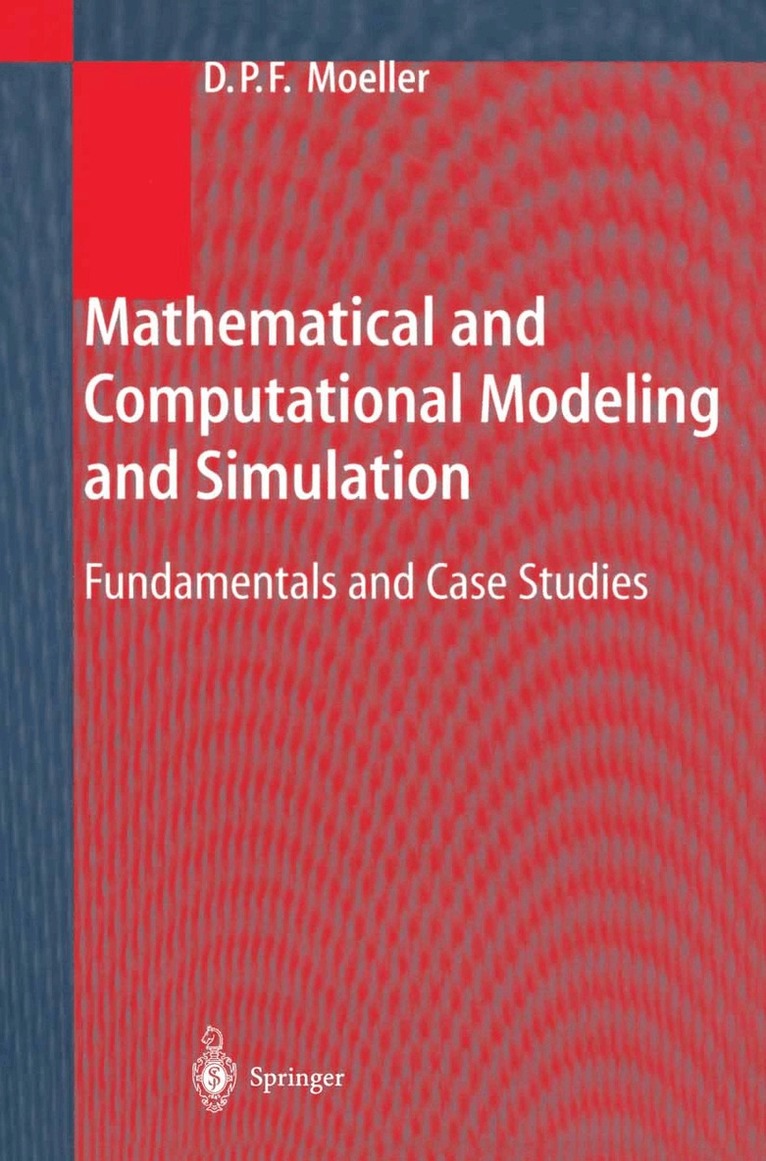
    Mathematical and Computational Modeling and Simulation

    Fundamentals and Case Studies

    AvDietmar P.F. Möller

    Häftad, Engelska, 2003

    546 kr

    Beställningsvara. Skickas inom 10-15 vardagar. Fri frakt över 249 kr.

    Beskrivning

    Mathematical and Computational Modeling and Simulation - a highly multi-disciplinary field with ubiquitous applications in science and engineering - is one of the key enabling technologies of the 21st century. This book introduces the reader to the use of mathematical and computational modeling and simulation in order to develop an understanding of the solution characteristics of a broad class of real-world problems. The relevant basic and advanced methodologies are explained in detail, with special emphasis on ill-defined problems. Some 15 simulation systems are presented on the language and the logical level. Moreover, the reader can accumulate experience by studying a wide variety of case studies. The latter are briefly described within the book but their full versions as well as some simulation software demos are available on the Web. The book can be used for university courses of different levels as well as for self-study. Advanced sections are marked and can be skipped in a first reading or in undergraduate courses.

    Produktinformation

    • Utgivningsdatum:2003-08-19
    • Mått:155 x 235 x 24 mm
    • Vikt:668 g
    • Format:Häftad
    • Språk:Engelska
    • Antal sidor:422
    • Förlag:Springer-Verlag Berlin and Heidelberg GmbH & Co. KG
    • ISBN:9783540403890

    Utforska kategorier

    • Elektronik och kommunikationer inom Naturvetenskap och teknik
    • Systemvetenskap och AI inom Data och IT
    • Tillämpad matematik inom Naturvetenskap och teknik

    Innehållsförteckning

    • 1 Modeling Continuous-Time and Discrete-Time Systems.- 1.1 Introduction.- 1.2 Modeling Formalisms.- 1.3 System Elements and Models of Continuous-Time Systems.- 1.4 Block Diagram-based Algebraic Representation of Systems.- 1.5 Basic Principles of Discrete-Time Systems.- 1.6 Model Validation.- 1.7 References and Further Reading.- 1.8 Exercises.- 2 Mathematical Description of Continuous-Time Systems.- 2.1 Introduction.- 2.2 Controllability, Observability, and Identifiability.- 2.3 Time Domain Solution of the Linear State Equation System.- 2.4 Solution of the State Equation using the Laplace Transform.- 2.5 Eigenvalues of the Linear Vector-Equation Systems*.- 2.6 Stability Analysis*.- 2.7 First-Order Linear State-Equation Models.- 2.8 Second-Order Linear State-Equation Models.- 2.9 Higher-Order Linear State-Space Models*.- 2.10 Nonlinear State-Space Models*.- 2.11 References and Further Reading.- 2.12 Exercises.- 3 Mathematical Description of Discrete-Time Systems.- 3.1 Introduction.- 3.2 Statistical Models in Discrete-Time Systems.- 3.3 Discrete-Event Simulation of Queuing systems.- 3.4 Petri-Nets.- 3.5 Discrete-Event Simulation of Parallel Systems.- 3.6 References and Further Reading.- 3.7 Exercises.- 4 Simulation Sofware for Computational Modeling and Simulation.- 4.1 Introduction.- 4.2 Digital Simulation Systems.- 4.3 Simulation Software for Continuous-Time Systems.- 4.4 Discrete-Time System Simulation Software*.- 4.5 Multi-Domain Simulation Software for Large-Scale Systems*.- 4.6 Simulation Software for Mixed-Mode Circuits*.- 4.7 Combined Simulation Software.- 4.8 Checklist for the Selection of Simulation Software.- 4.9 References and Further Reading.- 4.10 Exercises.- 4.11 Case Study Examples.- 5 Parameter Identification of Dynamic Systems.- 5.1 Introduction.- 5.2 Mathematical Notation of the Identification Task.- 5.3 Identification Task.- 5.4 Output-Error Least Squares Method*.- 5.5 Equation-Error Least Squares Method*.- 5.6 Consistency of the Parameter Estimates*.- 5.7 Consistency Modifications of the Equation-Error Method*.- 5.8 Identifiability*.- 5.9 System Input Properties*.- 5.10 Parameter Identification of the Cardiovascular System*.- 5.11 Error-Functional Minimization by Gradient Methods*.- 5.12 Error-Functional Minimization by Direct Search Methods*.- 5.13 Identifiability and the Output-Error Least Squares Method*.- 5.14 References and Further Reading.- 5.15 Exercises.- 6 Soft-Computing Methods.- 6.1 Introduction.- 6.2 Fuzzy Logic.- 6.3 Neural Nets*.- 6.4 References and Further Reading.- 6.5 Exercises.- 7 Distributed Simulation.- 7.1 Introduction.- 7.2 Distributed Simulation of Traffic and Transportation.- 7.3 Introduction into HLA*.- 7.4 References and Further Reading.- 7.5 Exercises.- 8 Virtual Reality.- 8.1 Introduction.- 8.2 Virtual Reality applied to Medicine.- 8.3 Virtual Reality in Geo Science*.- 8.4 DDSim Prototyping Tool for Autonomous Robots.- 8.5 References and Further Reading.- 8.6 Exercises.- Appendix A.- Numeric Integration.- Single-Step Formulae.- Multi-Step Formulae.- Appendix B.- Laplace Transform.- Appendix C.- Online Resources.