• Fri frakt över 249 kr
  • •
  • Snabba leveranser
  • •
  • Billiga böcker
Kundservice

Du är på sajten för privatpersoner.

Företag, bibliotek eller offentlig verksamhet?

Du handlar på classic.bokus.com, där alla dina funktioner finns intakta.
Till classic.bokus.com
Bokus logotyp. Gå till startsidan.
  • Erbjudanden
  • Student
  • Topplistor
  • Barn & ungdom
  • Bokus Play
  • E-böcker
  • Ljudböcker
  • Pocketböcker
  • Spel & pussel

Upp till 25% på utvalda nyheter →

Sidfot

Mina sidor

    Hjälp

    • Kundservice
    • Vanliga frågor och svar
    • Frakt och leverans
    • Retur vid ångerrätt
    • Reklamera vara
    • Betalning
    • Köpvillkor
    • Allmänna villkor
    • Information om webbplatsens tillgänglighet

    Om Bokus

    • Om oss
    • Pressrum
    • För studenter
    • För företag
    • För bibliotek och offentlig verksamhet
    • För leverantörer
    • Hållbarhet

    Populärt

    • Aktuella erbjudanden
    • Presentkort
    • Studentlitteratur
    • Nya böcker
    • Topplistor
    • Signerade böcker
    • Engelska böcker

    Inspiration

    • Boktips
    • BookTok
    • Populära bokserier
    • Barnbokskaraktärer
    • Populära författare
    Logotyp för Bokus
    Följ oss på Facebook (extern länk)Följ oss på Instagram (extern länk)Följ oss på YouTube (extern länk)Följ oss på TikTok (extern länk)
    bokus @ CookiesAnpassa cookiesIntegritetspolicyKöpvillkor
    Till Citymail hemsida (extern länk)Till Budbee hemsida (extern länk)Till Postnord hemsida (extern länk)Till Schenker hemsida (extern länk)Till Early Bird hemsida (extern länk)Till Walleys hemsida (extern länk)
    1. Data och IT
    2. Systemvetenskap och AI
    3. Artificiell intelligens

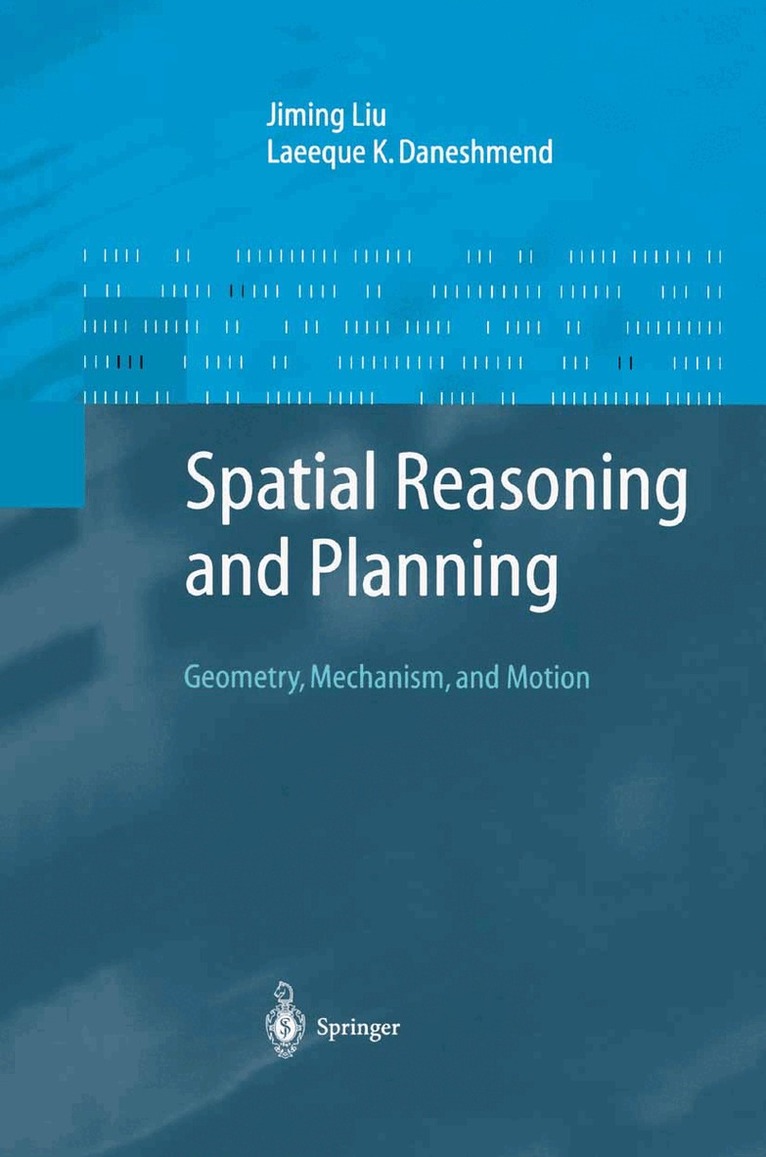
    Spatial Reasoning and Planning

    Geometry, Mechanism, and Motion

    AvJiming Liu,Laeeque K. Daneshmend

    Inbunden, Engelska, 2003

    Del i serien Advanced Information Processing

    1 119 kr

    Beställningsvara. Skickas inom 10-15 vardagar. Fri frakt över 249 kr.

    Fler format och utgåvor

    Häftad

    1 087 kr

    Beskrivning

    Spatial reasoning and planning is a core constituent in robotics, graphics, computer-aided design, and geographic information systems.After a review of previous work in the related areas, Liu and Daneshmend present here a unified framework for qualitative spatial representation and reasoning, which enables the generation of solutions to spatial problems where the geometric knowledge is imprecise. The approach utilizes qualitative spatial representation and reasoning integrated with a quantitative search procedure based on simulated annealing. Many graphical illustrations and detailed algorithm descriptions help the readers to comprehend the solution paths and to develop their own applications.The book is written as a self-contained text for researchers and graduate students in computer science and related engineering disciplines. The methodologies, algorithmic details, and case studies presented can be used as course material as well as a convenient reference.

    Produktinformation

    • Utgivningsdatum:2003-12-04
    • Mått:155 x 235 x 16 mm
    • Vikt:465 g
    • Format:Inbunden
    • Språk:Engelska
    • Serie:Advanced Information Processing
    • Antal sidor:180
    • Upplaga:2004
    • Förlag:Springer-Verlag Berlin and Heidelberg GmbH & Co. KG
    • ISBN:9783540406709

    Utforska kategorier

    • Artificiell intelligens inom Data och IT

    Recensioner i media

    From the reviews: "This book especially deals with the problems of spatial reasoning and planning which are especially important for design stages of mechanical systems where system parameters have not yet been specified ... . The presentation of the material is very interesting and will be an excellent example for further work at similar problems. ... This book can be used for graduate students in several areas, but also ... for the continuous education of people that are already working in a given field." (Christian Posthoff, Zentralblatt MATH, Vol. 1054, 2005)

    Innehållsförteckning

    • 1 Introduction.- 1.1 Motivation.- 1.2 Issues.- 1.3 Scope of the Book.- 1.4 Organization of the Book.- 2 Overview of Spatial Reasoning and Planning Techniques.- 2.1 Computer-Aided Kinematic Design of Mechanisms.- 2.2 Geometric Path Planning.- 2.2.1 Path Search in Configuration Space.- 2.3 Qualitative Reasoning.- 3 Interesting Problems in Spatial Reasoning and Planning.- 3.1 Terminology and Notation.- 3.2 The Problems.- 3.3 Assumptions.- 4 How to Represent Qualitative Spatial Relationships.- 4.1 Qualitative Distance.- 4.2 Qualitative Angle.- 4.3 Notes on Label-Based Distance and Angle Descriptions.- 4.4 Completeness.- 4.5 Minimum-Spanning Edge (m-Edge) between Two Polygons.- 4.6 Qualitative Location in a Convex Polygonal Environment.- 4.7 Graphic Representation of the m-Edge Partitioned Free-Space.- 4.8 Notes on Qualitative Location.- 5 Methodology of Spatial Reasoning and Planning.- 5.1 Spatial Inferencing.- 5.2 Envisionments.- 5.3 Spatial Planning in Q-Space.- 5.4 Quantitative Configuration Generation with Simulated Annealing.- 6 How to Reason about Mechanism Configurations.- 6.1 An Overview of the Method.- 6.2 Qualitative Configuration Analysis.- 6.3 Quantitative Configuration Generation.- 6.4 Discussions.- 6.6 Summary.- 7 How to Reason about Velocity Relationships.- 7.1 Instantaneous Rotation Center.- 7.2 Velocity Relationship Analysis.- 7.3 Examples.- 7.4 Notes on the Application of Velocity Analysis.- 7.5 Relative Motion Method of Analyzing Velocities.- 7.5.2 Kinematic Modeling.- 7.6 Qualitative Analysis of Relative Velocities.- 7.7 An Example.- 7.8 Summary.- 8 How to Plan Robot Motions.- 8.1 An Overview of the Method.- 8.2 Qualitative Route Planning in the m-Edge Partitioned Euclidean Free-Space.- 8.3 Constructing Exact Paths from Qualitative Routes.- 8.4 GraphicalSimulations.- 9 How to Make Spatial Measurements and Maps.- 9.1 Mapping.- 9.2 m-Uncertainty and FS Theory.- 9.3 Incorporating m-Uncertainty.- 9.4 Collective Spatial Map Construction.- 9.5 Self-Organization of a Potential Map.- 9.6 Experiments.- 9.7 Summary.- 10 Concluding Remarks.- 10.1 Key Concepts Revisited.- 10.2 Practical Application.- 10.3 Limitations.- 10.4 Future Challenges.- Appendices.- B The Boltzmann Distribution in Simulated Annealing.- C Qualitative Route Search Based on A. Algorithm.- References.