• Fri frakt över 249 kr
  • •
  • Snabba leveranser
  • •
  • Billiga böcker
Kundservice

Du är på sajten för privatpersoner.

Företag, bibliotek eller offentlig verksamhet?

Du handlar på classic.bokus.com, där alla dina funktioner finns intakta.
Till classic.bokus.com
Bokus logotyp. Gå till startsidan.
  • Erbjudanden
  • Nyheter
  • Student
  • Topplistor
  • Barn & ungdom
  • Bokus Play
  • E-böcker
  • Pocketböcker
  • Spel & pussel

10% rabatt på allt med kod NYSTART10 →

Sidfot

Mina sidor

    Hjälp

    • Kundservice
    • Vanliga frågor och svar
    • Frakt och leverans
    • Retur vid ångerrätt
    • Reklamera vara
    • Betalning
    • Köpvillkor
    • Allmänna villkor
    • Information om webbplatsens tillgänglighet

    Om Bokus

    • Om oss
    • Pressrum
    • För studenter
    • För företag
    • För bibliotek och offentlig verksamhet
    • För leverantörer
    • Hållbarhet

    Populärt

    • Aktuella erbjudanden
    • Presentkort
    • Studentlitteratur
    • Nya böcker
    • Topplistor
    • Signerade böcker
    • Engelska böcker

    Inspiration

    • Boktips
    • BookTok
    • Populära bokserier
    • Barnbokskaraktärer
    • Populära författare
    Logotyp för Bokus
    Följ oss på Facebook (extern länk)Följ oss på Instagram (extern länk)Följ oss på YouTube (extern länk)Följ oss på TikTok (extern länk)
    bokus @ CookiesAnpassa cookiesIntegritetspolicyKöpvillkor
    Till Citymail hemsida (extern länk)Till Budbee hemsida (extern länk)Till Postnord hemsida (extern länk)Till Schenker hemsida (extern länk)Till Early Bird hemsida (extern länk)Till Walleys hemsida (extern länk)
    1. Data och IT
    2. Systemvetenskap och AI

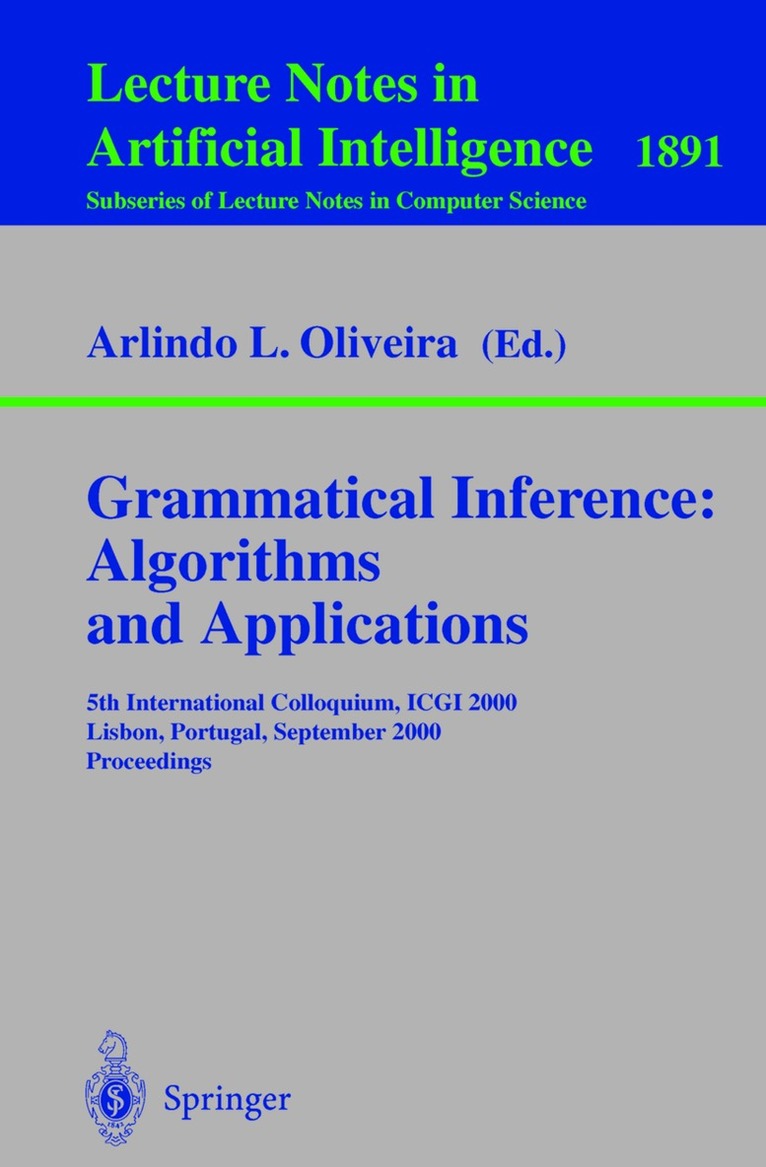
    Grammatical Inference: Algorithms and Applications

    5th International Colloquium, ICGI 2000, Lisbon, Portugal, September 11-13, 2000 Proceedings

    AvArlindo L. Oliveira

    Häftad, Engelska, 2000

    Del i serien Lecture Notes in Computer Science

    563 kr

    Beställningsvara. Skickas inom 10-15 vardagar. Fri frakt över 249 kr.

    Beskrivning

    The Fifth International Colloquium on Grammatical Inference (ICGI-2000) was heldinLisbononSeptember11-13th,2000.ICGI-2000wasthe?fthinaseriesof successfulbiennialinternationalconferencesintheareaofgrammaticalinference. Previous conferences were held in Essex, U.K.; Alicante, Spain; Montpellier, France; and Ames, Iowa, USA. This series of meetings seeks to provide a forum for the presentation and discussion of original research on all aspects of grammatical inference. Gram- tical inference, the process of inferring grammar from given data, is a ?eld that is not only challenging from a purely scienti?c standpoint but also ?nds many applications in real world problems. Despitethefactthatgrammaticalinferenceaddressesproblemsinarelatively narrow area, it uses techniques from many domains, and intersects a number of di?erent disciplines. Researchers in grammatical inference come from ?elds as diverse as machine learning, theoretical computer science, computational ling- stics, pattern recognition and arti?cial neural networks.From a practical standpoint, applications in areas such as natural language acquisition, computational biology, structural pattern recognition, information retrieval, text processing and adaptive intelligent agents have either been - monstrated or proposed in the literature. ICGI-2000 was held jointly with CoNLL-2000, the Computational Natural Language Learning Workshop and LLL-2000, the Second Learning Language in LogicWorkshop.Thetechnicalprogramincludedthepresentationof24accepted papers (out of 35 submitted) as well as joint sessions with CoNLL and LLL. A tutorial program organized by Gabriel Pereira Lopes took place after the meetings and included tutorials by Raymond Mooney, Gregory Grefenstette, Walter Daelemans, Ant' onio Ribeiro, Joaquim Ferreira da Silva, Gael Dias, Nuno Marques,VitorRossio,Jo" aoBalsaandAlexandreAgostini.Thejointrealization of these events represents a unique opportunity for researchers in these related ?elds to interact and exchange ideas.

    Produktinformation

    • Utgivningsdatum:2000-09-01
    • Mått:155 x 233 x 18 mm
    • Vikt:493 g
    • Format:Häftad
    • Språk:Engelska
    • Serie:Lecture Notes in Computer Science
    • Antal sidor:316
    • Förlag:Springer-Verlag Berlin and Heidelberg GmbH & Co. KG
    • ISBN:9783540410119

    Utforska kategorier

    • Systemvetenskap och AI inom Data och IT
    • Programspråk inom Data och IT

    Innehållsförteckning

    • Inference of Finite-State Transducers by Using Regular Grammars and Morphisms.- Computational Complexity of Problems on Probabilistic Grammars and Transducers.- Efficient Ambiguity Detection in C-NFA.- Learning Regular Languages Using Non Deterministic Finite Automata.- Smoothing Probabilistic Automata: An Error-Correcting Approach.- Inferring Subclasses of Contextual Languages.- Permutations and Control Sets for Learning Non-regular Language Families.- On the Complexity of Consistent Identification of Some Classes of Structure Languages.- Computation of Substring Probabilities in Stochastic Grammars.- A Comparative Study of Two Algorithms for Automata Identification.- The Induction of Temporal Grammatical Rules from Multivariate Time Series.- Identification in the Limit with Probability One of Stochastic Deterministic Finite Automata.- Iterated Transductions and Efficient Learning from Positive Data: A Unifying View.- An Inverse Limit of Context-Free Grammars – A New Approach to Identifiability in the Limit.- Synthesizing Context Free Grammars from Sample Strings Based on Inductive CYK Algorithm.- Combination of Estimation Algorithms and Grammatical Inference Techniques to Learn Stochastic Context-Free Grammars.- On the Relationship between Models for Learning in Helpful Environments.- Probabilistic k-Testable Tree Languages.- Learning Context-Free Grammars from Partially Structured Examples.- Identification of Tree Translation Rules from Examples.- Counting Extensional Differences in BC-Learning.- Constructive Learning of Context-Free Languages with a Subpansive Tree.- A Polynomial Time Learning Algorithm of Simple Deterministic Languages via Membership Queries and a Representative Sample.- Improve the Learning of Subsequential Transducers by Using Alignments andDictionaries.