• Fri frakt över 249 kr
  • •
  • Snabba leveranser
  • •
  • Billiga böcker
Kundservice

Du är på sajten för privatpersoner.

Företag, bibliotek eller offentlig verksamhet?

Du handlar på classic.bokus.com, där alla dina funktioner finns intakta.
Till classic.bokus.com
Bokus logotyp. Gå till startsidan.
  • Erbjudanden
  • Nyheter
  • Student
  • Topplistor
  • Barn & ungdom
  • Bokus Play
  • E-böcker
  • Pocketböcker
  • Spel & pussel

10% rabatt på allt med kod NYSTART10 →

Sidfot

Mina sidor

    Hjälp

    • Kundservice
    • Vanliga frågor och svar
    • Frakt och leverans
    • Retur vid ångerrätt
    • Reklamera vara
    • Betalning
    • Köpvillkor
    • Allmänna villkor
    • Information om webbplatsens tillgänglighet

    Om Bokus

    • Om oss
    • Pressrum
    • För studenter
    • För företag
    • För bibliotek och offentlig verksamhet
    • För leverantörer
    • Hållbarhet

    Populärt

    • Aktuella erbjudanden
    • Presentkort
    • Studentlitteratur
    • Nya böcker
    • Topplistor
    • Signerade böcker
    • Engelska böcker

    Inspiration

    • Boktips
    • BookTok
    • Populära bokserier
    • Barnbokskaraktärer
    • Populära författare
    Logotyp för Bokus
    Följ oss på Facebook (extern länk)Följ oss på Instagram (extern länk)Följ oss på YouTube (extern länk)Följ oss på TikTok (extern länk)
    bokus @ CookiesAnpassa cookiesIntegritetspolicyKöpvillkor
    Till Citymail hemsida (extern länk)Till Budbee hemsida (extern länk)Till Postnord hemsida (extern länk)Till Schenker hemsida (extern länk)Till Early Bird hemsida (extern länk)Till Walleys hemsida (extern länk)
    1. Naturvetenskap och teknik
    2. Teknik och industri
    3. Maskinteknik och material

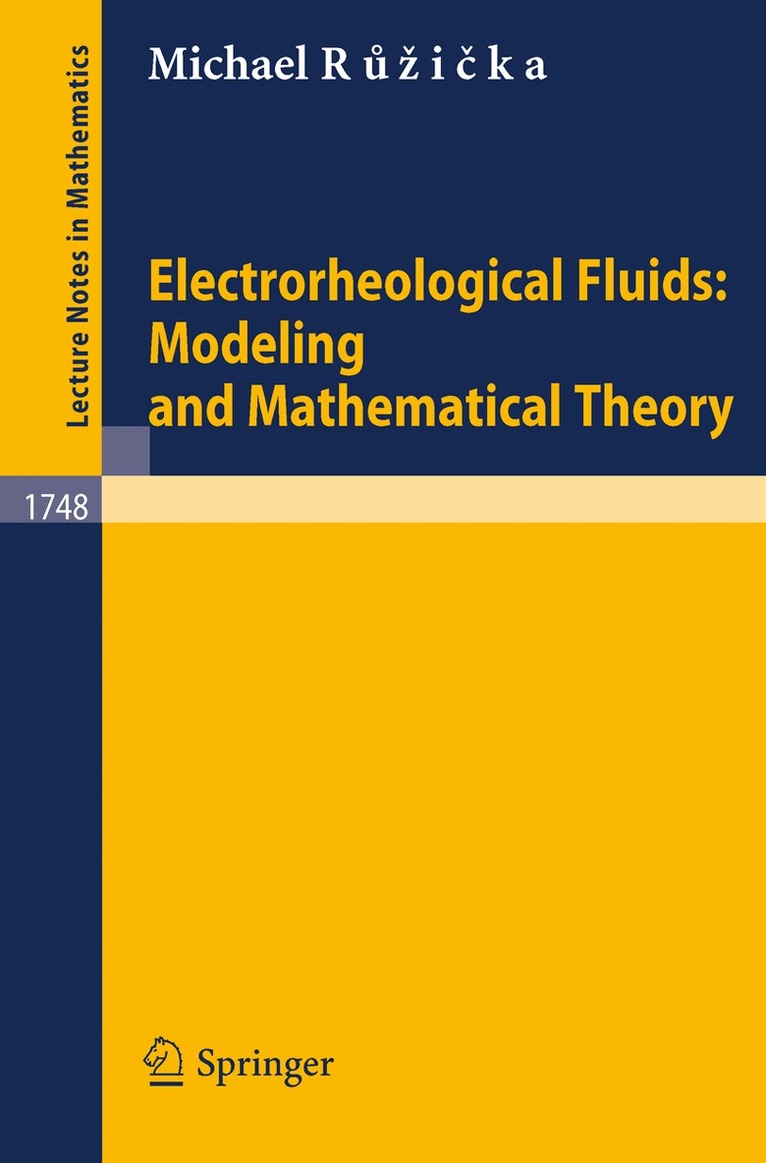
    Electrorheological Fluids: Modeling and Mathematical Theory

    AvMichael Ruzicka

    Häftad, Engelska, 2000

    Del 1748 i serien Lecture Notes in Mathematics

    546 kr

    Beställningsvara. Skickas inom 10-15 vardagar. Fri frakt över 249 kr.

    Fler format och utgåvor

    E-bok

    710 kr

    Beskrivning

    This is the first book to present a model, based on rational mechanics of electrorheological fluids, that takes into account the complex interactions between the electromagnetic fields and the moving liquid. Several constitutive relations for the Cauchy stress tensor are discussed. The main part of the book is devoted to a mathematical investigation of a model possessing shear-dependent viscosities, proving the existence and uniqueness of weak and strong solutions for the steady and the unsteady case. The PDS systems investigated possess so-called non-standard growth conditions. Existence results for elliptic systems with non-standard growth conditions and with a nontrivial nonlinear r.h.s. and the first ever results for parabolic systems with a non-standard growth conditions are given for the first time. Written for advanced graduate students, as well as for researchers in the field, the discussion of both the modeling and the mathematics is self-contained.

    Produktinformation

    • Utgivningsdatum:2000-12-12
    • Mått:156 x 234 x 11 mm
    • Vikt:300 g
    • Format:Häftad
    • Språk:Engelska
    • Serie:Lecture Notes in Mathematics
    • Antal sidor:178
    • Förlag:Springer-Verlag Berlin and Heidelberg GmbH & Co. KG
    • ISBN:9783540413851

    Utforska kategorier

    • Maskinteknik och material inom Naturvetenskap och teknik

    Innehållsförteckning

    • Modeling of Electrorheological Fluids: General Balance Laws; Electrorheological Fluids; Linear Models for the Stress Tensor T; Shear Dependent Electrorheological Fluids. Mathematical Framework: Setting of the Problem and Introduction; Function Spaces; Maxwell's Equations. Electrorheological Fluids with Shear Dependent Viscosities - Steady Flows: Introduction; Weak Solutions; Strong Solutions; Existence of Approximate Solutions; Limiting Process A > infinity; Limiting Process epsylon > 0. Electrorheoligical Fluids with Shear Dependent Viscosities - Unsteady Flows: Setting of the Problem and Main Results; Existence of Approximate Solutions; Limiting Process A > infinity; Limiting Process epsylon > 0. Appendix: General Auxiliary Results; Auxiliary Results for the Approximations.