• Fri frakt över 249 kr
  • •
  • Snabba leveranser
  • •
  • Billiga böcker
Kundservice

Du är på sajten för privatpersoner.

Företag, bibliotek eller offentlig verksamhet?

Du handlar på classic.bokus.com, där alla dina funktioner finns intakta.
Till classic.bokus.com
Bokus logotyp. Gå till startsidan.
  • Erbjudanden
  • Nyheter
  • Student
  • Topplistor
  • Barn & ungdom
  • Bokus Play
  • E-böcker
  • Pocketböcker
  • Spel & pussel

10% rabatt på allt med kod NYSTART10 →

Sidfot

Mina sidor

    Hjälp

    • Kundservice
    • Vanliga frågor och svar
    • Frakt och leverans
    • Retur vid ångerrätt
    • Reklamera vara
    • Betalning
    • Köpvillkor
    • Allmänna villkor
    • Information om webbplatsens tillgänglighet

    Om Bokus

    • Om oss
    • Pressrum
    • För studenter
    • För företag
    • För bibliotek och offentlig verksamhet
    • För leverantörer
    • Hållbarhet

    Populärt

    • Aktuella erbjudanden
    • Presentkort
    • Studentlitteratur
    • Nya böcker
    • Topplistor
    • Signerade böcker
    • Engelska böcker

    Inspiration

    • Boktips
    • BookTok
    • Populära bokserier
    • Barnbokskaraktärer
    • Populära författare
    Logotyp för Bokus
    Följ oss på Facebook (extern länk)Följ oss på Instagram (extern länk)Följ oss på YouTube (extern länk)Följ oss på TikTok (extern länk)
    bokus @ CookiesAnpassa cookiesIntegritetspolicyKöpvillkor
    Till Citymail hemsida (extern länk)Till Budbee hemsida (extern länk)Till Postnord hemsida (extern länk)Till Schenker hemsida (extern länk)Till Early Bird hemsida (extern länk)Till Walleys hemsida (extern länk)
    1. Naturvetenskap och teknik
    2. Geovetenskap
    3. Geovetenskap

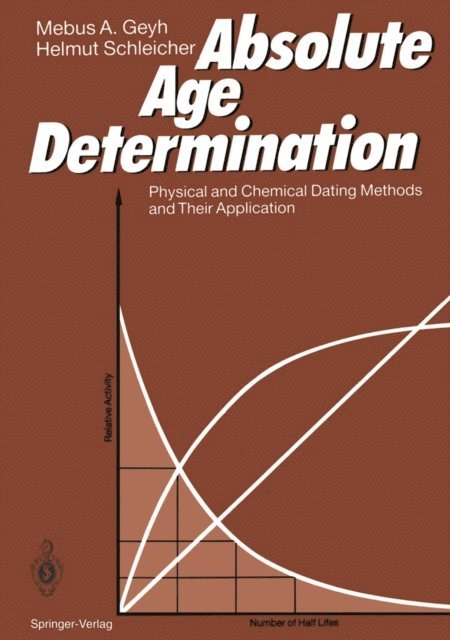
    Absolute Age Determination

    Physical and Chemical Dating Methods and Their Application

    AvMebus A. Geyh,Helmut Schleicher

    Häftad, Engelska, 1990

    1 085 kr

    Beställningsvara. Skickas inom 10-15 vardagar. Fri frakt över 249 kr.

    Beskrivning

    With the growing recognition during the last two centuries that the Earth has an immense age and processes over long periods of time have changed the morphology and composition of the Earth's crust, geologists have become increasingly interested in determination of absolute ages. A rela­ tive geochronology was established on the basis of the lithostratigraphic and biostratigraphic principles developed during the last century. With the discovery of radioactivity, the basis for a new geoscientific discipline - geochronology - was established (Rutherford 1906). It is the study of geological time, based mainly on the time signatures provided by the isotopic composition in geologic materials. The isotopic signature in a rock yields more information than that provided by the geochemical signature alone because it reflects the origin and history of the element in the rock. The aim of geochronology is to calibrate and standardize chronostrati­ graphic scales, to develop geological time scales that have a sensitive or at least useful resolution in order to place the geological events in the correct chronological order, and to assign their proper time spans. In practice, the application of geochronology is much wider because the data in the "natural archives" often provide information on the origin, genesis, and history of the materials. This, of course, requires an understanding of the geochemical behavior of the substances involved.

    Produktinformation

    • Utgivningsdatum:1990-08-27
    • Mått:170 x 244 x 28 mm
    • Vikt:880 g
    • Format:Häftad
    • Språk:Engelska
    • Antal sidor:505
    • Förlag:Springer-Verlag Berlin and Heidelberg GmbH & Co. KG
    • ISBN:9783540512769
    • Översättare:Clark Newcomb

    Utforska kategorier

    • Geovetenskap inom Naturvetenskap och teknik
    • Tillämpad fysik inom Naturvetenskap och teknik

    Innehållsförteckning

    • 1 Introduction.- 2 Time Scales and Ages.- 2.1 Absolute Time Scales.- 2.2 Relative Time Scales.- 2.3 Physical and Chemical Time Scales.- 3 Selection, Collection, Packing, Storage, Transport, and Description of the Samples.- 3.1 Selection and Collection of the Samples.- 3.2 Packing, Storage, and Transport of the Samples.- 3.3 Sample Description.- 4 Treatment and Interpretation of the Raw Data.- 4.1 Suitability of a Sample for Dating and Reliability of the Dates.- 4.2 Mathematical Evaluation of Physical and Chemical Age Data.- 4.3 Publication of the Age Values.- 5 Physical Dating Methods.- 5.1 Principles.- 5.2 Sample Treatment and Measurement Techniques.- 6 Radiometric Dating Methods.- 6.1 Parent/Daughter Isotope Ratios as a Geochronometer.- 6.2 Dating with Cosmogenic Radionuclides.- 6.3 Dating Based on Radioactive Disequilibrium of the Uranium, Thorium, and Protactinium Decay Series: The Uranium/Thorium/Protactinium Methods ***.- 6.4 Age Determination Using Radiation Damage.- 6.5 Dating Meteorites and Lunar Rocks.- 7 Chronostratigraphic Methods Using Global Time Markers.- 7.1 Paleomagnetic Dating Methods***.- 7.2 Chronostratigraphic Time-Scale Using ?18O Values ***.- 7.3 Chronostratigraphic Time-Scale Using ?34S and ?13C Values and 87Sr/86Sr Ratios**.- 7.4 Artificial Radionuclides as Time Markers ***.- 7.5 Geochemical Time Markers *.- 7.6 Chemical Pollution as Time Markers *.- 8 Chemical Dating Methods.- 8.1 Amino-Acid Racemization Method (AAR)***.- 8.2 Amino-Acid Degradation Method.- 8.3 Dating of Bones Using the Nitrogen or Collagen Content *.- 8.4 Chemical Electron-Spin-Resonance (ESR) Dating.- 8.5 Molecular (Protein and DNA) Clocks.- 8.6 Obsidian Hydration Method***.- 8.7 Dating of Man-Made Glass.- 8.8 Calcium Diffusion and Cation-Ratio Methods.- 8.9 Dating ofBones Using the Fluorine or Uranium Content *.- 9 Phanerozoic Time-Scale.- 9.1 Objectives and History of Geochronolgy.- 9.2 Geological Time-Scales.- 9.3 The Future.- 10 Literature.- 10.1 Journals that Frequently Publish Geochronological Papers.- 10.2 Geochronology Textbooks.- 10.3 References.- Acknowledgments.- Appendix A: Geochronology Glossary.- Appendix B: Radioactive and Stable Isotopes in Geochronology.- Appendix C: List of Addresses.