• Fri frakt över 249 kr
  • •
  • Snabba leveranser
  • •
  • Billiga böcker
Kundservice

Du är på sajten för privatpersoner.

Företag, bibliotek eller offentlig verksamhet?

Du handlar på classic.bokus.com, där alla dina funktioner finns intakta.
Till classic.bokus.com
Bokus logotyp. Gå till startsidan.
  • Erbjudanden
  • Nyheter
  • Student
  • Topplistor
  • Barn & ungdom
  • Bokus Play
  • E-böcker
  • Pocketböcker
  • Spel & pussel

10% rabatt på allt med kod NYSTART10 →

Sidfot

Mina sidor

    Hjälp

    • Kundservice
    • Vanliga frågor och svar
    • Frakt och leverans
    • Retur vid ångerrätt
    • Reklamera vara
    • Betalning
    • Köpvillkor
    • Allmänna villkor
    • Information om webbplatsens tillgänglighet

    Om Bokus

    • Om oss
    • Pressrum
    • För studenter
    • För företag
    • För bibliotek och offentlig verksamhet
    • För leverantörer
    • Hållbarhet

    Populärt

    • Aktuella erbjudanden
    • Presentkort
    • Studentlitteratur
    • Nya böcker
    • Topplistor
    • Signerade böcker
    • Engelska böcker

    Inspiration

    • Boktips
    • BookTok
    • Populära bokserier
    • Barnbokskaraktärer
    • Populära författare
    Logotyp för Bokus
    Följ oss på Facebook (extern länk)Följ oss på Instagram (extern länk)Följ oss på YouTube (extern länk)Följ oss på TikTok (extern länk)
    bokus @ CookiesAnpassa cookiesIntegritetspolicyKöpvillkor
    Till Citymail hemsida (extern länk)Till Budbee hemsida (extern länk)Till Postnord hemsida (extern länk)Till Schenker hemsida (extern länk)Till Early Bird hemsida (extern länk)Till Walleys hemsida (extern länk)
    1. Naturvetenskap och teknik
    2. Matematik och naturvetenskap
    3. Fysik
    4. Tillämpad fysik

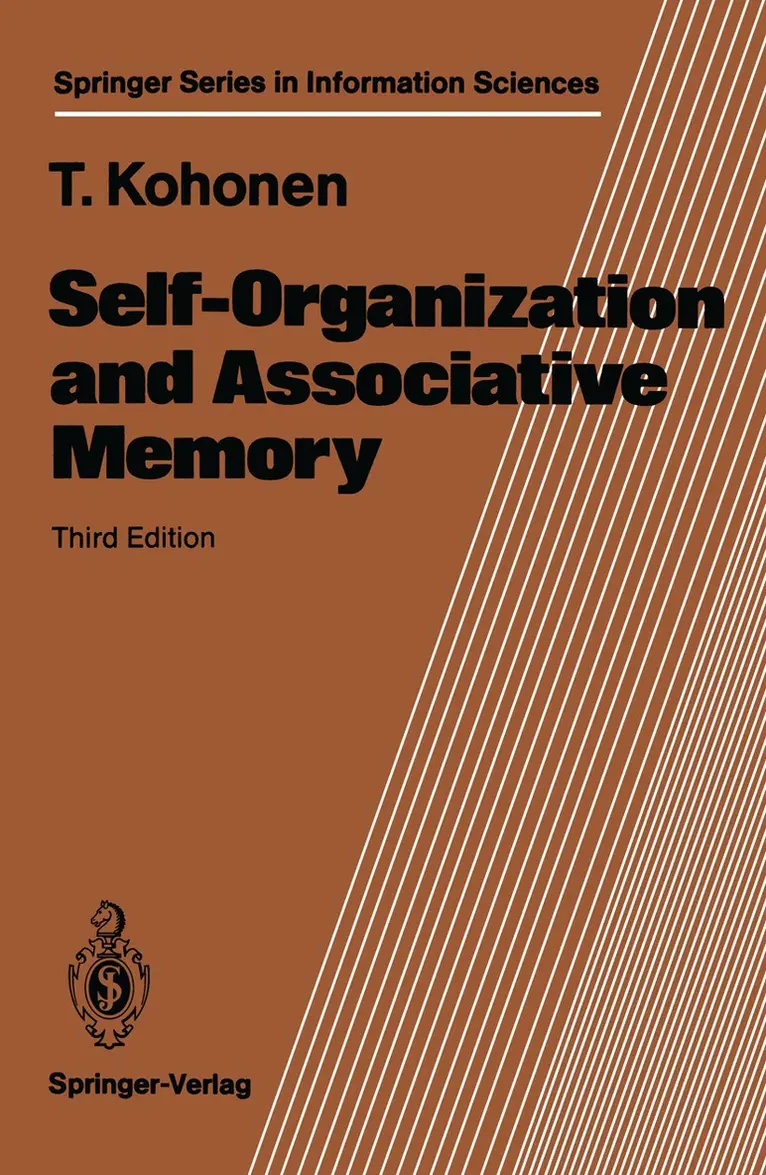
    Self-Organization and Associative Memory

    AvTeuvo Kohonen

    Häftad, Engelska, 1989

    Del 8 i serien Springer Series in Information Sciences

    546 kr

    Beställningsvara. Skickas inom 10-15 vardagar. Fri frakt över 249 kr.

    Fler format och utgåvor

    E-bok

    710 kr

    E-bok

    1 140 kr

    Beskrivning

    While the present edition is bibliographically the third one of Vol. 8 of the Springer Series in Information Sciences (IS 8), the book actually stems from Vol. 17 of the series Communication and Cybernetics (CC 17), entitled Associative Memory - A System-Theoretical Approach, which appeared in 1977. That book was the first monograph on distributed associative memories, or "content-addressable memories" as they are frequently called, especially in neural-networks research. This author, however, would like to reserve the term "content-addressable memory" for certain more traditional constructs, the memory locations of which are selected by parallel search. Such devices are discussed in Vol. 1 of the Springer Series in Information Sciences, Content-Addressable Memories. This third edition of IS 8 is rather similar to the second one. Two new discussions have been added: one to the end of Chap. 5, and the other (the L VQ 2 algorithm) to the end of Chap. 7. Moreover, the convergence proof in Sect. 5.7.2 has been revised.

    Produktinformation

    • Utgivningsdatum:1989-09-14
    • Mått:155 x 235 x 19 mm
    • Vikt:505 g
    • Format:Häftad
    • Språk:Engelska
    • Serie:Springer Series in Information Sciences
    • Antal sidor:312
    • Upplaga:3
    • Förlag:Springer-Verlag Berlin and Heidelberg GmbH & Co. KG
    • ISBN:9783540513872

    Utforska kategorier

    • Tillämpad fysik inom Naturvetenskap och teknik
    • Teknik: allmänt inom Naturvetenskap och teknik
    • Biovetenskap inom Naturvetenskap och teknik

    Innehållsförteckning

    • 1. Various Aspects of Memory.- 1.1 On the Purpose and Nature of Biological Memory.- 1.2 Questions Concerning the Fundamental Mechanisms of Memory.- 1.3 Elementary Operations Implemented by Associative Memory.- 1.4 More Abstract Aspects of Memory.- 2. Pattern Mathematics.- 2.1 Mathematical Notations and Methods.- 2.2 Distance Measures for Patterns.- 3. Classical Learning Systems.- 3.1 The Adaptive Linear Element (Adaline).- 3.2 The Perceptron.- 3.3 The Learning Matrix.- 3.4 Physical Realization of Adaptive Weights.- 4. A New Approach to Adaptive Filters.- 4.1 Survey of Some Necessary Functions.- 4.2 On the “Transfer Function” of the Neuron.- 4.3 Models for Basic Adaptive Units.- 4.4 Adaptive Feedback Networks.- 5. Self-Organizing Feature Maps.- 5.1 On the Feature Maps of the Brain.- 5.2 Formation of Localized Responses by Lateral Feedback.- 5.3 Computational Simplification of the Process.- 5.4 Demonstrations of Simple Topology-Preserving Mappings.- 5.5 Tonotopic Map.- 5.6 Formation of Hierarchical Representations.- 5.7 Mathematical Treatment of Self-Organization.- 5.8 Automatic Selection of Feature Dimensions.- 6. Optimal Associative Mappings.- 6.1 Transfer Function of an Associative Network.- 6.2 Autoassociative Recall as an Orthogonal Projection.- 6.3 The Novelty Filter.- 6.4 Autoassociative Encoding.- 6.5 Optimal Associative Mappings.- 6.6 Relationship Between Associative Mapping, Linear Regression, and Linear Estimation.- 6.7 Recursive Computation of the Optimal Associative Mapping.- 6.8 Special Cases.- 7. Pattern Recognition.- 7.1 Discriminant Functions.- 7.2 Statistical Formulation of Pattern Classification.- 7.3 Comparison Methods.- 7.4 The Subspace Methods of Classification.- 7.5 Learning Vector Quantization.- 7.6 Feature Extraction.- 7.7 Clustering.- 7.8Structural Pattern Recognition Methods.- 8. More About Biological Memory.- 8.1 Physiological Foundations of Memory.- 8.2 The Unified Cortical Memory Model.- 8.3 Collateral Reading.- 9. Notes on Neural Computing.- 9.1 First Theoretical Views of Neural Networks.- 9.2 Motives for the Neural Computing Research.- 9.3 What Could the Purpose of the Neural Networks be?.- 9.4 Definitions of Artificial “Neural Computing” and General Notes on Neural Modelling.- 9.5 Are the Biological Neural Functions Localized or Distributed?.- 9.6 Is Nonlinearity Essential to Neural Computing?.- 9.7 Characteristic Differences Between Neural and Digital Computers.- 9.8 “Connectionist Models”.- 9.9 How can the Neural Computers be Programmed?.- 10. Optical Associative Memories.- 10.1 Nonholographic Methods.- 10.2 General Aspects of Holographic Memories.- 10.3 A Simple Principle of Holographic Associative Memory.- 10.4 Addressing in Holographic Memories.- 10.5 Recent Advances of Optical Associative Memories.- Bibliography on Pattern Recognition.- References.