• Fri frakt över 249 kr
  • •
  • Snabba leveranser
  • •
  • Billiga böcker
Kundservice

Du är på sajten för privatpersoner.

Företag, bibliotek eller offentlig verksamhet?

Du handlar på classic.bokus.com, där alla dina funktioner finns intakta.
Till classic.bokus.com
Bokus logotyp. Gå till startsidan.
  • Erbjudanden
  • Student
  • Topplistor
  • Barn & ungdom
  • Bokus Play
  • E-böcker
  • Ljudböcker
  • Pocketböcker
  • Spel och pussel

Pocketfynda! Hundratals böcker för 49 kr/st →

Sidfot

Mina sidor

    Hjälp

    • Kundservice
    • Vanliga frågor och svar
    • Frakt och leverans
    • Retur vid ångerrätt
    • Reklamera vara
    • Betalning
    • Köpvillkor
    • Allmänna villkor
    • Information om webbplatsens tillgänglighet

    Om Bokus

    • Om oss
    • Pressrum
    • För studenter
    • För företag
    • För bibliotek och offentlig verksamhet
    • För leverantörer
    • Hållbarhet

    Populärt

    • Aktuella erbjudanden
    • Presentkort
    • Studentlitteratur
    • Nya böcker
    • Topplistor
    • Signerade böcker
    • Engelska böcker

    Inspiration

    • Boktips
    • BookTok
    • Barnbokskaraktärer
    • Populära författare
    Logotyp för Bokus
    Följ oss på Facebook (extern länk)Följ oss på Instagram (extern länk)Följ oss på YouTube (extern länk)Följ oss på TikTok (extern länk)
    bokus @ CookiesAnpassa cookiesIntegritetspolicyKöpvillkor
    Till Citymail hemsida (extern länk)Till Budbee hemsida (extern länk)Till Postnord hemsida (extern länk)Till Schenker hemsida (extern länk)Till Early Bird hemsida (extern länk)Till Walleys hemsida (extern länk)
    1. Data och IT
    2. Systemvetenskap och AI
    3. Artificiell intelligens

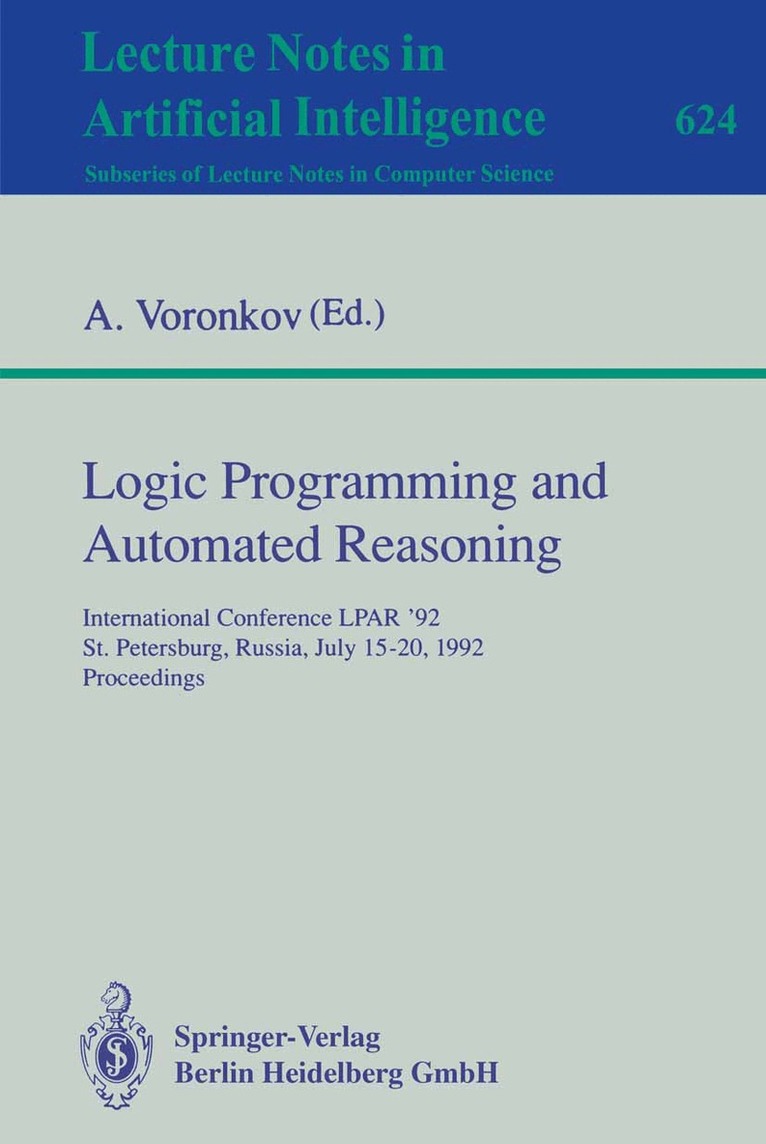
    Logic Programming and Automated Reasoning

    International Conference LPAR '92, St.Petersburg, Russia, July 15-20, 1992. Proceedings

    AvAndrei Voronkov

    Häftad, Engelska, 1992

    Del i serien Lecture Notes in Computer Science

    559 kr

    Beställningsvara. Skickas inom 10-15 vardagar. Fri frakt över 249 kr.

    Beskrivning

    This volume contains the proceedings of LPAR '92, theinternational conference on logic programming and automatedreasoning held in St. Petersburg in July 1992. The aim ofthe conference was to bring together researchers from theRussian and the international logic programming and theoremproving communities.The topics of interest covered by papers inthe volumeinclude automated theorem proving, non-monotonic reasoning,applications of mathematical logic to computer science,deductive databases, implementation of declarative concepts,and programming in non-classical logics.LPAR '92 is the successor of the First and Second RussianConferences on Logic Programming held in 1990 and 1991,respectively, the proceedings of which were publishedinLNAI Vol. 592.

    Produktinformation

    • Utgivningsdatum:1992-07-01
    • Mått:155 x 233 x 29 mm
    • Vikt:791 g
    • Format:Häftad
    • Språk:Engelska
    • Serie:Lecture Notes in Computer Science
    • Antal sidor:516
    • Upplaga:1992
    • Förlag:Springer-Verlag Berlin and Heidelberg GmbH & Co. KG
    • ISBN:9783540557272

    Utforska kategorier

    • Artificiell intelligens inom Data och IT

    Innehållsförteckning

    • Soundness and completeness of partial deductions for well-founded semantics.- On deductive planning and the frame problem.- On resolution in fragments of classical linear logic (extended abstract).- A procedure for automatic proof nets construction.- Free logic and infinite constraint networks.- Towards probabilistic knowledge bases.- Two-level grammar: A functional/logic query language for database and knowledge-base systems.- Extending deductive database languages by embedded implications.- Controlling redundancy in large search spaces: Argonne-style theorem proving through the years.- Resolution for many-valued logics.- An ordered theory resolution calculus.- Application of automated deduction to the search for single axioms for exponent groups.- Elementary lower bounds for the lengths of refutations.- Shortening proofs by quantifier introduction.- Reform compilation for nonlinear recursion.- Pruning infinite failure branches in programs with occur-check.- The use of planning critics in mechanizing inductive proofs.- ??-Calculus: An algorithmic interpretation of classical natural deduction.- Building proofs by analogy via the Curry-Howard Isomorphism.- On the use of the constructive omega-rule within automated deduction.- OR-parallel theorem proving with random competition.- Parallel computation of multiple sets-of-support.- Towards using the Andorra Kernel Language for industrial real-time applications.- Unification in a combination of equational theories with shared constants and its application to primal algebras.- Non-clausal resolution and superposition with selection and redundancy criteria.- Relating innermost, weak, uniform and modular termination of term rewriting systems.- A two steps semantics for logic programs with negation.- Generalized negation asfailure and semantics of normal disjunctive logic programs.- General model theoretic semantics for Higher-Order horn logic programming.- Disjunctive deductive databases.- Netlog — A concept oriented logic programming language.- From the past to the future: Executing temporal logic programs.- Computing induction axioms.- Consistency of equational enrichments.- A programming logic for a verified structured assembly language.- The unification of infinite sets of terms and its applications.- Unification in order-sorted type theory.- Infinite, canonical string rewriting systems generated by completion.- Spes: A system for logic program transformation.- Linear Objects: A logic framework for open system programming.- ISAR: An interactive system for algebraic implementation proofs.- Mathpert: Computer support for learning algebra, trig, and calculus.- MegaLog — A platform for developing knowledge base management systems.- SPIKE, an automatic theorem prover.- An application to teaching in logic course of ATP based on natural deduction.- A generic logic environment.- ElipSys A parallel programming system based on logic.- Opium — A high-level debugging environment.- An inductive theorem prover based on narrowing.- A cooperative answering system.- MIZ-PR: A theorem prover for polymorphic and recursive functions.- ProPre A programming language with proofs.- FRIENDLY-WAM: An interactive tool to understand the compilation of PROLOG.- SEPIA — a Basis for Prolog extensions.- The external database in SICStus Prolog.- The KCM system: Speeding-up logic programming through hardware support.- Logician's Workbench.- EUODHILOS: A general reasoning system for a variety of logics.- The EKS-V1 system.- CHIP and Propia.