• Fri frakt över 249 kr
  • •
  • Snabba leveranser
  • •
  • Billiga böcker
Kundservice

Du är på sajten för privatpersoner.

Företag, bibliotek eller offentlig verksamhet?

Du handlar på classic.bokus.com, där alla dina funktioner finns intakta.
Till classic.bokus.com
Bokus logotyp. Gå till startsidan.
  • Erbjudanden
  • Nyheter
  • Student
  • Topplistor
  • Barn & ungdom
  • Bokus Play
  • E-böcker
  • Pocketböcker
  • Spel & pussel

10% rabatt på allt med kod: NYSTART10 →

Sidfot

Mina sidor

    Hjälp

    • Kundservice
    • Vanliga frågor och svar
    • Frakt och leverans
    • Retur vid ångerrätt
    • Reklamera vara
    • Betalning
    • Köpvillkor
    • Allmänna villkor
    • Information om webbplatsens tillgänglighet

    Om Bokus

    • Om oss
    • Pressrum
    • För studenter
    • För företag
    • För bibliotek och offentlig verksamhet
    • För leverantörer
    • Hållbarhet

    Populärt

    • Aktuella erbjudanden
    • Presentkort
    • Studentlitteratur
    • Nya böcker
    • Topplistor
    • Signerade böcker
    • Engelska böcker

    Inspiration

    • Boktips
    • BookTok
    • Populära bokserier
    • Barnbokskaraktärer
    • Populära författare
    Logotyp för Bokus
    Följ oss på Facebook (extern länk)Följ oss på Instagram (extern länk)Följ oss på YouTube (extern länk)Följ oss på TikTok (extern länk)
    bokus @ CookiesAnpassa cookiesIntegritetspolicyKöpvillkor
    Till Citymail hemsida (extern länk)Till Budbee hemsida (extern länk)Till Postnord hemsida (extern länk)Till Schenker hemsida (extern länk)Till Early Bird hemsida (extern länk)Till Walleys hemsida (extern länk)
    1. Ekonomi och Ledarskap
    2. Nationalekonomi
    3. Mikroekonomi

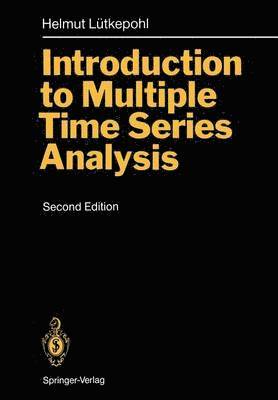
    Introduction to Multiple Time Series Analysis

    AvHelmut Lütkepohl

    Häftad, Engelska, 1993

    563 kr

    Beställningsvara. Skickas inom 10-15 vardagar. Fri frakt över 249 kr.

    Fler format och utgåvor

    E-bok

    1 136 kr

    Beskrivning

    This graduate level textbook deals with analyzing and forecasting multiple time series. It considers a wide range of multiple time series models and methods. The models include vector autoregressive, vector autoregressive moving average, cointegrated, and periodic processes as well as state space and dynamic simultaneous equations models. Least squares, maximum likelihood, and Bayesian methods are considered for estimating these models. Different procedures for model selection or specification are treated and a range of tests and criteria for evaluating the adequacy of a chosen model are introduced. The choice of point and interval forecasts is considered and impulse response analysis, dynamic multipliers as well as innovation accounting are presented as tools for structural analysis within the multiple time series context. This book is accessible to graduate students in business and economics. In addition, multiple time series courses in other fields such as statistics and engineering may be based on this book. Applied researchers involved in analyzing multiple time series may benefit from the book as it provides the background and tools for their task. It enables the reader to perform his or her analyses in a gap to the difficult technical literature on the topic.

    Produktinformation

    • Utgivningsdatum:1993-08-13
    • Mått:170 x 244 x 31 mm
    • Vikt:959 g
    • Format:Häftad
    • Språk:Engelska
    • Antal sidor:545
    • Upplaga:2
    • Förlag:Springer-Verlag Berlin and Heidelberg GmbH & Co. KG
    • ISBN:9783540569404

    Utforska kategorier

    • Mikroekonomi inom Ekonomi och Ledarskap
    • Nationalekonomi inom Ekonomi och Ledarskap

    Innehållsförteckning

    • 1. Introduction.- 1.1 Objectives of Analyzing Multiple Time Series.- 1.2 Some Basics.- 1.3 Vector Autoregressive Processes.- 1.4 Outline of the Following Chapters.- I. Finite Order Vector Autoregressive Processes.- 2. Stable Vector Autoregressive Processes.- 3. Estimation of Vector Autoregressive Processes.- 4. VAR Order Selection and Checking the Model Adequacy.- 5. VAR Processes with Parameter Constraints.- II. Infinite Order Vector Autoregressive Processes.- 6. Vector Autoregressive Moving Average Processes.- 7. Estimation of VARMA Models.- 8. Specification and Checking the Adequacy of VARMA Models.- 9. Fitting Finite Order VAR Models to Infinite Order Processes.- III. Systems with Exogenous Variables and Nonstationary Processes.- 10. Systems of Dynamic Simultaneous Equations.- 11. Nonstationary Systems with Integrated and Cointegrated Variables.- 12. Periodic VAR Processes and Intervention Models.- 13. State Space Models.- Appendices.- Appendix A. Vectors and Matrices.- A.1 Basic Definitions.- A.2 Basic Matrix Operations.- A.3 The Determinant.- A.4 The Inverse, the Adjoint, and Generalized Inverses.- A.4.1 Inverse and Adjoint of a Square Matrix.- A.4.2 Generalized Inverses.- A.5 The Rank.- A.6 Eigenvalues and -vectors — Characteristic Values and Vectors.- A.7 The Trace.- A.8 Some Special Matrices and Vectors.- A.8.1 Idempotent and Nilpotent Matrices.- A.8.2 Orthogonal Matrices and Vectors.- A.8.3 Definite Matrices and Quadratic Forms.- A.9 Decomposition and Diagonalization of Matrices.- A.9.1 The Jordan Canonical Form.- A.9.2 Decomposition of Symmetric Matrices.- A.9.3 The Choleski Decomposition of a Positive Definite Matrix.- A.10 Partitioned Matrices.- A.11 The Kronecker Product.- A.12 The vec and vech Operators and Related Matrices.- A.12.1 The Operators.-A.12.2 The Elimination, Duplication, and Commutation Matrices.- A.13 Vector and Matrix Differentiation.- A.14 Optimization of Vector Functions.- A.15 Problems.- Appendix B. Multivariate Normal and Related Distributions.- B.1 Multivariate Normal Distributions.- B.2 Related Distributions.- Appendix C. Convergence of Sequences of Random Variables and Asymptotic Distributions.- C.1 Concepts of Stochastic Convergence.- C.2 Asymptotic Properties of Estimators and Test Statistics.- C.3 Infinite Sums of Random Variables.- C.4 Maximum Likelihood Estimation.- C.5 Likelihood Ratio, Lagrange Multiplier, and Wald Tests.- Appendix D. Evaluating Properties of Estimators and Test Statistics by Simulation and Resampling Techniques.- D.1 Simulating a Multiple Time Series with VAR Generation Process.- D.2 Evaluating Distributions of Functions of Multiple Time Series by Simulation.- D.3 Evaluating Distributions of Functions of Multiple Time Series by Resampling.- Appendix E. Data Used for Examples and Exercises.- References.- List of Propositions and Definitions.- Index of Notation.- Author Index.