• Fri frakt över 249 kr
  • •
  • Snabba leveranser
  • •
  • Billiga böcker
Kundservice

Du är på sajten för privatpersoner.

Företag, bibliotek eller offentlig verksamhet?

Du handlar på classic.bokus.com, där alla dina funktioner finns intakta.
Till classic.bokus.com
Bokus logotyp. Gå till startsidan.
  • Erbjudanden
  • Nyheter
  • Student
  • Topplistor
  • Barn & ungdom
  • Bokus Play
  • E-böcker
  • Pocketböcker
  • Spel & pussel

10% rabatt på allt med kod NYSTART10 →

Sidfot

Mina sidor

    Hjälp

    • Kundservice
    • Vanliga frågor och svar
    • Frakt och leverans
    • Retur vid ångerrätt
    • Reklamera vara
    • Betalning
    • Köpvillkor
    • Allmänna villkor
    • Information om webbplatsens tillgänglighet

    Om Bokus

    • Om oss
    • Pressrum
    • För studenter
    • För företag
    • För bibliotek och offentlig verksamhet
    • För leverantörer
    • Hållbarhet

    Populärt

    • Aktuella erbjudanden
    • Presentkort
    • Studentlitteratur
    • Nya böcker
    • Topplistor
    • Signerade böcker
    • Engelska böcker

    Inspiration

    • Boktips
    • BookTok
    • Populära bokserier
    • Barnbokskaraktärer
    • Populära författare
    Logotyp för Bokus
    Följ oss på Facebook (extern länk)Följ oss på Instagram (extern länk)Följ oss på YouTube (extern länk)Följ oss på TikTok (extern länk)
    bokus @ CookiesAnpassa cookiesIntegritetspolicyKöpvillkor
    Till Citymail hemsida (extern länk)Till Budbee hemsida (extern länk)Till Postnord hemsida (extern länk)Till Schenker hemsida (extern länk)Till Early Bird hemsida (extern länk)Till Walleys hemsida (extern länk)
    1. Naturvetenskap och teknik
    2. Teknik och industri
    3. Elektronik och kommunikationer

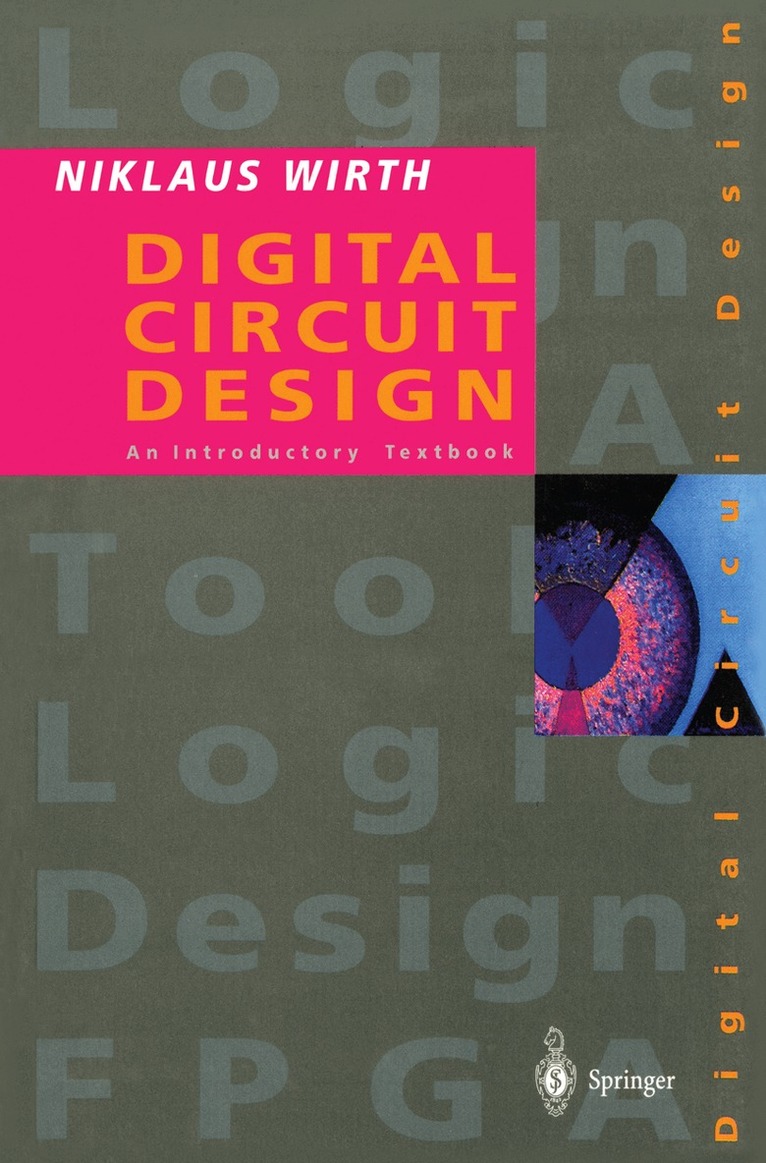
    Digital Circuit Design for Computer Science Students

    An Introductory Textbook

    AvNiklaus Wirth

    Häftad, Engelska, 1995

    924 kr

    Beställningsvara. Skickas inom 10-15 vardagar. Fri frakt över 249 kr.

    Fler format och utgåvor

    E-bok

    1 176 kr

    Beskrivning

    This book emerged from lecture notes of a course taught in the second year to students of Computer Science at the Federal Institute of Tech­ nology, Zurich. The topic of hardware design plays a relatively minor role in Compu­ ter Science curricula at many universities. Most courses concentrate on the various aspects of theory, software, and of information sys­ tems. Students therefore obtain few opportunities to deal with con­ crete engineering problems and physical devices. We consider this as rather unfortunate, particularly for technical universities. As a result, we observe a growing gap between interest in and understanding of design issues involving not only software but also hardware and inter­ faces. This is regrettable at a time when new and advanced solutions to many problems are often crucially influenced by recent hardware de­ velopments, at a time when the engineer needs to be competent in both software and hardware issues in order to fmd an optimally inte­ grated, competitive solution. It turns out that the hesitation of many students in Computer Science to take an active interest in hardware - his or her daily tool! - does not only stem from a preference of "clean", abstract concepts with a corre­ sponding distaste for dealing with concrete components, construction techniques, and the "dirty" realities inflicted by nature, but also stems from the lack of a bridge between the two realms.

    Produktinformation

    • Utgivningsdatum:1995-08-23
    • Mått:155 x 235 x 13 mm
    • Vikt:347 g
    • Format:Häftad
    • Språk:Engelska
    • Antal sidor:204
    • Förlag:Springer-Verlag Berlin and Heidelberg GmbH & Co. KG
    • ISBN:9783540585770

    Utforska kategorier

    • Elektronik och kommunikationer inom Naturvetenskap och teknik

    Innehållsförteckning

    • 1. Transistors and Gates.- 1.1. Gates with Bipolar Transistors.- 1.2. Gates with Field Effect Transistors.- 1.3. Electrical Characteristics of Gates.- 2. Combinational Circuits.- 2.1. Boolean Algebra.- 2.2. Graphical Notations.- 2.3. Circuit Simplification.- 2.4. The Decoder or Demultiplexer.- 2.5. The Multiplexer.- 2.6. The Adder.- 2.7. The Adder with Fast Carry Generation.- 2.8. The Multiplier.- 2.9. The Read-Only Memory (ROM).- 2.10. The Combinational PLD.- 2.11. The Programmable Gate Array.- 2.12. Dynamic Behaviour of Combinational Circuits.- 3. Latches and Registers.- 3.1. The SR-Latch.- 3.2. The D-Latch.- 3.3. The D-Register.- 3.4. The JK Register.- 4. Synchronous, Sequential Circuits.- 4.1. The State Machine.- 4.2. The Shift Register.- 4.3. The Synchronous Binary Counter.- 4.4. A Design Methodology for State Machines.- 4.5. The PLD and the FPGA with Registers.- 4.6. Timing and Practical Considerations.- 5. Bus Systems.- 5.1. The Concept of a Bus.- 5.2. The Open-Collector Circuit.- 5.3. The Tri-state Gate.- 6. Memories.- 6.1. Static Memories.- 6.2. Dynamic Memories.- 6.3. Dual-Port Memories.- 7. Formal Description of Synchronous Circuits.- 7.1. Motivation.- 7.2. Lola: A Formal Notation for Synchronous Circuits.- 7.3. Examples of Textual Circuit Descriptions.- 8. Design of an Elementary Computer.- 8.1. The Design of von Neumann.- 8.2. Choice of a Specific Architecture.- 8.3. The Arithmetic-Logic Unit (ALU).- 8.4. The Control Unit.- 8.5. Phase Control and Instruction Decoding.- 8.6. An Implementation Using Standard Parts.- 8.7. Interrupts.- 9. Multiplication and Division.- 9.1. Multiplication of Natural Numbers.- 9.2. Division of Natural Numbers.- 9.3. Extending the ALU by a Multiplier-Quotient Register.- 10. Design of a Computer Based on a Microprocessor.- 11. Interfaces Between Asynchronous Units.- 11.1. The Handshake Protocol.- 11.2. Processor-Bus Interfaces.- 11.3. Adding an I/O Interface to the Hercules Computer.- 12. Serial Data Transmission.- 12.1. Introduction.- 12.2. Synchronous Transmission.- 12.3. Asynchronous Transmission.- 12.4. A Buffered Transmitter and Receiver.- Appendix 1: Implementations Based on the Programmable Gate Array AT6002.- 1. The Laboratory.- 2. The Structure of the Gate Array.- 3. The FPGA Extension Board.- 4. A Set of Design Examples.- Appendix 2: Syntax of Lola.- Selected Design Exercises.