• Fri frakt över 249 kr
  • •
  • Snabba leveranser
  • •
  • Billiga böcker
Kundservice

Du är på sajten för privatpersoner.

Företag, bibliotek eller offentlig verksamhet?

Du handlar på classic.bokus.com, där alla dina funktioner finns intakta.
Till classic.bokus.com
Bokus logotyp. Gå till startsidan.
  • Erbjudanden
  • Nyheter
  • Student
  • Topplistor
  • Barn & ungdom
  • Bokus Play
  • E-böcker
  • Pocketböcker
  • Spel & pussel

10% rabatt på allt med kod NYSTART10 →

Sidfot

Mina sidor

    Hjälp

    • Kundservice
    • Vanliga frågor och svar
    • Frakt och leverans
    • Retur vid ångerrätt
    • Reklamera vara
    • Betalning
    • Köpvillkor
    • Allmänna villkor
    • Information om webbplatsens tillgänglighet

    Om Bokus

    • Om oss
    • Pressrum
    • För studenter
    • För företag
    • För bibliotek och offentlig verksamhet
    • För leverantörer
    • Hållbarhet

    Populärt

    • Aktuella erbjudanden
    • Presentkort
    • Studentlitteratur
    • Nya böcker
    • Topplistor
    • Signerade böcker
    • Engelska böcker

    Inspiration

    • Boktips
    • BookTok
    • Populära bokserier
    • Barnbokskaraktärer
    • Populära författare
    Logotyp för Bokus
    Följ oss på Facebook (extern länk)Följ oss på Instagram (extern länk)Följ oss på YouTube (extern länk)Följ oss på TikTok (extern länk)
    bokus @ CookiesAnpassa cookiesIntegritetspolicyKöpvillkor
    Till Citymail hemsida (extern länk)Till Budbee hemsida (extern länk)Till Postnord hemsida (extern länk)Till Schenker hemsida (extern länk)Till Early Bird hemsida (extern länk)Till Walleys hemsida (extern länk)
    1. Naturvetenskap och teknik
    2. Teknik och industri
    3. Maskinteknik och material

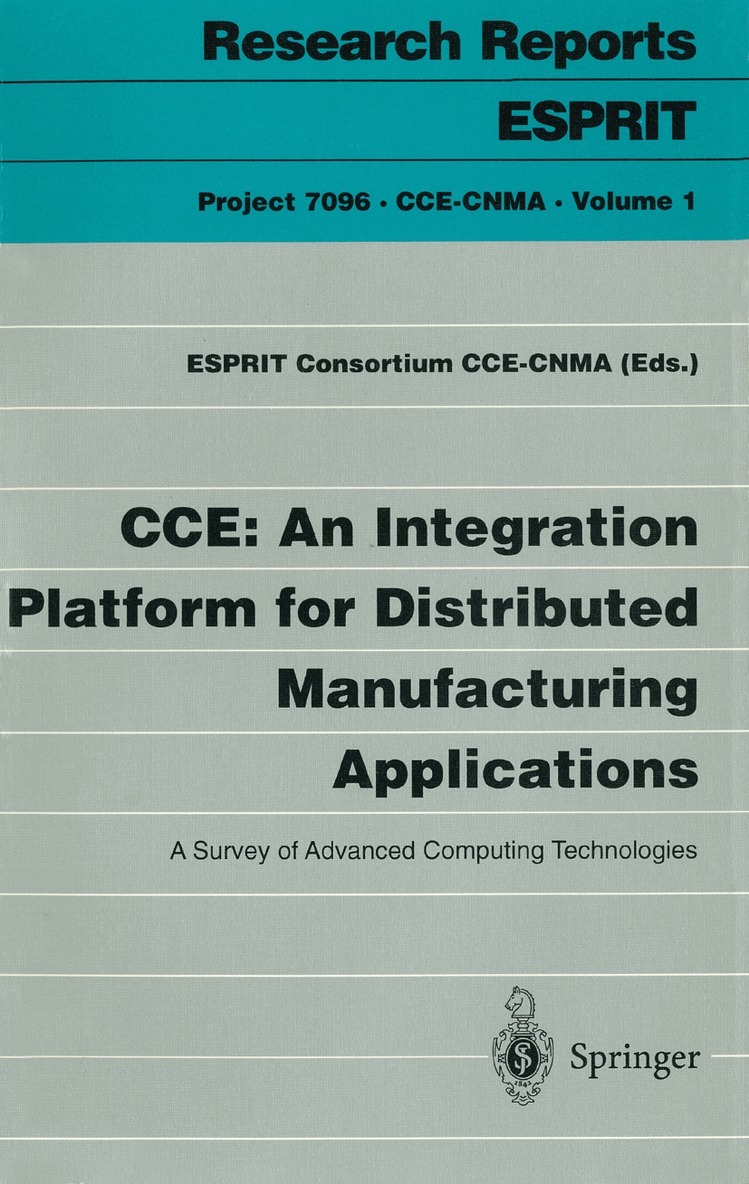
    CCE: An Integration Platform for Distributed Manufacturing Applications

    A Survey of Advanced Computing Technologies

    AvESPRIT Consortium CCE-CNMA

    Häftad, Engelska, 1995

    Del i serien Research Reports Esprit

    1 085 kr

    Beställningsvara. Skickas inom 10-15 vardagar. Fri frakt över 249 kr.

    Beskrivning

    Within CIME environments, one continually comes across a multitude of different working practices, network devices, information systems and manufacturing technologies. This heterogeneous environment extends to individual enterprises and can have profound effects on the efficiency and effectiveness of an organisation, and often results in symptoms such as: long product lead times, poor visibility of the product and process status, high product inventory and work-in­ progress, low data integrity, etc., as well as incurring excessive infrastructure costs. Having to select an appropriate information system to help achieve the business objectives of anyone manufacturing enterprise can be an awesome task. During the 1980s, vendor-independent communications such as MAP (Manu­ facturing Automation Protocol) and CNMA (Communications Network for Manufacturing Applications) brought standard, open communications to computer controlled industrial devices, but this alone was not enough to satisfy the more demanding requirements of creating and maintaining manufacturing applications. In order to create manufacturing solutions that effectively utilise Open Systems Interconnection (OSI) it is necessary to look beyond the standard communications protocols to how and why applications are developed.

    Produktinformation

    • Utgivningsdatum:1995-04-18
    • Mått:155 x 235 x undefined mm
    • Format:Häftad
    • Språk:Engelska
    • Serie:Research Reports Esprit
    • Antal sidor:207
    • Förlag:Springer-Verlag Berlin and Heidelberg GmbH & Co. KG
    • ISBN:9783540590606

    Utforska kategorier

    • Maskinteknik och material inom Naturvetenskap och teknik

    Innehållsförteckning

    • 1 Introduction.- 1.1 Origin of the project.- 1.2 History and evolution of the project.- 1.3. Who should read this book.- 1.4. Organisation of this book.- 1.5. How to read this book.- 1.6. Acknowledgements.- 2 The Problem of Integration in Manufacturing Applications.- 2.1 Introduction.- 2.2 Automation, communication and integration.- 2.3 Problems integrating applications in manufacturing.- 2.4 Partial solutions to the integration problem.- 2.5 The notion of application integration infrastructure.- 2.6 The CIMOSA approach to integration.- 2.7 Requirements for an information integration infrastructure.- 2.8 Summary.- 3 Architecture Overview.- 3.1 The CIME Computing Environment (CCE).- 3.2. The CCE-CNMA architecture.- 3.3 The components of the CCE-CNMA architecture.- 3.4 The CNMA communication architecture.- 3.5 Summary.- 4 Communication Services.- 4.1 Transport services.- 4.2 Transmission media.- 4.3 LAN access methods.- 4.4 LAN interconnection.- 4.5. Summary.- 5. Distribution Services.- 5.1. The client/server model.- 5.2. The producer/consumer model.- 5.3. OSI layers 5 to 7.- 5.4. Distributed computing: DCE and DDE.- 5.5. Object oriented technology: CORBA and OLE.- 5.6. Summary.- 6. Application Services.- 6.1. File access services.- 6.2. Messaging (electronic mail).- 6.3. Directory access services.- 6.4. Database access services.- 6.5. Transaction processing.- 6.6. Device access services.- 6.7. Fieldbus networks.- 6.8. Summary.- 7. Migration Tools.- 7.1. Introduction.- 7.2. Main features of the NIK.- 7.3. A Network Integrator at Work.- 7.4. Design of the Network Integrator.- 7.5. Summary.- 8. Network Management.- 8.1. Introduction.- 8.2. The Network Management Model.- 8.3. Architecture of the CNMA Network Manager Platform.- 8.4. Network Management Application Services.- 8.5. Benefits of using Network Management.- 8.6. Summary.- 9. The CIME Computing Environment (CCE).- 9.1. Overview of CCE.- 9.2. The CCE object model.- 9.3. CCE distribution mechanisms.- 9.4. Properties of CCE.- 9.5. CCE Execution environments.- 9.6. CCE services and Application Program Interfaces (APIs).- 9.7. Tools for CCE.- 9.8. CCE administration.- 9.9. Example: the Aérospatiale pilot.- 9.10. Summary.- 10. Relationships with Other Initiatives.- 10.1 Introduction.- 10.2. ESPRIT CIMOSA.- 10.3. ESPRIT COMANDOS.- 10.4. ESPRIT Delta-4.- 10.5. ESPRIT TT-CNMA and IT-CIM.- 10.6. ESPRIT FICIM.- 10.7. MAP.- 10.8. FAIS.- 10.9. Summary.- 11. Conclusions.- 11.1. The problems experienced by manufacturing enterprises.- 11.2. The problems with developing distributed manufacturing applications.- 11.3. So how can CCE-CNMA help to solve these problems?.- 11.4. Benefits of the CCE-CNMA technology.- 11.5. Industrial Achievements.- 11.6. So what of the future?.