• Fri frakt över 249 kr
  • •
  • Snabba leveranser
  • •
  • Billiga böcker
Kundservice

Du är på sajten för privatpersoner.

Företag, bibliotek eller offentlig verksamhet?

Du handlar på classic.bokus.com, där alla dina funktioner finns intakta.
Till classic.bokus.com
Bokus logotyp. Gå till startsidan.
  • Erbjudanden
  • Student
  • Topplistor
  • Barn & ungdom
  • Bokus Play
  • E-böcker
  • Ljudböcker
  • Pocketböcker
  • Spel & pussel

Upp till 25% på utvalda nyheter →

Sidfot

Mina sidor

    Hjälp

    • Kundservice
    • Vanliga frågor och svar
    • Frakt och leverans
    • Retur vid ångerrätt
    • Reklamera vara
    • Betalning
    • Köpvillkor
    • Allmänna villkor
    • Information om webbplatsens tillgänglighet

    Om Bokus

    • Om oss
    • Pressrum
    • För studenter
    • För företag
    • För bibliotek och offentlig verksamhet
    • För leverantörer
    • Hållbarhet

    Populärt

    • Aktuella erbjudanden
    • Presentkort
    • Studentlitteratur
    • Nya böcker
    • Topplistor
    • Signerade böcker
    • Engelska böcker

    Inspiration

    • Boktips
    • BookTok
    • Populära bokserier
    • Barnbokskaraktärer
    • Populära författare
    Logotyp för Bokus
    Följ oss på Facebook (extern länk)Följ oss på Instagram (extern länk)Följ oss på YouTube (extern länk)Följ oss på TikTok (extern länk)
    bokus @ CookiesAnpassa cookiesIntegritetspolicyKöpvillkor
    Till Citymail hemsida (extern länk)Till Budbee hemsida (extern länk)Till Postnord hemsida (extern länk)Till Schenker hemsida (extern länk)Till Early Bird hemsida (extern länk)Till Walleys hemsida (extern länk)
    1. Naturvetenskap och teknik
    2. Teknik och industri
    3. Maskinteknik och material

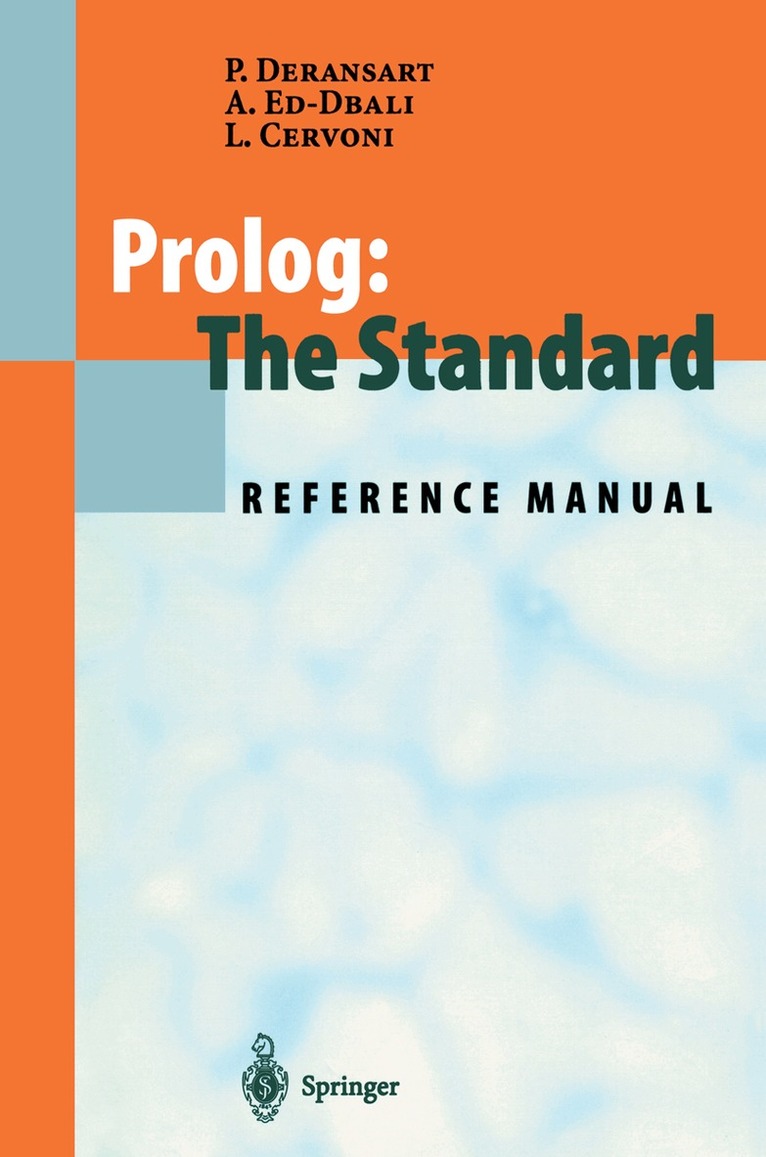
    Prolog: The Standard

    Reference Manual

    AvPierre Deransart,AbdelAli Ed-Dbali

    Häftad, Engelska, 1996

    1 194 kr

    Beställningsvara. Skickas inom 10-15 vardagar. Fri frakt över 249 kr.

    Beskrivning

    From the viewpoint of an "industrial" this book is most welcome, as one of the most significant demonstrations of the maturity of Prolog. Logic programming is a fascinating area in computer science, which held for years - and still does - the promise of freeing ourselves from programming based on the "Von Neumann" machine. In addition computer programming has long been for solid theoretical foundations. While conventional engineering, dealing mainly with "analogical complexity", developed over some hundred years a complete body of mathematical tools, no such toolset was available for "digital complexity". The only mathematical discipline which deals with digital complexity is logic and Prolog is certainly the operational tool which comes closest to the logical programming ideal. So, why does Prolog, despite nearly twenty years of development, still appear to many today to be more of a research or academic tool, rather than an industrial programming language? A few reasons may explain this: First, I think Prolog suffers from having been largely assimilated into - and thus followed the fate of - Artificial Intelligence. Much hype in the late 1980 created overexpectations and failed to deliver, and the counterreaction threw both AI and Prolog into relative obscurity. In a way, maybe this is a new chance for the Prolog community: the ability to carry out real work and progress without the disturbance of limelights and the unrealistic claims of various gurus. Second, programming in Prolog is a new experience for computer professionals.

    Produktinformation

    • Utgivningsdatum:1996-04-15
    • Mått:155 x 235 x 16 mm
    • Vikt:446 g
    • Format:Häftad
    • Språk:Engelska
    • Antal sidor:272
    • Förlag:Springer-Verlag Berlin and Heidelberg GmbH & Co. KG
    • Medarbetare:C. Biro
    • ISBN:9783540593041

    Utforska kategorier

    • Maskinteknik och material inom Naturvetenskap och teknik
    • Programspråk inom Data och IT

    Innehållsförteckning

    • 1. Introduction.- 2. Prolog Data Structures.- 2.1 Terms.- 2.2 Some particular terms.- 3. Prolog Unification.- 3.1 Substitutions.- 3.2 Unifiers.- 3.3 The definition of the unification in Standard Prolog.- 4. Prolog Execution Model.- 4.1 Database and environment.- 4.2 The execution model for definite Prolog.- 4.3 The execution model for Standard Prolog.- 4.4 Additional error situations.- 4.5 The side-effects of cut.- 5. The Built-in Predicates.- 5.1 Presentation.- 5.2 Templates.- 5.3 The built-in predicates.- 6. Prolog Arithmetic.- 6.1 Arithmetic expressions.- 6.2 Expression evaluation.- 7. Prolog Environment: Sources and Sinks.- 7.1 Overview.- 7.2 Streams in Standard Prolog.- 7.3 Properties of the streams.- 7.4 Inputting and outputting terms.- 8. Prolog Flags and Directives.- 8.1 Unchangeable flags.- 8.2 Changeable flags.- 8.3 Directives for initialising flags and tables.- 8.4 Directives for preparation of Prolog texts and goals.- 9. Prolog Syntax.- 9.1 Character sets and character conversion table.- 9.2 Expression and operator table.- 9.3 Presentation of the syntax.- 9.4 Syntax of Prolog text.- 9.5 Syntax of read-term.- 9.6 Syntax errors.- 10. Writing Portable Programs.- 10.1 Unification.- 10.2 The database update view.- 11. Annexes.- 11.1 Compliance.- 11.2 The ftp package.- 11.3 Elements of lexical analysis.- 11.4 ASCII table.- 11.5 Glossary of auxiliary concepts.- Thematic classification of the built-in predicates.