• Fri frakt över 249 kr
  • •
  • Snabba leveranser
  • •
  • Billiga böcker
Kundservice

Du är på sajten för privatpersoner.

Företag, bibliotek eller offentlig verksamhet?

Du handlar på classic.bokus.com, där alla dina funktioner finns intakta.
Till classic.bokus.com
Bokus logotyp. Gå till startsidan.
  • Erbjudanden
  • Student
  • Topplistor
  • Barn & ungdom
  • Bokus Play
  • Bokus Play
  • E-böcker
  • Ljudböcker
  • Pocketböcker
  • Spel & pussel

10% rabatt på allt med kod NYSTART10 →

Sidfot

Mina sidor

    Hjälp

    • Kundservice
    • Vanliga frågor och svar
    • Frakt och leverans
    • Retur vid ångerrätt
    • Reklamera vara
    • Betalning
    • Köpvillkor
    • Allmänna villkor
    • Information om webbplatsens tillgänglighet

    Om Bokus

    • Om oss
    • Pressrum
    • För studenter
    • För företag
    • För bibliotek och offentlig verksamhet
    • För leverantörer
    • Hållbarhet

    Populärt

    • Aktuella erbjudanden
    • Presentkort
    • Studentlitteratur
    • Nya böcker
    • Topplistor
    • Signerade böcker
    • Engelska böcker

    Inspiration

    • Boktips
    • BookTok
    • Populära bokserier
    • Barnbokskaraktärer
    • Populära författare
    Logotyp för Bokus
    Följ oss på Facebook (extern länk)Följ oss på Instagram (extern länk)Följ oss på YouTube (extern länk)Följ oss på TikTok (extern länk)
    bokus @ CookiesAnpassa cookiesIntegritetspolicyKöpvillkor
    Till Citymail hemsida (extern länk)Till Budbee hemsida (extern länk)Till Postnord hemsida (extern länk)Till Schenker hemsida (extern länk)Till Early Bird hemsida (extern länk)Till Walleys hemsida (extern länk)
    1. Data och IT
    2. Systemvetenskap och AI

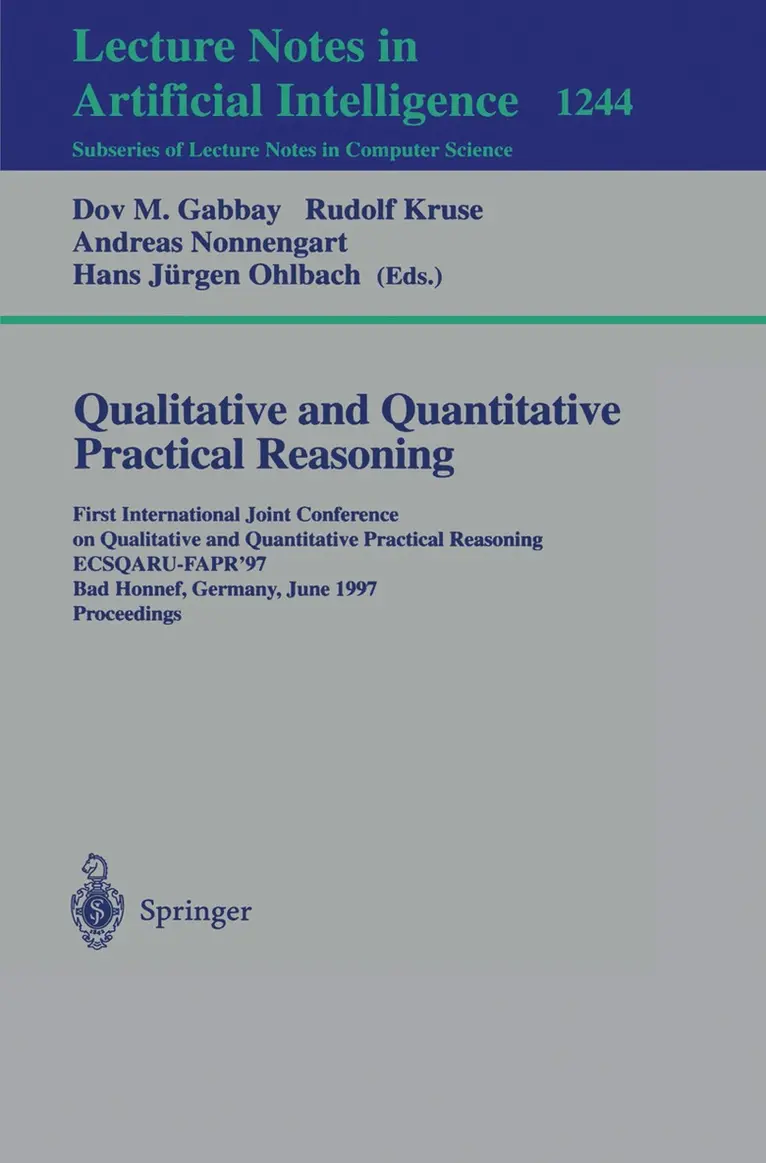
    Qualitative and Quantitative Practical Reasoning

    First International Joint Conference on Qualitative and Quantitative Practical Reasoning, ECSQARU-FAPR'97, Bad Honnef, Germany, June 9-12, 1997 Proceedings

    AvDov Gabbay,Rudolf Kruse

    Häftad, Engelska, 1997

    Del i serien Lecture Notes in Computer Science

    1 084 kr

    Beställningsvara. Skickas inom 10-15 vardagar. Fri frakt över 249 kr.

    Beskrivning

    This book constitutes the refereed proceedings of the First International Joint Conference on Qualitative and Quantitative Practical Reasoning, ECSQARU-FAPR'97, held in Bad Honnef, Germany, in June 1997.The volume presents 33 revised full papers carefully selected for inclusion in the book by the program committee as well as 12 invited contributions. Among the various aspects of human practical reasoning addressed in the papers are nonmonotonic logics, default reasoning, modal logics, belief function theory, Bayesian networks, fuzzy logic, possibility theory, inference algorithms, dynamic reasoning with partial models, and user modeling approaches.

    Produktinformation

    • Utgivningsdatum:1997-05-28
    • Mått:155 x 235 x 35 mm
    • Vikt:961 g
    • Format:Häftad
    • Språk:Engelska
    • Serie:Lecture Notes in Computer Science
    • Antal sidor:626
    • Upplaga:1997
    • Förlag:Springer-Verlag Berlin and Heidelberg GmbH & Co. KG
    • ISBN:9783540630951

    Utforska kategorier

    • Systemvetenskap och AI inom Data och IT
    • Matematikens grunder inom Naturvetenskap och teknik
    • Filosofiska discipliner inom Filosofi och religion

    Innehållsförteckning

    • Multisensor data fusion in situation assessment processes.- Dependency mining in relational databases.- Syntactic combination of uncertain information: A possibilistic approach.- A coherence-based approach to default reasoning.- A syntactical approach to data fusion.- Some experimental results on learning probabilistic and possibilistic networks with different evaluation measures.- Information fusion in logic: A brief overview.- Focusing vs. belief revision: A fundamental distinction when dealing with generic knowledge.- Background and perspectives of possibilistic graphical models.- Checking several forms of consistency in nonmonotonic knowledge-bases.- The ?-junctions: Combination operators applicable to belief functions.- Just how stupid is postmodernism?.- Integrating preference orderings into argument-based reasoning.- Assumption-based modeling using ABEL.- Propositional quantification for conditional logic.- Fast-division architecture for Dempster-Shafer belief functions.- Graduality by means of analogical reasoning.- Reasoning about unpredicted change and explicit time.- Non-elementary speed-ups in default reasoning.- A compositional reasoning system for executing nonmonotonic theories of reasoning.- Structured belief bases: A practical approach to prioritised base revision.- Entrenchment relations: A uniform approach to nonmonotonicity.- A modal logic for reasoning about knowledge and time on binary subset trees.- How to change factual beliefs using laws and dependence information.- Using default logic for lexical knowledge.- A layered, any time approach to sensor validation.- TreeNets: A framework for anytime evaluation of belief networks.- A logically sound method for uncertain reasoning with quantified conditionals.- Belief functions with nonstandardvalues.- Error tolerance method in multiple-valued logic.- Representing and reasoning with events from natural language.- Reasoning about security: A logic and a decision method for role-based access control.- Process modeling with different qualities of knowledge.- A Fuzzy analysis of linguistic negation of nuanced property in Knowledge-Based systems.- Normative argumentation and qualitative probability.- Towards a formalization of narratives: Actions with duration, concurrent actions and qualifications.- Multiple subarguments in logic, argumentation, rhetoric and text generation.- Cactus: A branching-time logic programming language.- Creating prototypes for fast classification in Dempster-Shafer clustering.- Probabilistic default logic based on irrelevance and relevance assumptions.- Logic for two: The semantics of distributive substructural logics.- Multivalued extension of conditional belief functions.- Combining evidence under partial ignorance.- Rational Default Quantifier Logic.- Disjunctive update, minimal change, and default reasoning.- Toward a uniform logical representation of different kinds of integrity constraints.