• Fri frakt över 249 kr
  • •
  • Snabba leveranser
  • •
  • Billiga böcker
Kundservice

Du är på sajten för privatpersoner.

Företag, bibliotek eller offentlig verksamhet?

Du handlar på classic.bokus.com, där alla dina funktioner finns intakta.
Till classic.bokus.com
Bokus logotyp. Gå till startsidan.
  • Erbjudanden
  • Nyheter
  • Student
  • Topplistor
  • Barn & ungdom
  • Bokus Play
  • E-böcker
  • Pocketböcker
  • Spel & pussel

10% rabatt på allt med kod NYSTART10 →

Sidfot

Mina sidor

    Hjälp

    • Kundservice
    • Vanliga frågor och svar
    • Frakt och leverans
    • Retur vid ångerrätt
    • Reklamera vara
    • Betalning
    • Köpvillkor
    • Allmänna villkor
    • Information om webbplatsens tillgänglighet

    Om Bokus

    • Om oss
    • Pressrum
    • För studenter
    • För företag
    • För bibliotek och offentlig verksamhet
    • För leverantörer
    • Hållbarhet

    Populärt

    • Aktuella erbjudanden
    • Presentkort
    • Studentlitteratur
    • Nya böcker
    • Topplistor
    • Signerade böcker
    • Engelska böcker

    Inspiration

    • Boktips
    • BookTok
    • Populära bokserier
    • Barnbokskaraktärer
    • Populära författare
    Logotyp för Bokus
    Följ oss på Facebook (extern länk)Följ oss på Instagram (extern länk)Följ oss på YouTube (extern länk)Följ oss på TikTok (extern länk)
    bokus @ CookiesAnpassa cookiesIntegritetspolicyKöpvillkor
    Till Citymail hemsida (extern länk)Till Budbee hemsida (extern länk)Till Postnord hemsida (extern länk)Till Schenker hemsida (extern länk)Till Early Bird hemsida (extern länk)Till Walleys hemsida (extern länk)
    1. Naturvetenskap och teknik
    2. Matematik och naturvetenskap
    3. Matematik
    4. Tillämpad matematik

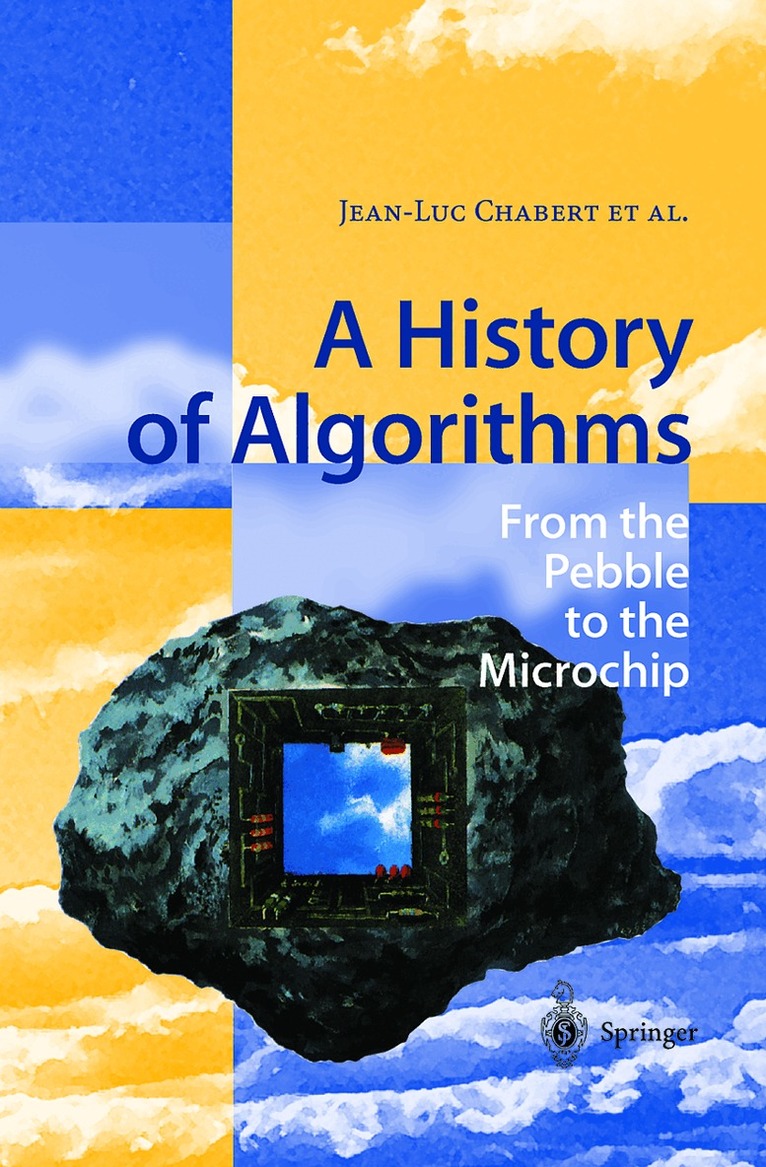
    History of Algorithms

    From the Pebble to the Microchip

    AvJean-Luc Chabert

    Häftad, Engelska, 1999

    1 086 kr

    Beställningsvara. Skickas inom 5-8 vardagar. Fri frakt över 249 kr.

    Beskrivning

    A Source Book for the History of Mathematics, but one which offers a different perspective by focusinng on algorithms. With the development of computing has come an awakening of interest in algorithms. Often neglected by historians and modern scientists, more concerned with the nature of concepts, algorithmic procedures turn out to have been instrumental in the development of fundamental ideas: practice led to theory just as much as the other way round. The purpose of this book is to offer a historical background to contemporary algorithmic practice.

    Produktinformation

    • Utgivningsdatum:1999-08-20
    • Mått:155 x 235 x 29 mm
    • Vikt:803 g
    • Format:Häftad
    • Språk:Engelska
    • Antal sidor:524
    • Upplaga:1999
    • Förlag:Springer-Verlag Berlin and Heidelberg GmbH & Co. KG
    • ISBN:9783540633693
    • Översättare:C. Weeks

    Utforska kategorier

    • Tillämpad matematik inom Naturvetenskap och teknik

    Innehållsförteckning

    • 1 Algorithms for Arithmetic Operations.- 1.1 Sumerian Division.- 1.2 A Babylonian Algorithm for Calculating Inverses.- 1.3 Egyptian Algorithms for Arithmetic.- 1.4 Tableau Multiplication.- 1.5 Optimising Calculations.- 1.6 Simple Division by Difference on a Counting Board.- 1.7 Division on the Chinese Abacus.- 1.8 Numbers Written as Decimals.- 1.9 Binary Arithmetic.- 1.10 Computer Arithmetic.- 2 Magic Squares.- Squares with Borders.- The Marking Cells Method.- Proceeding by 2 and by 3.- Arnauld's Borders Method.- 3 Methods of False Position.- 3.1 Mesopotamia: a Geometric False Position.- 3.2 Egypt: Problem 26 of the Rhind Papyrus.- 3.3 China: Chapter VII of the Jiuzhang Suanshu.- 3.4 India: Bh?skara and the Rule of Simple False Position.- 3.5 Qust? Ibn L?q?: A Geometric Justification.- 3.6 Ibn al-Bann?: The Method of the Scales.- 3.7 Fibonacci: the Elchatayn rule.- 3.8 Pellos: The Rule of Three and The Method of Simple False Position.- 3.9 Clavius: Solving a System of Equations.- 4 Euclid's Algorithm.- 4.1 Euclid's Algorithm.- 118 Comparing Ratios.- 4.3 Bézout's Identity.- 4.4 Continued Fractions.- 4.5 The Number of Roots of an Equation.- 5 From Measuring the Circle to Calculating ?.- Geometric Approaches.- 5.1 The Circumference of the Circle.- 5.2 The Area of the Circle in the Jiuzhang Suanshu.- 5.3 The Method of Isoperimeters.- Analytic Approaches.- 5.4 Arithmetic Quadrature.- 5.5 Using Series.- 5.6 Epilogue.- 6 Newton's Methods.- The Tangent Method.- 6.1 Straight Line Approximations.- 6.2 Recurrence Formulas.- 6.3 Initial Conditions.- 6.4 Measure of Convergence.- 6.5 Complex Roots.- Newton's Polygon.- 6.6 The Ruler and Small Parallelograms.- Solving Equations by Successive Approximations.- Extraction of Square Roots.- 7.1 The Method of Heron of Alexandria.-7.2 The Method of Theon of Alexandria.- 7.3 Mediaeval Binomial Algorithms.- Numerical Solutions of Equations.- 7.4 Al-T?si’s Tables.- 7.5 Viète's Method.- 7.6 Kepler's Equation.- 7.7 Bernoulli's Method of Recurrent Series.- 7.8 Approximation by Continued Fractions.- Horner like Transformations of Polynomial Equations.- 7.9 The Ruffini-Budan Schema.- Algorithms in Arithmetic.- Factors and Multiples.- 8.1 The Sieve of Eratosthenes.- 8.2 Criteria For Divisibility.- 8.3 Quadratic Residues.- Tests for Primality.- 8.4 The Converse of Fermat's Theorem.- 8.5 The Lucas Test.- 8.6 Pépin'sTest.- Factorisation Algorithms.- 8.7 Factorisation by the Difference of Two Squares.- 8.8 Factorisation by Quadratic Residues.- 8.9 Factorisation by Continued Fractions.- The Pell-Fermat Equation.- 8.10 The Arithmetica of Diophantus.- 8.11 The Lagrange Result.- Solving Systems of Linear Equations.- 9.1 Cramer's Rule.- 9.2 The Method of Least Squares.- 9.3 The Gauss Pivot Method.- 9.4 A Gauss Iterative Method.- 9.5 Jacobi's Method.- 9.6 Seidel's Method.- 9.7 Nekrasov and the Rate of Convergence.- 9.8 Cholesky's Method.- 9.9 Epilogue.- 10 Tables and Interpolation.- 10.1 Ptolemy's Chord Tables.- 10.2 Briggs and Decimal Logarithms.- 10.3 The Gregory-Newton Formula.- 10.4 Newton's Interpolation Polynomial.- 10.5 The Lagrange Interpolation Polynomial.- 10.6 An Error Upper Bound.- 10.7 Neville's Algorithm.- Approximate Quadratures.- 11.1 Gregory's Formula.- 11.2 Newton's Three-Eighths Rule.- 11.3 The Newton-Cotes Formulas.- 11.4 Stirling's Correction Formulas.- 11.5 Simpson's Rule.- 11.6 The Gauss Quadrature Formulas.- 11.7 Chebyshev's Choice.- 11.8 Epilogue.- Approximate Solutions of Differential Equations.- 12.1 Euler's Method.- 12.2 The Existence of a Solution.- 12.3 Runge's Methods.- 12.4Heun's Methods.- 12.5 Kutta's Methods.- 12.6 John Adams and the Use of Finite Differences.- 12.7 Epilogue.- 13 Approximation of Functions.- Uniform Approximation.- 13.1 Taylor's Formula.- 13.2 The Lagrange Remainder.- 13.3 Chebyshev's Polynomial of Best Approximation.- 13.4 Spline-Fitting.- Mean Quadratic Approximation.- 13.5 Fourier Series.- 13.6 The Fast Fourier Transform.- 14 Acceleration of Convergence.- 14.1 Stirling's Method for Series.- 14.2 The Euler-Maclaurin Summation Formula.- 14.3 The Euler Constant.- 14.4 Aitken's Method.- 14.5 Richardson's Extrapolation Method.- 14.6 Romberg's Integration Method.- 15 Towards the Concept of Algorithm.- Recursive Functions and Computable Functions.- 15.1 The 1931 Definition.- 15.2 General Gödel Recursive Functions.- 15.3 Alonzo Church and Effective Calculability.- 15.4 Recursive Functions in the Kleene Sense.- Machines.- 15.5 The Turing Machine.- 15.6 Post's Machine.- 15.7 Conclusion.- Biographies.- General Index.- Index of Names.