• Fri frakt över 249 kr
  • •
  • Snabba leveranser
  • •
  • Billiga böcker
Kundservice

Du är på sajten för privatpersoner.

Företag, bibliotek eller offentlig verksamhet?

Du handlar på classic.bokus.com, där alla dina funktioner finns intakta.
Till classic.bokus.com
Bokus logotyp. Gå till startsidan.
  • Erbjudanden
  • Student
  • Topplistor
  • Barn & ungdom
  • Bokus Play
  • E-böcker
  • Ljudböcker
  • Pocketböcker
  • Spel och pussel

5% studentrabatt – använd koden KURSBOK27 →

Sidfot

Mina sidor

    Hjälp

    • Kundservice
    • Vanliga frågor och svar
    • Frakt och leverans
    • Retur vid ångerrätt
    • Reklamera vara
    • Betalning
    • Köpvillkor
    • Allmänna villkor
    • Information om webbplatsens tillgänglighet

    Om Bokus

    • Om oss
    • Pressrum
    • För studenter
    • För företag
    • För bibliotek och offentlig verksamhet
    • För leverantörer
    • Hållbarhet

    Populärt

    • Aktuella erbjudanden
    • Presentkort
    • Studentlitteratur
    • Nya böcker
    • Topplistor
    • Signerade böcker
    • Engelska böcker

    Inspiration

    • Boktips
    • BookTok
    • Barnbokskaraktärer
    • Populära författare
    Logotyp för Bokus
    Följ oss på Facebook (extern länk)Följ oss på Instagram (extern länk)Följ oss på YouTube (extern länk)Följ oss på TikTok (extern länk)
    bokus @ CookiesAnpassa cookiesIntegritetspolicyKöpvillkor
    Till Citymail hemsida (extern länk)Till Budbee hemsida (extern länk)Till Postnord hemsida (extern länk)Till Schenker hemsida (extern länk)Till Early Bird hemsida (extern länk)Till Walleys hemsida (extern länk)
    1. Data och IT
    2. Systemvetenskap och AI
    3. Artificiell intelligens

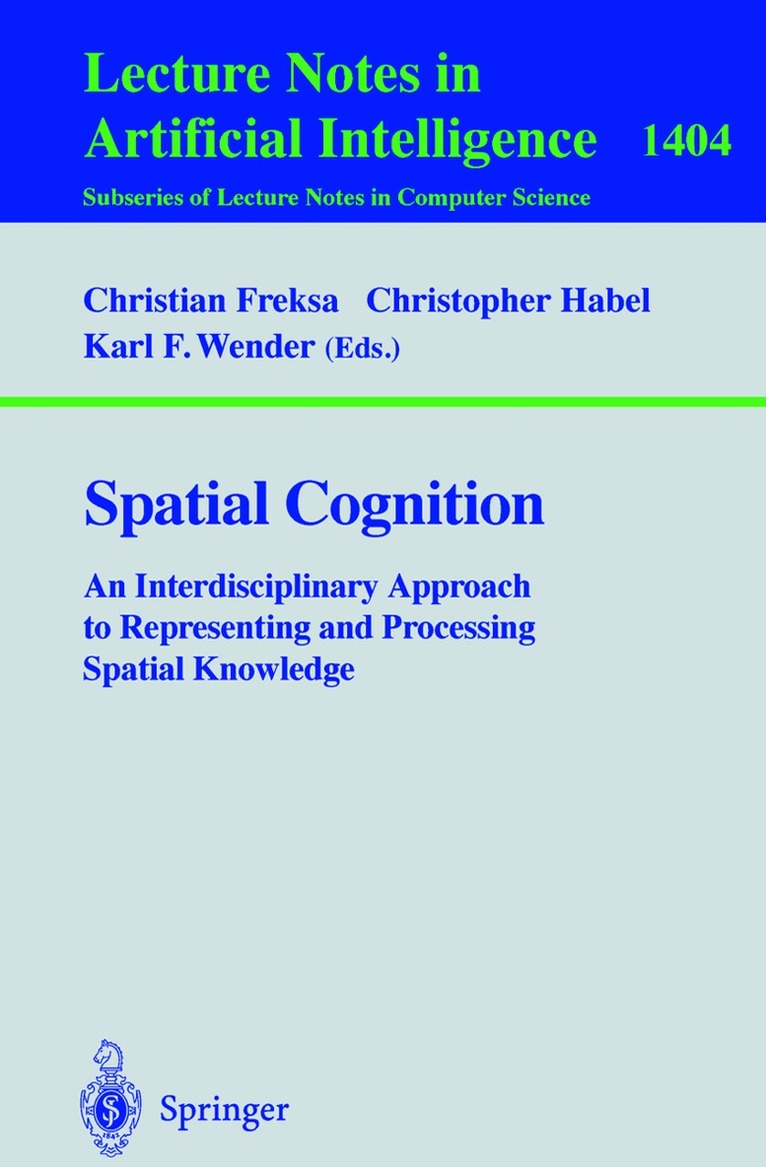
    Spatial Cognition

    An Interdisciplinary Approach to Representing and Processing Spatial Knowledge

    AvChristian Freksa,Christopher Habel

    Häftad, Engelska, 1998

    Del i serien Lecture Notes in Computer Science

    543 kr

    Beställningsvara. Skickas inom 10-15 vardagar. Fri frakt över 249 kr.

    Beskrivning

    Research on spatial cognition is a rapidly evolving interdisciplinary enterprise for the study of spatial representations and cognitive spatial processes, be they real or abstract, human or machine. Spatial cognition brings together a variety of - search methodologies: empirical investigations on human and animal orientation and navigation; studies of communicating spatial knowledge using language and graphical or other pictorial means; the development of formal models for r- resenting and processing spatial knowledge; and computer implementations to solve spatial problems, to simulate human or animal orientation and navigation behavior, or to reproduce spatial communication patterns. These approaches can interact in interesting and useful ways: Results from empirical studies call for formal explanations both of the underlying memory structures and of the processes operating upon them; we can develop and - plement operational computer models obeying the relationships between objects and events described by the formal models; we can empirically test the computer models under a variety of conditions, and we can compare the results to the - sults from the human or animal experiments. A disagreement between these results can provide useful indications towards the re nement of the models.

    Produktinformation

    • Utgivningsdatum:1998-05-25
    • Mått:155 x 235 x 28 mm
    • Vikt:755 g
    • Format:Häftad
    • Språk:Engelska
    • Serie:Lecture Notes in Computer Science
    • Antal sidor:489
    • Förlag:Springer-Verlag Berlin and Heidelberg GmbH & Co. KG
    • ISBN:9783540646037

    Utforska kategorier

    • Artificiell intelligens inom Data och IT
    • Geografi inom Naturvetenskap och teknik

    Innehållsförteckning

    • Spatial Knowledge Acquisition and Spatial Memory.- Allocentric and Egocentric Spatial Representations: Definitions, Distinctions, and Interconnections.- The Route Direction Effect and its Constraints.- Spatial Information and Actions.- The Impact of Exogenous Factors on Spatial Coding in Perception and Memory.- Judging Spatial Relations from Memory.- Relations between the mental representation of extrapersonal space and spatial behavior.- Representational Levels for the Perception of the Courses of Motion.- Formal and Linguistic Models.- How Space Structures Language.- Shape Nouns and Shape Concepts: A Geometry for ‘Corner’.- Typicality Effects in the Categorization of Spatial Relations.- The Use of Locative Expressions in Dependence of the Spatial Relation between Target and Reference Object in Two-Dimensional Layouts.- Reference Frames for Spatial Inference in Text Understanding.- Mental Models in Spatial Reasoning.- Formal Models for Cognition — Taxonomy of Spatial Location Description and Frames of Reference.- Spatial Representation with Aspect Maps.- A Hierarchy of Qualitative Representations for Space.- Spatial Reasoning with Topological Information.- Navigation in Real and Virtual Worlds.- A Taxonomy of Spatial Knowledge for Navigation and its Application to the Bremen Autonomous Wheelchair.- Human Place Learning in a Computer Generated Arena.- Spatial Orientation and Spatial Memory Within a ‘Locomotor Maze’ for Humans.- Behavioral experiments in spatial cognition using virtual reality.- Spatial orientation in virtual environments: Background considerations and experiments.