• Fri frakt över 249 kr
  • •
  • Snabba leveranser
  • •
  • Billiga böcker
Kundservice

Du är på sajten för privatpersoner.

Företag, bibliotek eller offentlig verksamhet?

Du handlar på classic.bokus.com, där alla dina funktioner finns intakta.
Till classic.bokus.com
Bokus logotyp. Gå till startsidan.
  • Erbjudanden
  • Nyheter
  • Student
  • Topplistor
  • Barn & ungdom
  • Bokus Play
  • E-böcker
  • Pocketböcker
  • Spel & pussel

10% rabatt på allt med kod NYSTART10 →

Sidfot

Mina sidor

    Hjälp

    • Kundservice
    • Vanliga frågor och svar
    • Frakt och leverans
    • Retur vid ångerrätt
    • Reklamera vara
    • Betalning
    • Köpvillkor
    • Allmänna villkor
    • Information om webbplatsens tillgänglighet

    Om Bokus

    • Om oss
    • Pressrum
    • För studenter
    • För företag
    • För bibliotek och offentlig verksamhet
    • För leverantörer
    • Hållbarhet

    Populärt

    • Aktuella erbjudanden
    • Presentkort
    • Studentlitteratur
    • Nya böcker
    • Topplistor
    • Signerade böcker
    • Engelska böcker

    Inspiration

    • Boktips
    • BookTok
    • Populära bokserier
    • Barnbokskaraktärer
    • Populära författare
    Logotyp för Bokus
    Följ oss på Facebook (extern länk)Följ oss på Instagram (extern länk)Följ oss på YouTube (extern länk)Följ oss på TikTok (extern länk)
    bokus @ CookiesAnpassa cookiesIntegritetspolicyKöpvillkor
    Till Citymail hemsida (extern länk)Till Budbee hemsida (extern länk)Till Postnord hemsida (extern länk)Till Schenker hemsida (extern länk)Till Early Bird hemsida (extern länk)Till Walleys hemsida (extern länk)
    1. Ekonomi och Ledarskap
    2. Nationalekonomi

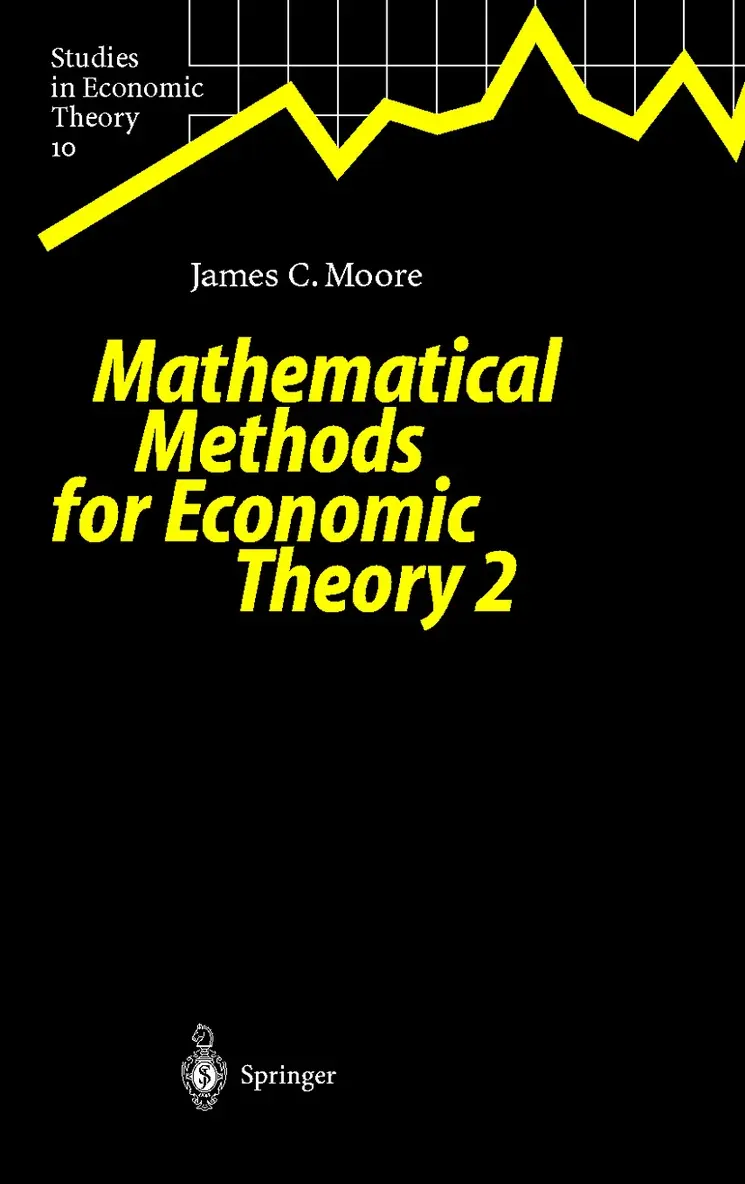
    Mathematical Methods for Economic Theory 2

    AvJames C. Moore

    Inbunden, Engelska, 1999

    Del 10 i serien Studies in Economic Theory

    546 kr

    Beställningsvara. Skickas inom 10-15 vardagar. Fri frakt över 249 kr.

    Fler format och utgåvor

    Häftad

    546 kr

    E-bok

    710 kr

    Beskrivning

    This is the second of a two-volume work intended to function as a textbook well as a reference work for economic for graduate students in economics, as scholars who are either working in theory, or who have a strong interest in economic theory. While it is not necessary that a student read the first volume before tackling this one, it may make things easier to have done so. In any case, the student undertaking a serious study of this volume should be familiar with the theories of continuity, convergence and convexity in Euclidean space, and have had a fairly sophisticated semester's work in Linear Algebra. While I have set forth my reasons for writing these volumes in the preface to Volume 1 of this work, it is perhaps in order to repeat that explanation here. I have undertaken this project for three principal reasons. In the first place, I have collected a number of results which are frequently useful in economics, but for which exact statements and proofs are rather difficult to find; for example, a number of results on convex sets and their separation by hyperplanes, some results on correspondences, and some results concerning support functions and their duals. Secondly, while the mathematical top­ ics taken up in these two volumes are generally taught somewhere in the mathematics curriculum, they are never (insofar as I am aware) done in a two-course sequence as they are arranged here.

    Produktinformation

    • Utgivningsdatum:1999-10-19
    • Mått:156 x 234 x 25 mm
    • Vikt:699 g
    • Format:Inbunden
    • Språk:Engelska
    • Serie:Studies in Economic Theory
    • Antal sidor:339
    • Upplaga:1999
    • Förlag:Springer-Verlag Berlin and Heidelberg GmbH & Co. KG
    • ISBN:9783540662426

    Utforska kategorier

    • Nationalekonomi inom Ekonomi och Ledarskap
    • Referensverk och tvärvetenskap inom Samhälle och politik
    • Topologi inom Naturvetenskap och teknik

    Innehållsförteckning

    • 7 An Introduction to Topology.- 8 Additional Topics in Topology.- 9 Correspondences.- 10 Banach Spaces.- 11 Topological Vector Spaces.- 12 Selection and Fixed Point Theorems.