• Fri frakt över 249 kr
  • •
  • Snabba leveranser
  • •
  • Billiga böcker
Kundservice

Du är på sajten för privatpersoner.

Företag, bibliotek eller offentlig verksamhet?

Du handlar på classic.bokus.com, där alla dina funktioner finns intakta.
Till classic.bokus.com
Bokus logotyp. Gå till startsidan.
  • Erbjudanden
  • Nyheter
  • Student
  • Topplistor
  • Barn & ungdom
  • Bokus Play
  • E-böcker
  • Pocketböcker
  • Spel & pussel

10% studentrabatt med kod TERM26

Sidfot

Mina sidor

    Hjälp

    • Kundservice
    • Vanliga frågor och svar
    • Frakt och leverans
    • Retur vid ångerrätt
    • Reklamera vara
    • Betalning
    • Köpvillkor
    • Allmänna villkor
    • Information om webbplatsens tillgänglighet

    Om Bokus

    • Om oss
    • Pressrum
    • För studenter
    • För företag
    • För bibliotek och offentlig verksamhet
    • För leverantörer
    • Hållbarhet

    Populärt

    • Aktuella erbjudanden
    • Presentkort
    • Studentlitteratur
    • Nya böcker
    • Topplistor
    • Signerade böcker
    • Engelska böcker

    Inspiration

    • Boktips
    • BookTok
    • Populära bokserier
    • Barnbokskaraktärer
    • Populära författare
    Logotyp för Bokus
    Följ oss på Facebook (extern länk)Följ oss på Instagram (extern länk)Följ oss på YouTube (extern länk)Följ oss på TikTok (extern länk)
    bokus @ CookiesAnpassa cookiesIntegritetspolicyKöpvillkor
    Till Citymail hemsida (extern länk)Till Budbee hemsida (extern länk)Till Postnord hemsida (extern länk)Till Schenker hemsida (extern länk)Till Early Bird hemsida (extern länk)Till Walleys hemsida (extern länk)
    1. Naturvetenskap och teknik
    2. Matematik och naturvetenskap
    3. Fysik

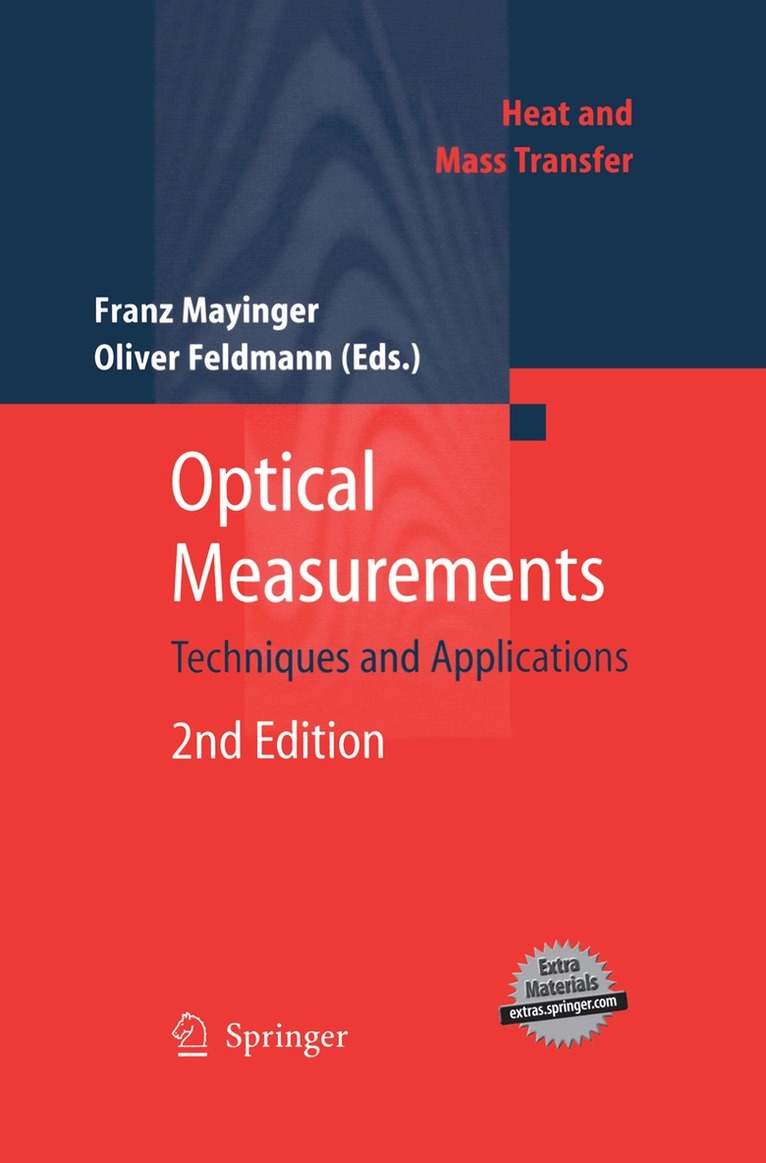
    Optical Measurements

    Techniques and Applications

    AvOliver Feldmann,F. Mayinger

    Inbunden, Engelska, 2001

    Del i serien Heat and Mass Transfer

    1 634 kr

    Beställningsvara. Skickas inom 10-15 vardagar. Fri frakt över 249 kr.

    Beskrivning

    Increasing possibilities of computer-aided data processing have caused a new revival of optical techniques in many areas of mechanical and chemical engi­ neering. Optical methods have a long tradition in heat and mass transfer and in fluid dynamics. Global experimental information is not sufficient for de­ veloping constitution equations to describe complicated phenomena in fluid dynamics or in transfer processes by a computer program. Furthermore, a detailed insight with high local and temporal resolution into the thermo­ and fluiddynamic situations is necessary. Sets of equations for computer program in thermo dynamics and fluid dynamics usually consist of two types of formulations: a first one derived from the conservation laws for mass, energy and momentum, and a second one mathematically modelling transport processes like laminar or turbulent diffusion. For reliably predicting the heat transfer, for example, the velocity and temperature field in the boundary layer must be known, or a physically realistic and widely valid correlation describing the turbulence must be avail­ able. For a better understanding of combustion processes it is necessary to know the local concentration and temperature just ahead of the flame and in the ignition zone.

    Produktinformation

    • Utgivningsdatum:2001-07-17
    • Mått:155 x 235 x undefined mm
    • Format:Inbunden
    • Språk:Engelska
    • Serie:Heat and Mass Transfer
    • Antal sidor:405
    • Upplaga:2
    • Förlag:Springer-Verlag Berlin and Heidelberg GmbH & Co. KG
    • ISBN:9783540666905

    Utforska kategorier

    • Fysik inom Naturvetenskap och teknik
    • Maskinteknik och material inom Naturvetenskap och teknik

    Innehållsförteckning

    • 1 Introduction.- 2 The Schlieren Technique.- 2.1 Introduction.- 2.2 Basic Principle.- 2.3 Optical and Thermodynamic Interrelations.- 2.4 Application of the Schlieren Technique.- 3 Fundamentals of Holography and Interferometry.- 3.1 Abstract.- 3.2 Introduction.- 3.3 Principle of Holography.- 3.4 Simple Holographic Arrangement.- 3.5 Holographic Interferometry.- 3.6 An Interference Method for Simultaneous Heat and Mass Transfer.- 3.7 Comparison with Classical Methods.- 4 Holographic Interferometry.- 4.1 Introduction.- 4.2 Components of a Holographic Interferometer.- 4.3 Evaluation of Interferograms.- 4.4 Examples.- 5 Short Time Holography.- 5.1 Introduction.- 5.2 Elements of holography.- 5.3 Application example: Dispersion characteristics in stirred bubble columns.- 6 Evaluation of holograms by digital image processing.- 6.1 Introduction.- 6.2 A digital image processing system for the evaluation of holographic reconstructions.- 6.3 Image processing.- 6.4 Evaluation of interferograms.- 7 Light Scattering.- 7.1 Introduction.- 7.2 Scattering Processes.- 7.3 Light Scattering Techniques in Heat Transfer.- 7.4 Concluding Remarks.- 8 Laser—Doppler Velocimetry.- 8.1 Introduction.- 8.2 Principles of LDV.- 8.3 Optics.- 8.4 Signal Processing.- 8.5 Seeding Particles.- 8.6 Determination of Characteristic Turbulence-Quantities.- 9 Phase Doppler Anemometry (PDA).- 9.1 Introduction.- 9.2 General considerations for the application of PDA.- 9.3 Principles of PDA.- 9.4 Measurement accuracy.- 9.5 Applications of PDA.- 10 Dynamic Light Scattering.- 10.1 Introduction.- 10.2 Overview.- 10.3 Light Scattering Theory.- 10.4 Experimental Methods.- 10.5 Measurement of Thermal Diffusivity.- 11 Raman Scattering.- 11.1 Introduction.- 11.2 Theoretical Basics of Raman Spectroscopy.- 11.3 Experimentalset-up.- 11.4 Selected Applications.- 11.5 Concluding Remarks.- 12 Laser induced Fluorescence.- 12.1 Introduction.- 12.2 Basic Principles of Laser Induced Fluorescence.- 12.3 Experimental Setup and Procedures.- 12.4 Selected Applications.- 12.5 Concluding Remarks.- 13 Absorption.- 13.1 Introduction.- 13.2 Line spectra.- 13.3 Experimental techniques.- 14 Pyrometry and Thermography.- 14.1 Introduction.- 14.2 Temperature Radiation.- 14.3 Method of Transmission.- 14.4 Radiation Receiver (Detector).- 14.5 Thermal Cameras — Thermography Image Systems.- 14.6 Pyrometers.- 14.7 Error Potential.- 14.8 Appendix.- 15 Tomography.- 15.1 Introduction.- 15.2 Integral Measurement Methods.- 15.3 Mathematical Reconstruction Methods.- 15.4 Implementations.- 16 Particle Image Velocimetry.- 16.1 Introduction.- 16.2 Hardware for the experimental set-up.- 16.3 Evaluation software.- 16.4 Three-dimensional flow.- 16.5 Applications.- Nomenclature.- References.