• Fri frakt över 249 kr
  • •
  • Snabba leveranser
  • •
  • Billiga böcker
Kundservice

Du är på sajten för privatpersoner.

Företag, bibliotek eller offentlig verksamhet?

Du handlar på classic.bokus.com, där alla dina funktioner finns intakta.
Till classic.bokus.com
Bokus logotyp. Gå till startsidan.
  • Erbjudanden
  • Student
  • Topplistor
  • Barn & ungdom
  • Bokus Play
  • E-böcker
  • Ljudböcker
  • Pocketböcker
  • Spel och pussel

5% studentrabatt – använd koden KURSBOK27 →

Sidfot

Mina sidor

    Hjälp

    • Kundservice
    • Vanliga frågor och svar
    • Frakt och leverans
    • Retur vid ångerrätt
    • Reklamera vara
    • Betalning
    • Köpvillkor
    • Allmänna villkor
    • Information om webbplatsens tillgänglighet

    Om Bokus

    • Om oss
    • Pressrum
    • För studenter
    • För företag
    • För bibliotek och offentlig verksamhet
    • För leverantörer
    • Hållbarhet

    Populärt

    • Aktuella erbjudanden
    • Presentkort
    • Studentlitteratur
    • Nya böcker
    • Topplistor
    • Signerade böcker
    • Engelska böcker

    Inspiration

    • Boktips
    • BookTok
    • Barnbokskaraktärer
    • Populära författare
    Logotyp för Bokus
    Följ oss på Facebook (extern länk)Följ oss på Instagram (extern länk)Följ oss på YouTube (extern länk)Följ oss på TikTok (extern länk)
    bokus @ CookiesAnpassa cookiesIntegritetspolicyKöpvillkor
    Till Citymail hemsida (extern länk)Till Budbee hemsida (extern länk)Till Postnord hemsida (extern länk)Till Schenker hemsida (extern länk)Till Early Bird hemsida (extern länk)Till Walleys hemsida (extern länk)
    1. Data och IT
    2. Programmeringsböcker

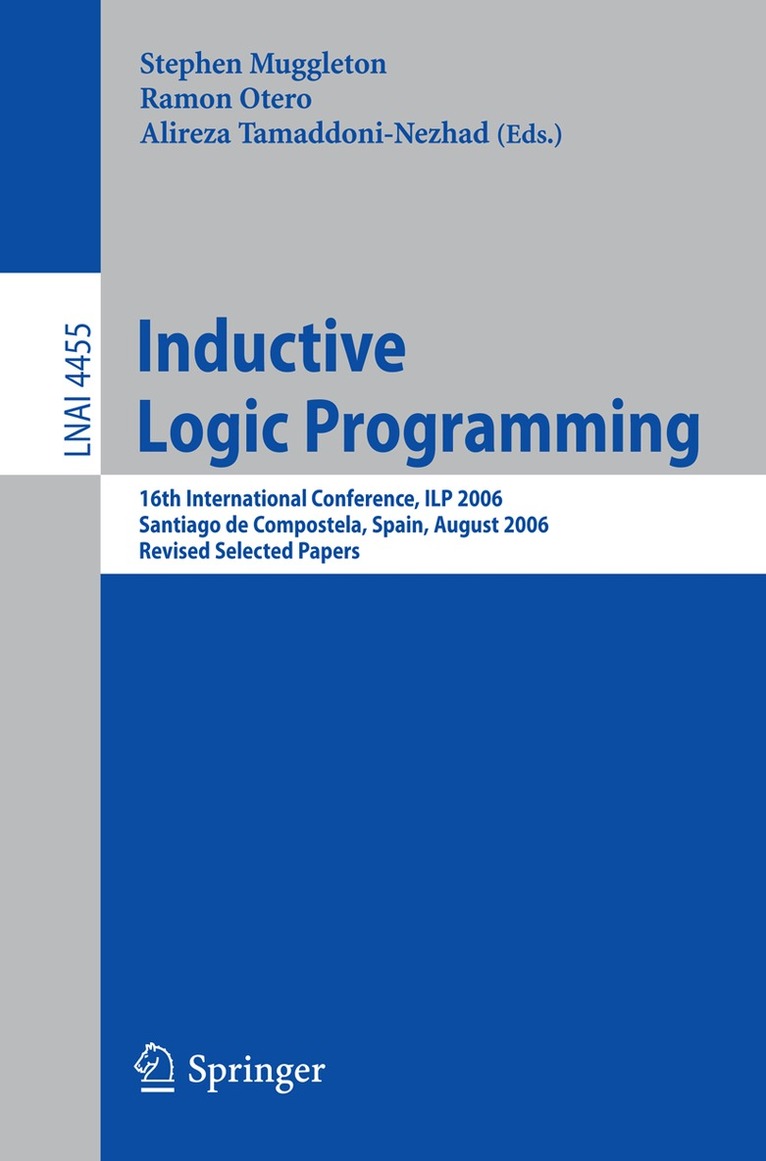
    Inductive Logic Programming

    16th International Conference, ILP 2006, Santiago de Compostela, Spain, August 24-27, 2006, Revised Selected Papers

    AvStephen Muggleton,Ramon Otero

    Häftad, Engelska, 2007

    Del i serien Lecture Notes in Computer Science

    559 kr

    Beställningsvara. Skickas inom 10-15 vardagar. Fri frakt över 249 kr.

    Beskrivning

    The inherent dangers of change are often summed up in the misquoted Chinese curse “May you live in interesting times.” The submission procedure for the 16th International Conference of Inductive Logic Programming (ILP 2006) was a radical (hopefully interesting but not cursed) departure from previous years. Submissions were requested in two phases. The ?rst phase involved submission of short papers (three pages) which were then presented at the conference and included in a short papers proceedings. In the second phase, reviewers selected papersforlongpapersubmission(15pagesmaximum).Thesewerethenassessed by the same reviewers, who then decided which papers to include in the journal special issue and proceedings. In the ?rst phase there were a record 77 papers, comparedto the usual20 orso long papersofpreviousyears.Eachpaper was- viewed by three reviewers. Out of these, 71 contributors were invited to submit long papers. Out of the long paper submissions, 7 were selected for the - chine Learning Journal special issue and 27 were accepted for the proceedings. In addition, two papers were nominated by Program Committee referees for the applications prize and two for the theory prize. The papers represent the div- sity and vitality in present ILP research including ILP theory, implementations, search and phase transition, distributed and large-scale learning, probabilistic ILP, biological applications, natural language learning and planning and action learning.

    Produktinformation

    • Utgivningsdatum:2007-07-27
    • Mått:155 x 235 x 30 mm
    • Vikt:802 g
    • Format:Häftad
    • Språk:Engelska
    • Serie:Lecture Notes in Computer Science
    • Antal sidor:456
    • Upplaga:2007
    • Förlag:Springer-Verlag Berlin and Heidelberg GmbH & Co. KG
    • ISBN:9783540738466

    Utforska kategorier

    • Programmeringsböcker inom Data och IT

    Innehållsförteckning

    • Invited Papers.- Actions, Causation and Logic Programming.- Challenges to Machine Learning: Relations Between Reality and Appearance.- First-Order Probabilistic Languages: Into the Unknown.- Integration of Learning and Reasoning Techniques.- Injecting Life with Computers.- Special Issue Extended Abstracts.- On the Connection Between the Phase Transition of the Covering Test and the Learning Success Rate.- Revising Probabilistic Prolog Programs.- Inductive Logic Programming for Gene Regulation Prediction.- QG/GA: A Stochastic Search for Progol.- Generalized Ordering-Search for Learning Directed Probabilistic Logical Models.- ALLPAD: Approximate Learning of Logic Programs with Annotated Disjunctions.- Margin-Based First-Order Rule Learning.- Research Papers.- Extension of the Top-Down Data-Driven Strategy to ILP.- Extracting Requirements from Scenarios with ILP.- Learning Recursive Patterns for Biomedical Information Extraction.- Towards Learning Non-recursive LPADs by Transforming Them into Bayesian Networks.- Multi-class Prediction Using Stochastic Logic Programs.- Structuring Natural Language Data by Learning Rewriting Rules.- An Efficient Algorithm for Computing Kernel Function Defined with Anti-unification.- Towards Automating Simulation-Based Design Verification Using ILP.- Minimal Distance-Based Generalisation Operators for First-Order Objects.- Efficient and Scalable Induction of Logic Programs Using a Deductive Database System.- Inductive Mercury Programming.- An ILP Refinement Operator for Biological Grammar Learning.- Combining Macro-operators with Control Knowledge.- Frequent Hypergraph Mining.- Induction of Fuzzy and Annotated Logic Programs.- Boosting Descriptive ILP for Predictive Learning in Bioinformatics.- Relational Sequence Alignments and Logos.- On the Missing Link Between Frequent Pattern Discovery and Concept Formation.- Learning Modal Theories.- A Mining Algorithm Using Property Items Extracted from Sampled Examples.- The Complexity of Translating BLPs to RMMs.- Inferring Regulatory Networks from Time Series Expression Data and Relational Data Via Inductive Logic Programming.- ILP Through Propositionalization and Stochastic k-Term DNF Learning.- ?-Subsumption Based on Object Context.- Word Sense Disambiguation Using Inductive Logic Programming.- ReMauve: A Relational Model Tree Learner.- Relational Data Mining Applied to Virtual Engineering of Product Designs.