• Fri frakt över 249 kr
  • •
  • Snabba leveranser
  • •
  • Billiga böcker
Kundservice

Du är på sajten för privatpersoner.

Företag, bibliotek eller offentlig verksamhet?

Du handlar på classic.bokus.com, där alla dina funktioner finns intakta.
Till classic.bokus.com
Bokus logotyp. Gå till startsidan.
  • Erbjudanden
  • Student
  • Topplistor
  • Barn & ungdom
  • Bokus Play
  • E-böcker
  • Ljudböcker
  • Pocketböcker
  • Spel och pussel

5% studentrabatt – använd koden KURSBOK27 →

Sidfot

Mina sidor

    Hjälp

    • Kundservice
    • Vanliga frågor och svar
    • Frakt och leverans
    • Retur vid ångerrätt
    • Reklamera vara
    • Betalning
    • Köpvillkor
    • Allmänna villkor
    • Information om webbplatsens tillgänglighet

    Om Bokus

    • Om oss
    • Pressrum
    • För studenter
    • För företag
    • För bibliotek och offentlig verksamhet
    • För leverantörer
    • Hållbarhet

    Populärt

    • Aktuella erbjudanden
    • Presentkort
    • Studentlitteratur
    • Nya böcker
    • Topplistor
    • Signerade böcker
    • Engelska böcker

    Inspiration

    • Boktips
    • BookTok
    • Barnbokskaraktärer
    • Populära författare
    Logotyp för Bokus
    Följ oss på Facebook (extern länk)Följ oss på Instagram (extern länk)Följ oss på YouTube (extern länk)Följ oss på TikTok (extern länk)
    bokus @ CookiesAnpassa cookiesIntegritetspolicyKöpvillkor
    Till Citymail hemsida (extern länk)Till Budbee hemsida (extern länk)Till Postnord hemsida (extern länk)Till Schenker hemsida (extern länk)Till Early Bird hemsida (extern länk)Till Walleys hemsida (extern länk)
    1. Data och IT
    2. Systemvetenskap och AI
    3. Artificiell intelligens

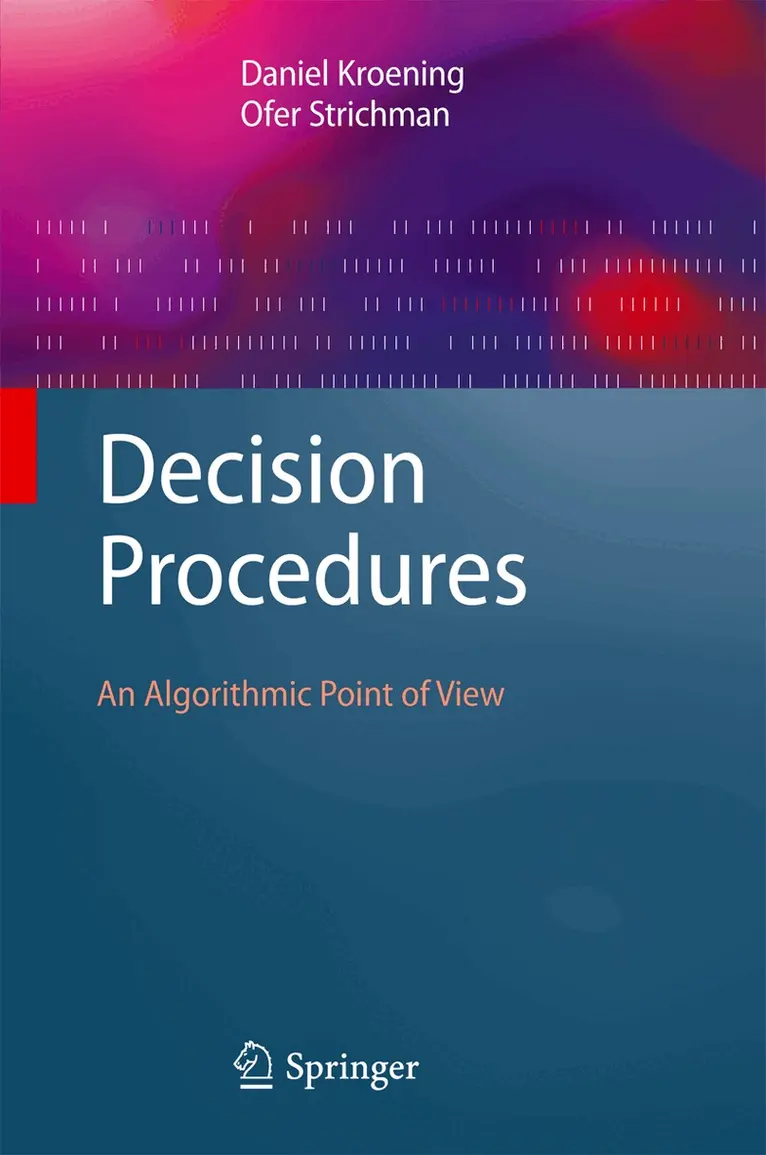
    Decision Procedures

    An Algorithmic Point of View

    AvDaniel Kroening,Ofer Strichman

    Inbunden, Engelska, 2008

    Del i serien Texts in Theoretical Computer Science. An EATCS Series

    911 kr

    Beställningsvara. Skickas inom 5-8 vardagar. Fri frakt över 249 kr.

    Fler format och utgåvor

    Häftad

    378 kr

    Inbunden

    551 kr

    Beskrivning

    A decision procedure is an algorithm that, given a decision problem, terminates with a correct yes/no answer. Here, the authors focus on theories that are expressive enough to model real problems, but are still decidable. Specifically, the book concentrates on decision procedures for first-order theories that are commonly used in automated verification and reasoning, theorem-proving, compiler optimization and operations research. The techniques described in the book draw from fields such as graph theory and logic, and are routinely used in industry. The authors introduce the basic terminology of satisfiability modulo theories and then, in separate chapters, study decision procedures for each of the following theories: propositional logic; equalities and uninterpreted functions; linear arithmetic; bit vectors; arrays; pointer logic; and quantified formulas. They also study the problem of deciding combined theories and dedicate a chapter to modern techniques based on an interplay between a SAT solver and a decision procedure for the investigated theory.This textbook has been used to teach undergraduate and graduate courses at ETH Zurich, at the Technion, Haifa, and at the University of Oxford. Each chapter includes a detailed bibliography and exercises. Lecturers' slides and a C++ library for rapid prototyping of decision procedures are available from the authors' website.

    Produktinformation

    • Utgivningsdatum:2008-05-23
    • Mått:155 x 235 x undefined mm
    • Format:Inbunden
    • Språk:Engelska
    • Serie:Texts in Theoretical Computer Science. An EATCS Series
    • Antal sidor:306
    • Förlag:Springer-Verlag Berlin and Heidelberg GmbH & Co. KG
    • Medarbetare:R.E. Bryant
    • ISBN:9783540741046

    Utforska kategorier

    • Artificiell intelligens inom Data och IT

    Recensioner i media

    From the reviews: "The topic of this book is decision procedures for first-order theories ... . it is one of the first to capture the essential concepts of SMT in a book. ... relevant to those wishing to understand the area today. ... the book more accessible to those without a strong background in mathematical logic." (Clark Barrett, Journal of Automated Reasoning, Vol. 51, 2013) "This book is a developed version of classroom notes for a course on decision procedures, intended for undergraduate and graduate students ... . The developments are intended for programmers who need to know about the algorithms that solve their particular problems, as well as for students and researchers who need to know how to define such algorithms in the framework of appropriate logics. ... Overall, the book is well structured ... ." (Siva Anantharaman, Mathematical Reviews, Issue 2009 m) "There are a number of things that I like about the book. Although the material is often complex, the exposition is extremely clear, precise and meticulous. A definition is almost always followed by a clarifying example. As noted above, Kroening and Strichman go to great efforts to explain the notations used. In fact, I'd be hard pressed to think of another text on an advanced subject that does so much to make the material accessible to the reader." (K. Harrow, ACM Computing Reviews, September, 2008) "This book has two topics as main points: 'decision procedures' and 'algorithms to be applied for these decisions'. ... Such an approach is very useful for graduate students or students in year four or five ... . Each chapter introduces and explains a lot of different concepts and presents good examples, some problems and exercises with algorithm-based solutions, and a glossary at its end, which makes the book very applicable and readable. ... The book is very well written and interesting to read." (Christian Posthoff, Zentralblatt MATH, Vol. 1149, 2008)

    Innehållsförteckning

    • and Basic Concepts.- Decision Procedures for Propositional Logic.- Equality Logic and Uninterpreted Functions.- Decision Procedures for Equality Logic and Uninterpreted Functions.- Linear Arithmetic.- Bit Vectors.- Arrays.- Pointer Logic.- Quantified Formulas.- Deciding a Combination of Theories.- Propositional Encodings.