• Fri frakt över 249 kr
  • •
  • Snabba leveranser
  • •
  • Billiga böcker
Kundservice

Du är på sajten för privatpersoner.

Företag, bibliotek eller offentlig verksamhet?

Du handlar på classic.bokus.com, där alla dina funktioner finns intakta.
Till classic.bokus.com
Bokus logotyp. Gå till startsidan.
  • Erbjudanden
  • Student
  • Topplistor
  • Barn & ungdom
  • Bokus Play
  • E-böcker
  • Ljudböcker
  • Pocketböcker
  • Spel och pussel

5% studentrabatt – använd koden KURSBOK27 →

Sidfot

Mina sidor

    Hjälp

    • Kundservice
    • Vanliga frågor och svar
    • Frakt och leverans
    • Retur vid ångerrätt
    • Reklamera vara
    • Betalning
    • Köpvillkor
    • Allmänna villkor
    • Information om webbplatsens tillgänglighet

    Om Bokus

    • Om oss
    • Pressrum
    • För studenter
    • För företag
    • För bibliotek och offentlig verksamhet
    • För leverantörer
    • Hållbarhet

    Populärt

    • Aktuella erbjudanden
    • Presentkort
    • Studentlitteratur
    • Nya böcker
    • Topplistor
    • Signerade böcker
    • Engelska böcker

    Inspiration

    • Boktips
    • BookTok
    • Barnbokskaraktärer
    • Populära författare
    Logotyp för Bokus
    Följ oss på Facebook (extern länk)Följ oss på Instagram (extern länk)Följ oss på YouTube (extern länk)Följ oss på TikTok (extern länk)
    bokus @ CookiesAnpassa cookiesIntegritetspolicyKöpvillkor
    Till Citymail hemsida (extern länk)Till Budbee hemsida (extern länk)Till Postnord hemsida (extern länk)Till Schenker hemsida (extern länk)Till Early Bird hemsida (extern länk)Till Walleys hemsida (extern länk)
    1. Språk och ordböcker
    2. Språkvetenskap och lingvistik

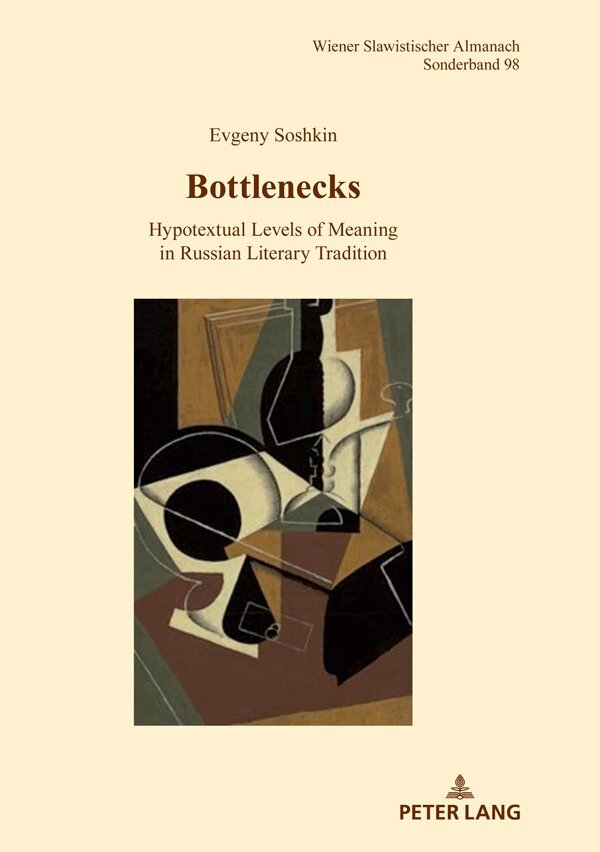
    Bottlenecks

    Hypotextual Levels of Meaning in Russian Literary Tradition

    AvEvgeny Soshkin,Aage A. Hansen-Löve

    Inbunden, Engelska, 2020

    Del 98 i serien Wiener Slawistischer Almanach - Sonderbaende

    843 kr

    Beställningsvara. Skickas inom 5-8 vardagar. Fri frakt över 249 kr.

    Beskrivning

    Why did Osip Mandelstam picture himself as a victim of anti-Semitic persecution, but at the same time described his victimizers using the grotesque features of Jews from anti-Semitic mythology? What was the meaning of Sasha Chorny’s pen name? Why were the Russian translators of Gargantua and Pantagruel steadily leaving out one phrase from the novel? Why did Alexander Pushkin use the same idiom in his fragments on Cleopatra, though in different contexts and referring to different things? What was the principle used by Leo Tolstoy when choosing one of the four patterns created by a diegetic or non-diegetic narrator and a personal or narratorial point of view? Why was the common knowledge about the tight alliance of the four post-symbolist poets – Osip Mandelstam, Marina Tsvetaeva, Boris Pasternak, and Anna Akhmatova – so enthusiastically appreciated by Akhmatova herself? Why in Nikolai Gogol’s The Overcoat the robbed Akaky Akakievich receives a kick in the butt but falls face-up? Which fairy-tale character does the name of the dwarf from Vladimir Nabokov’s short story The Potato Elf allude to? Each of these questions is reviewed in a separate chapter of this book, united by a uniform interpretation method, theoretically substantiated in the book’s foreword.

    Produktinformation

    • Utgivningsdatum:2020-05-08
    • Mått:148 x 210 x 0 mm
    • Vikt:362 g
    • Format:Inbunden
    • Språk:Engelska
    • Serie:Wiener Slawistischer Almanach - Sonderbaende
    • Antal sidor:222
    • Förlag:Peter Lang AG
    • ISBN:9783631821220

    Utforska kategorier

    • Språkvetenskap och lingvistik inom Språk och ordböcker
    • Litteraturvetenskap inom Skönlitteratur

    Mer om författaren

    Evgeny Soshkin holds a PhD from the Hebrew University in Jerusalem where he now participates in a collective research project. He is the author of the Russian language monograph Hypogrammar: A Book on Mandelstam (2015) as well as articles on literary theory, history, and poetics.

    Innehållsförteckning

    • Mandelstam, Khlebnikov, Sasha Chorny, Pushkin, Shakespeare, Rabelais, Bakhtin, Tolstoy, Shklovsky, Akhmatova, Pasternak, Tsvetaeva, Gogol, Plato, Nabokov, Hauff, Literary interpretation strategies, Anti-Semitism, Censorship, Estrangement, Four elements