• Fri frakt över 249 kr
  • •
  • Snabba leveranser
  • •
  • Billiga böcker
Kundservice

Du är på sajten för privatpersoner.

Företag, bibliotek eller offentlig verksamhet?

Du handlar på classic.bokus.com, där alla dina funktioner finns intakta.
Till classic.bokus.com
Bokus logotyp. Gå till startsidan.
  • Erbjudanden
  • Nyheter
  • Student
  • Topplistor
  • Barn & ungdom
  • Bokus Play
  • E-böcker
  • Pocketböcker
  • Spel & pussel

10% rabatt på allt med kod: NYSTART10 →

Sidfot

Mina sidor

    Hjälp

    • Kundservice
    • Vanliga frågor och svar
    • Frakt och leverans
    • Retur vid ångerrätt
    • Reklamera vara
    • Betalning
    • Köpvillkor
    • Allmänna villkor
    • Information om webbplatsens tillgänglighet

    Om Bokus

    • Om oss
    • Pressrum
    • För studenter
    • För företag
    • För bibliotek och offentlig verksamhet
    • För leverantörer
    • Hållbarhet

    Populärt

    • Aktuella erbjudanden
    • Presentkort
    • Studentlitteratur
    • Nya böcker
    • Topplistor
    • Signerade böcker
    • Engelska böcker

    Inspiration

    • Boktips
    • BookTok
    • Populära bokserier
    • Barnbokskaraktärer
    • Populära författare
    Logotyp för Bokus
    Följ oss på Facebook (extern länk)Följ oss på Instagram (extern länk)Följ oss på YouTube (extern länk)Följ oss på TikTok (extern länk)
    bokus @ CookiesAnpassa cookiesIntegritetspolicyKöpvillkor
    Till Citymail hemsida (extern länk)Till Budbee hemsida (extern länk)Till Postnord hemsida (extern länk)Till Schenker hemsida (extern länk)Till Early Bird hemsida (extern länk)Till Walleys hemsida (extern länk)
    1. Juridik
    2. Särskilda rättsområden
    3. Rättsordning

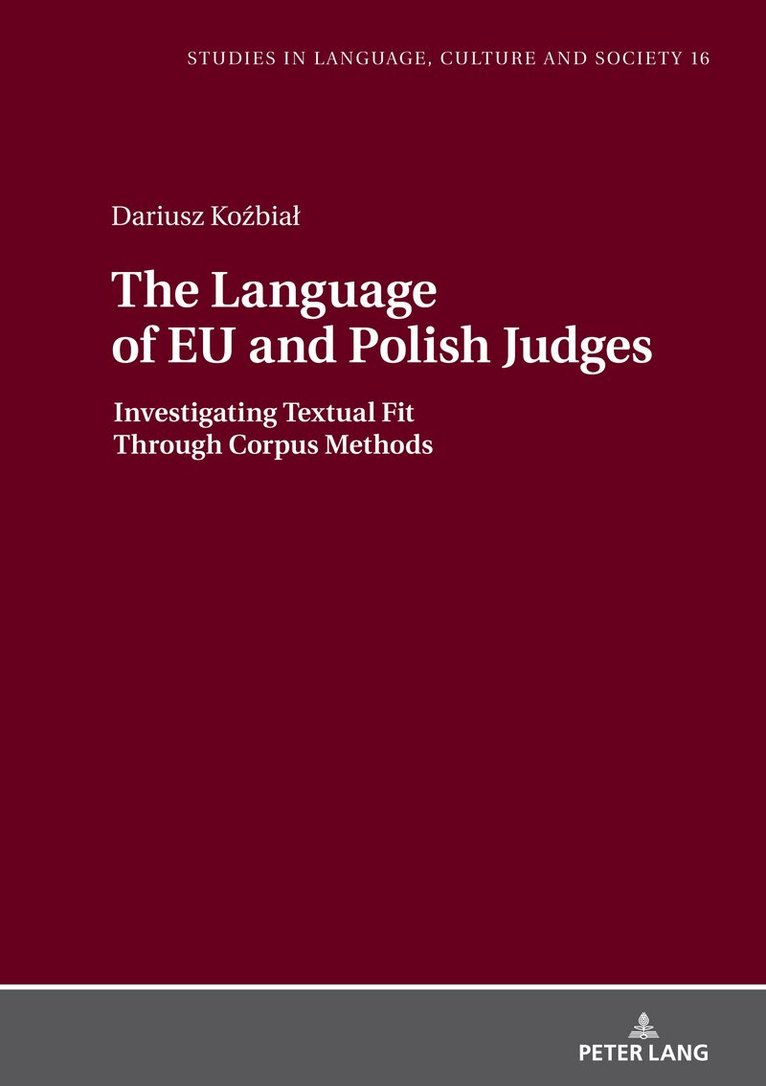
    Language of EU and Polish Judges

    Investigating Textual Fit Through Corpus Methods

    AvDariusz Koźbiał,Lucja Biel

    Inbunden, Engelska, 2020

    Del 16 i serien Studies in Language, Culture and Society

    723 kr

    Beställningsvara. Skickas inom 5-8 vardagar. Fri frakt över 249 kr.

    Beskrivning

    This book is an in-depth study of EU judicial language and its impact on the language of national judges. It is the first comprehensive study of the judicial variety of the Polish Eurolect. The book applies the intertextual relation of textual fit and corpora of EU and Polish judgments to empirically measure the linguistic distance between translations and non-translations. It analyzes both the level of genre macrostructure and the microstructure (lexis and grammar, formulaicity, terminology). This interdisciplinary monograph explores a distinct European, translation-shaped variety of judicial language which departs from the conventions of judicial Polish. The volume is essential reading for researchers in legal linguistics, legal translation and genre analysis.

    Produktinformation

    • Utgivningsdatum:2020-12-21
    • Mått:148 x 210 x 0 mm
    • Vikt:866 g
    • Format:Inbunden
    • Språk:Engelska
    • Serie:Studies in Language, Culture and Society
    • Antal sidor:628
    • Förlag:Peter Lang AG
    • ISBN:9783631822265

    Utforska kategorier

    • Rättsordning inom Juridik
    • Språkvetenskap och lingvistik inom Språk och ordböcker

    Mer om författaren

    Dariusz Koźbiał is a corpus linguist and a translation scholar. He was an investigator in the Polish Eurolect research project at the University of Warsaw, Poland. His work focuses on the analysis of judges’ discourse.

    Innehållsförteckning

    • Table of contentsList of tablesList of figuresAbbreviations and acronymsGlossing abbreviationsAcknowledgmentsIntroductionPart I. Theoretical backgroundChapter 1. Multilingualism and translation at the Court of Justice of the European Union1.1 Context of production of CJEU judgments: policy of multilingualism1.2 The translation process1.3 The translator profile: lawyer-linguistsChapter 2. Approach to genre analysis2.1 Genre, register, style, discourse (community), legal language — setting the scene for the analysis of judgments2.2 A mixed genre-register approach to the linguistic profiling of judgmentsChapter 3. Corpus-linguistic methodology and the operationalization of textual fit3.1 Corpus Linguistics as a methodology3.1.1 Corpus-based and corpus-driven approaches to the study of language3.1.2 Advantages and disadvantages of corpus methodology3.2 Multi-perspective framework for analysis of judicial language3.3 The relation of textual fit and its operationalizationPart II. Empirical studyChapter 4. Design of the JURIDIC corpus4.1 Corpus design4.2 Structure of the individual sub-corpora4.2.1 CJEU corpus4.2.2 SN corpus4.2.3 The National Corpus of Polish (NKJP)4.3 Representativeness, balance and comparability of the sub-corpora4.4 Software4.5 Normalization of corpus data and statistical measuresPart II.A Macro levelChapter 5. Contextual and macrostructural analysis of CJEU and SN judgments5.1 Contextual analysis of CJEU and SN judgments5.1.1 Situational characteristics5.1.2 Discourse participants5.1.3 Communicative purposes5.1.4 Communicative conventions5.2 Macrostructural analysis of CJEU and SN judgments5.2.1 Macro- and microstructure of CJEU judgments5.2.2 Macro- and microstructure of SN judgments5.3 ConclusionsPart II.B. Micro level: Pillar I — Lexico-grammatical patternsChapter 6. Analysis of chosen lexico-grammatical patterns6.1 Global comparison of corpora6.2 Analysis of keyword lists: identification of lexico-grammatical categories for further analysis6.3 Phraseological framing with prepositions6.3.1 Prepositions as a word class6.3.2 Distribution of simple prepositions6.3.3 Distribution of top 50 compound and secondary prepositions6.3.4 Grammaticalized discourse functions of compound and secondary prepositions6.3.4.1 Time6.3.4.2 Cause-effect, result, contravention and condition6.3.4.3 Reference6.4.4.4 Intra- and inter-textual reference6.3.4.5 Participation6.3.4.6 Modality6.3.4.7 Apposition6.3.4.8 Manner and instrumental relations6.3.4.9 Adversariality6.3.4.10 Measure6.3.4.11 Inclusivity/exclusivity6.3.4.12 Commutative relations6.3.4.13 Purpose6.3.4.14 Distribution6.3.4.15 Comparison6.3.4.16 Space relations6.3.4.17 Partitive relations6.3.4.18 Active relations6.3.5 Prepositions in judgments – summary6.4 Structurization of judicial arguments6.4.1 Parataxis6.4.2 Hypotaxis6.5 Deixis6.6 Depersonalization6.6.1 Auxiliary verbs6.6.2 Passive voice6.6.3 The siê impersonal pattern6.6.4 The –no/to impersonal pattern6.7 Legal reasoning and argumentation6.7.1 Verdictive, exercitive (argumentative) and reporting verbs6.7.2 Causal patterns6.7.3 If-then conditionals and related patterns6.7.4 Patterns of purpose6.8 Framing with adverbials and participles6.8.1 Adverbials6.8.2 ParticiplesPart II.C. Micro level: Pillar II — FormulaicityChapter 7. Lexical bundles7.1. Lexical bundles in the frequency-based (distributional) approach to phraseology7.2. Related studies and research questions7.3. Research material and methodology7.4. Overall distribution of 2–8–grams in judicial language7.5. Refinement of 3–4–grams7.5.1 Thematic classification into content and non-content bundles7.5.2 Overlap of 3– and 4–grams in the translation and non-translation corpora7.6. Functional classification of lexical bundles7.6.1 Referential bundles7.6.1.1 Agents/institutions7.6.1.2 Bundles denoting abstract concepts7.6.1.3 Bundles denoting documents7.6.1.4 Legal procedure bundles7.6.1.5 Dates7.6.1.6 Places7.6.2 Discourse-organizing bundles7.6.2.1 Intra-/Intertextual bundles7.6.2.2 Causative-resultative and inferential bundles7.6.2.3 Focus bundles7.6.2.4 Framing bundles7.6.2.5 Topic elaboration/clarification bundles7.6.2.6 Transition bundles7.6.2.7 Purpose bundles7.6.2.8 Conditional bundles7.6.3 Stance bundles7.6.3.1 Evaluative bundles7.6.3.2 Epistemic stance bundles7.7 Conclusions and implications for the futureChapter 8. Binomials8.1 Research material and methodology8.2 Binomials and multinomials8.2.1 Distribution of non-extended binomials8.2.2 Structural and semantic qualities of non-extended binomials8.2.3 Distribution of extended binomials8.2.4 Structural and semantic qualities of extended binomials8.2.5 Distribution and structural qualities of multinomials8.2.6 Functional typology of binomials8.3 ConclusionsPart II.D. Micro level: Pillar III —TerminologyChapter 9. Terms in the common conceptual base of EU and national judgments9.1 Key (EU and national) terminology-related terms9.2 Methodological approach and research material9.3 Global distribution and overlap of simple terms and complex terms9.4 Top 30 simple terms and top 15 complex terms9.5 Conceptual classification of node terms9.5.1 Agentive and institutional node terms and their environment9.5.2 Node terms related to substantive law and case-law and their environment9.5.3 Legal procedure node terms and their environment9.6 ConclusionsChapter 10. Latinisms10.1 Research material and methodology10.2 Distribution of Latinisms in the corpora10.3 Overlap of Latinisms between the corpora10.4 Repertoire of key Latinisms in the genre of judgments10.5 Degrees of textual integration and discourse functions of Latinisms10.6 ConclusionsChapter 11. Synthesis and conclusions11.1 Divergence of translated EU judgments from non-translated Polish judgments, internal variation within the Eurolect, and judicial Polish against general Polish11.1.1 Pillar I – Divergence at the lexico-grammatical level: CJ and GC vs SN_2011–2015, CJ vs GC, SN_2011–2015 vs NKJP11.1.2 Pillar II – Divergence at the phraseological level: CJ and GC vs SN_2011–2015, CJ vs GC11.1.3 Pillar III – Divergence at the terminological level: CJ and GC vs SN_2011–2015, CJ vs GC11.1.4 Possible causes of divergence and acceptability of translated language11.2 The limited impact of translated EU judgments on national judgments (microdiachronic language change) – 1999 vs 2011–201511.2.1 Pillar I – Microdiachronic change at the level of chosen lexico-grammatical features11.2.2 Pillar II – Microdiachronic change at the phraseological level11.2.3 Pillar III – Microdiachronic change at the terminological level11.3 Limitations of the study and suggestions for further research11.4 Practical applications of the studyBibliographyIndex