E-bok, Engelska, 2009
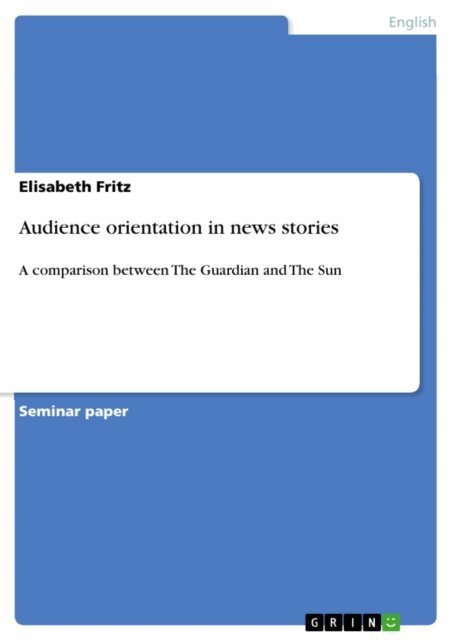
Audience orientation in news stories
255 kr
Läs direkt i Bokus Reader – eller ladda ned till din enhet (PDF kräver ofta zoom och scroll på små skärmar).
Beskrivning
Seminar paper from the year 2007 in the subject English Language and Literature Studies - Literature, grade: 1,3, University of Augsburg (Lehrstuhl für Englische Sprachwissenschaft), language: English, abstract: Every day new things happen. With modern technology, news can be distributed all over the world and faster than ever before. Additionally, the distribution of (and access to) news has become much cheaper. Consequently, the number of sources we can get information from has increased drastically throughout the last decades, as has the amount of information. In our modern information society, the mass media have come to play a decisive role. At the same time, it becomes more and more difficult to judge the reliability of the news. One of the oldest forms of mass media, which is still generally regarded as trustworthy, is the newspaper.When it comes to newspapers, people usually prefer one (or two) specific news¬papers to others. Every newspaper has its own specific image which includes some characteristics that it is generally known for. If all newspapers provided all the news there is and reported it in an objective manner, this would not make much sense. Indeed, with the amount of potential “news” emerging every day and the restrictions of the medium, it is impossible to cover everything – the newspapers must choose what to include in their coverage and what not to. Similarly, it is an illusion to expect news to be reported completely objectively. One reason for this is that the medium language inherently conveys connotations and values, which makes a purely objective coverage simply impossible. But apart from this restriction, it is a well-known fact that newspapers all have their particular perspective from which they contemplate and present news. However, this is not solely the newspapers’ choice. Since they are financially dependent on their readers who buy their issues, they have to do their best in order to meet their readerships’ interests. Considering that every newspaper has its own typical kind of readership, it should be possible to identify the means they use and analyse how they adapt to this specific group. This paper will analyse one specific news story which was published in the course of a few days in two newspapers known to write for opposite types of readers. The aim is to show how news can be reported differently and how these differences can be explained in terms of an orientation towards different kinds of audiences. Before the actual analysis, however, the communicative context of newspaper discourse will be briefly contrasted to face-to-face discourse with special reference to the role of its audience.
Produktinformation
- Utgivningsdatum: 2009-09-29
- Språk: Engelska
- Filformat: PDF
- Kopieringsskydd: LCP
- ISBN: 9783640434800
- Förlag: GRIN Verlag
Utforska kategorier
Betyg & recensioner
0 recensioner
Inga recensioner tillgängliga.