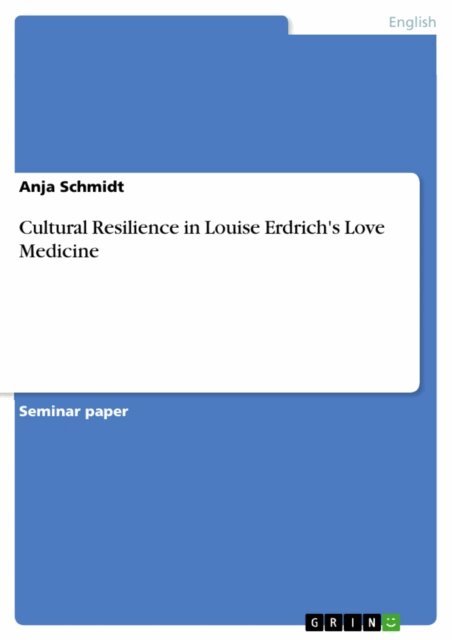
E-bok, Engelska, 2010
Cultural Resilience in Louise Erdrich's Love Medicine
Av Anja Schmidt
213 kr
Läs direkt i Bokus Reader – eller ladda ned till din enhet (PDF kräver ofta zoom och scroll på små skärmar).
Beskrivning
Seminar paper from the year 2005 in the subject American Studies - Literature, grade: 1,0, Humboldt-University of Berlin, language: English, abstract: Set on a North Dakota reservation, Louise Erdrich s novel Love Medicine1 is first of all afictitious story. Despite a writer s Indian heritage2 it is unsound to read novels as a trueaccounts of reservation life, yet it seems to me that Erdrich s depiction of Chippewa familiesincludes some issues that are very much part of American Indian reality. Federal and private agencies have made a series of depressing reports as to the condition ofAmerican Indian youth, both in the home and in their interaction with the judicial system. 3Sentences like this one are ubiquitous in sources not only on young American Indians. The problems usually mentioned are: Foetal Alcohol Syndrome, alcohol abuse, domesticviolence, gang violence, rape, unemployment, jobs with little chance of career growth,depression, suicide and teen pregnancy.4A number of explanations have been found. Historical trauma response (HTR) theory isbased on the hypothesis that when people were victims of cultural trauma, the aftereffects canbe passed down through the generations. 5 Variants of this are Transgenerational PostTraumatic Stress Disorder or soul wound. 6Another popular theory is that of internalized oppression. This theory states that Natives have been oppressed for hundreds of years and as a group have takeninto their own psyche the characteristics of the oppressors resulting in the tendency to oppressthemselves even in the absence of an identifiable external oppressor.7== == 1 Erdrich, Louise. Love Medicine. Hammersmith: Harper Perennial, 2004. 2 Louise Erdrich s mother is Ojibwe. 3 Fuller, Gary. A Snapshot Report on American Indian Youth and Families , in:http://www.ocbtracker.com/0007/snapshot.html. (taken Feb. 9th 2005). 4 Ibid. 5 Strand, Joyce; Peacock, Robert (eds.). Resource Guide: Cultural Resilience , in: Tribal College Journalhttp:/www.tribalcollegejournal.org/themag/backissues/summer2003/summer2003resource.html. (taken Feb. 2nd2005)6Kindya, Kenneth. Native mental health: Issues and challenges , in:http://www.indiancountry.com/content.cfm?id=1063901101 (taken Feb. 2nd 2005). 7 Ibid. This sounds like a variation of Stanley Elkins notorious Sambo-thesis widely repudiated by the Civil RightsMovement because it negates African Americans agency.
Produktinformation
- Utgivningsdatum: 2010-03-19
- Språk: Engelska
- Filformat: PDF
- Kopieringsskydd: LCP
- ISBN: 9783640569991
- Förlag: GRIN Verlag
Utforska kategorier
Betyg & recensioner
0 recensioner
Inga recensioner tillgängliga.