• Fri frakt över 249 kr
  • •
  • Snabba leveranser
  • •
  • Billiga böcker
Kundservice

Du är på sajten för privatpersoner.

Företag, bibliotek eller offentlig verksamhet?

Du handlar på classic.bokus.com, där alla dina funktioner finns intakta.
Till classic.bokus.com
Bokus logotyp. Gå till startsidan.
  • Erbjudanden
  • Nyheter
  • Student
  • Topplistor
  • Barn & ungdom
  • Bokus Play
  • E-böcker
  • Pocketböcker
  • Spel & pussel

10% rabatt på allt med kod: NYSTART10 →

Sidfot

Mina sidor

    Hjälp

    • Kundservice
    • Vanliga frågor och svar
    • Frakt och leverans
    • Retur vid ångerrätt
    • Reklamera vara
    • Betalning
    • Köpvillkor
    • Allmänna villkor
    • Information om webbplatsens tillgänglighet

    Om Bokus

    • Om oss
    • Pressrum
    • För studenter
    • För företag
    • För bibliotek och offentlig verksamhet
    • För leverantörer
    • Hållbarhet

    Populärt

    • Aktuella erbjudanden
    • Presentkort
    • Studentlitteratur
    • Nya böcker
    • Topplistor
    • Signerade böcker
    • Engelska böcker

    Inspiration

    • Boktips
    • BookTok
    • Populära bokserier
    • Barnbokskaraktärer
    • Populära författare
    Logotyp för Bokus
    Följ oss på Facebook (extern länk)Följ oss på Instagram (extern länk)Följ oss på YouTube (extern länk)Följ oss på TikTok (extern länk)
    bokus @ CookiesAnpassa cookiesIntegritetspolicyKöpvillkor
    Till Citymail hemsida (extern länk)Till Budbee hemsida (extern länk)Till Postnord hemsida (extern länk)Till Schenker hemsida (extern länk)Till Early Bird hemsida (extern länk)Till Walleys hemsida (extern länk)
    1. Naturvetenskap och teknik
    2. Matematik och naturvetenskap
    3. Kemi
    4. Fysikalisk kemi

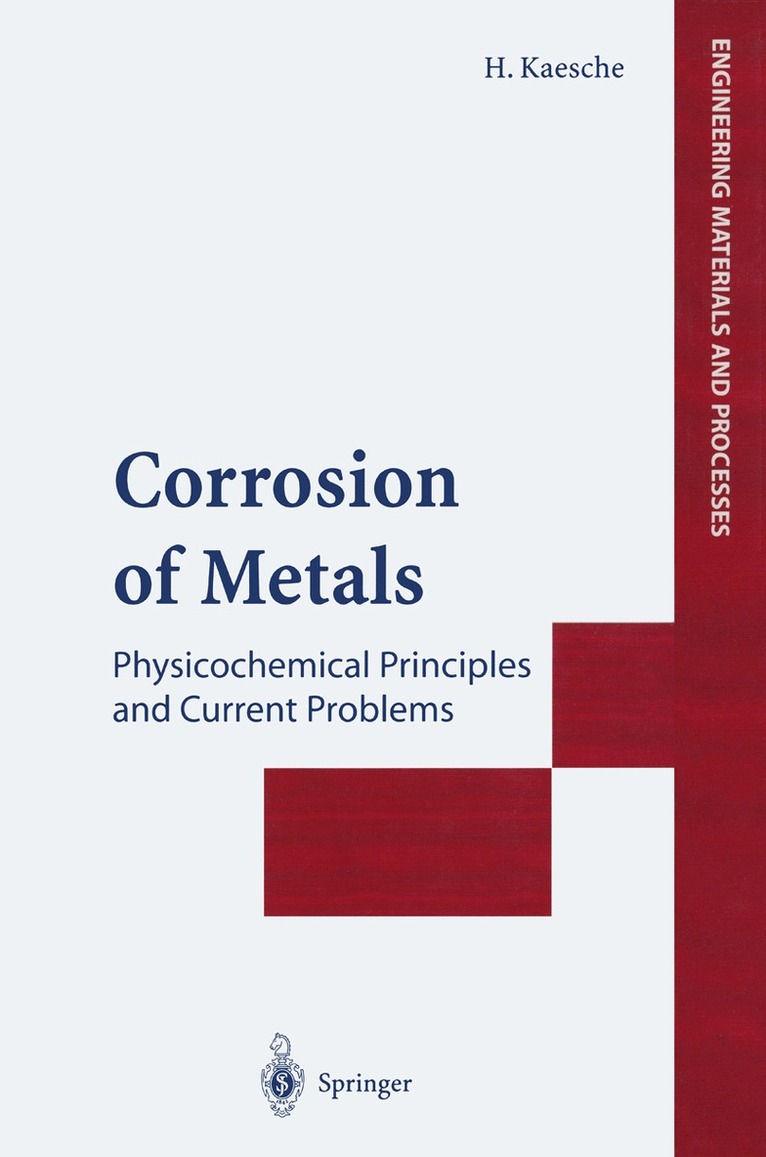
    Corrosion of Metals

    Physicochemical Principles and Current Problems

    AvHelmut Kaesche

    Häftad, Engelska, 2010

    Del i serien Engineering Materials and Processes

    2 165 kr

    Beställningsvara. Skickas inom 10-15 vardagar. Fri frakt över 249 kr.

    Fler format och utgåvor

    Inbunden

    2 165 kr

    E-bok

    2 833 kr

    Beskrivning

    Corrosion due to water is one of the most significant and complex causes of damage to metallic products. Written from the viewpoint of physical chemistry, this authoritative and established text deals with the aqueous corrosion of metals. Available for the first time in English, Corrosion of Metal addressing engineers, metallurgists, physicists and chemists. This self-contained, valuable reference comprehensively organizes and makes readily accessible the accumulated wealth of fundamental and applied knowledge. The concentration is on the underlying essentials of corrosion and failure, and the material is consistently presented in relation to practical applications to corrosion protection. The first chapters introducing the physicochemical principles are ideal for students. The following chapters provide an overview of the state of research for those familiar with the fundamentals. An exhaustive bibliography and appendices conclude the volume.

    Produktinformation

    • Utgivningsdatum:2010-12-15
    • Mått:155 x 235 x 33 mm
    • Vikt:908 g
    • Format:Häftad
    • Språk:Engelska
    • Serie:Engineering Materials and Processes
    • Antal sidor:594
    • Förlag:Springer-Verlag Berlin and Heidelberg GmbH & Co. KG
    • ISBN:9783642056208

    Utforska kategorier

    • Fysikalisk kemi inom Naturvetenskap och teknik
    • Maskinteknik och material inom Naturvetenskap och teknik

    Recensioner i media

    From the reviews: "Corrosion of Metals: Physicochemical Principles and Current Problems is a revision and translation into English of Die Korrosion der Metalle ... . Kaesche has provided ample opportunity for the serious reader to study the subjects in greater depth. This text is a solid addition to the library of both the practicing engineer and the researcher ... . The depth and breadth of the material ... make this an appropriate adjunct or even a primary text in a senior-level or graduate course on the subject." (Edward J. Bawolek, The Industrial Physicist, October, 2004) "In corrosion of metals, Helmut Kaesche ... gives a rich and insightful overview of metallic corrosion to the readers based upon his research works for several decades on passivity, stress corrosion cracking, pitting corrosion and corrosion fatigue of various metal systems. ... On the whole, this book is well balanced between the practical and theoretical viewpoints on metallic corrosion. ... I think that it is a mine of information relating to corrosion." (Su-Il Pyun, Journal of Solid State Electrochemistry, Vol. 9 (9), 2005)

    Innehållsförteckning

    • 1 Introduction.- References.- 2 Corrosion Reactions and Corrosion Products.- References.- 3 Chemical Thermodynamics of Corrosion.- 3.1 Outline of Fundamentals.- 3.2 Calculating Gibbs Energies for Overall Reactions.- 3.3 Equilibrium Galvanic Cells.- 3.4 Galvanic Cells with Transference.- 3.5 More on Equilibrium Electrode Potentials.- 3.6 Calculating Elevated-Temperature Gibbs Energies.- References.- 4 The Electrolytic Mechanism of Corrosion.- 4.1 Overview.- 4.2 Reactions, Currents, and Potentials in Galvanic Cells.- 4.3 Measuring Current-Potential Curves.- 4.4 Uniform Corrosion: The Work of Wagner and Traud.- References.- 5 The Kinetics of Electrode Reactions.- 5.1 Hydrogen Deposition and Hydrogen lonisation.- 5.2 Oxygen Reduction and Oxygen Evolution.- 5.3 Metal Dissolution and Metal Deposition.- 5.4 Closer Inspection of the Electrical Double Layer.- References.- 6 Uniform Electrolytic Corrosion.- 6.1 Acid and Neutral Solutions.- 6.2 Neutral and Alkaline Solutions.- 6.3 The Dependence of Corrosion Rates on Temperature.- References.- 7 Adsorption Inhibitors of Acid Iron Corrosion.- References.- 8 Corrosion of Homogeneous Alloys.- 8.1 Introduction.- 8.2 Uniform Dissolution.- 8.3 Selective Dissolution and Dealloying.- 8.4 Dealloying of Hume-Rothery Phases and of Martensites.- References.- 9 Rusting of Iron and Steel.- References.- 10 Passivity.- 10.1 Introduction.- 10.2 Iron in Acid Solutions.- 10.3 Iron in Weakly Acid, Neutral, and Alkaline Solutions.- 10.4 Chromium and Iron-Chromium Steels.- 10.5 Nickel, Molybdenum, and Stainless Steels.- 10.6 Amorphous and Nanocrystalline Alloys.- 10.7 Semiconducting Oxide Films, Spontaneous Passivation, and Passivating Inhibitors.- 10.8 Titanium, Aluminum.- 10.9 Zinc, Magnesium.- 10.10 Oxide Films on Steels in High-Temperature AqueousSolutions.- References.- 11 Galvanic Corrosion Cells.- 11.1 Dissimilar Metal Contact Corrosion.- 11.2 Differential Aeration Cells.- 11.3 Modeling Concentration Fields in Galvanic Cells.- References.- 12 Pitting Corrosion.- 12.1 General Aspects.- 12.2 Breakdown of Passivity and Pit Nucleation.- 12.3 Growth of Pit Nuclei.- 12.4 More on Aluminum and Aluminum Alloys.- 12.5 More on Iron, Nickel, and Stainless Steel.- 12.6 A Note on Crevice Corrosion.- References.- 13 Intercrystalline and Intracrystalline Corrosion.- References.- 14 Hydrogen Embrittlement.- 14.1 Introduction.- 14.2 HIC by High-Activity Hydrogen in Low Strength Steels.- 14.3 HISCC by Low-Activity Hydrogen in High-Strength Steels.- References.- 15 Stress Corrosion Cracking.- 15.1 General Aspects.- 15.2 Iron and Steels.- 15.3 Titanium and Titanium Alloys.- 15.4 Precipitation Hardening Aluminum Alloys.- 15.5 General Aspects Continued.- References.- 16 Corrosion Fatigue.- 16.1 General Aspects.- 16.2 The Fracture Mechanical Approach.- References.- 17 Appendix.- 17.1 Anodic and Cathodic Protection.- References.- 17.2 Mass Transport by Diffusion.- References.- 17.3 Applications of Fracture Mechanics.- References.- 17.4 Electrode Impedance Spectroscopy.- References.- 17.5 Electrode Noise Spectroscopy.- References.