• Fri frakt över 249 kr
  • •
  • Snabba leveranser
  • •
  • Billiga böcker
Kundservice

Du är på sajten för privatpersoner.

Företag, bibliotek eller offentlig verksamhet?

Du handlar på classic.bokus.com, där alla dina funktioner finns intakta.
Till classic.bokus.com
Bokus logotyp. Gå till startsidan.
  • Erbjudanden
  • Nyheter
  • Student
  • Topplistor
  • Barn & ungdom
  • Bokus Play
  • E-böcker
  • Pocketböcker
  • Spel & pussel

10% rabatt på allt med kod NYSTART10 →

Sidfot

Mina sidor

    Hjälp

    • Kundservice
    • Vanliga frågor och svar
    • Frakt och leverans
    • Retur vid ångerrätt
    • Reklamera vara
    • Betalning
    • Köpvillkor
    • Allmänna villkor
    • Information om webbplatsens tillgänglighet

    Om Bokus

    • Om oss
    • Pressrum
    • För studenter
    • För företag
    • För bibliotek och offentlig verksamhet
    • För leverantörer
    • Hållbarhet

    Populärt

    • Aktuella erbjudanden
    • Presentkort
    • Studentlitteratur
    • Nya böcker
    • Topplistor
    • Signerade böcker
    • Engelska böcker

    Inspiration

    • Boktips
    • BookTok
    • Populära bokserier
    • Barnbokskaraktärer
    • Populära författare
    Logotyp för Bokus
    Följ oss på Facebook (extern länk)Följ oss på Instagram (extern länk)Följ oss på YouTube (extern länk)Följ oss på TikTok (extern länk)
    bokus @ CookiesAnpassa cookiesIntegritetspolicyKöpvillkor
    Till Citymail hemsida (extern länk)Till Budbee hemsida (extern länk)Till Postnord hemsida (extern länk)Till Schenker hemsida (extern länk)Till Early Bird hemsida (extern länk)Till Walleys hemsida (extern länk)
    1. Data och IT
    2. Systemvetenskap och AI

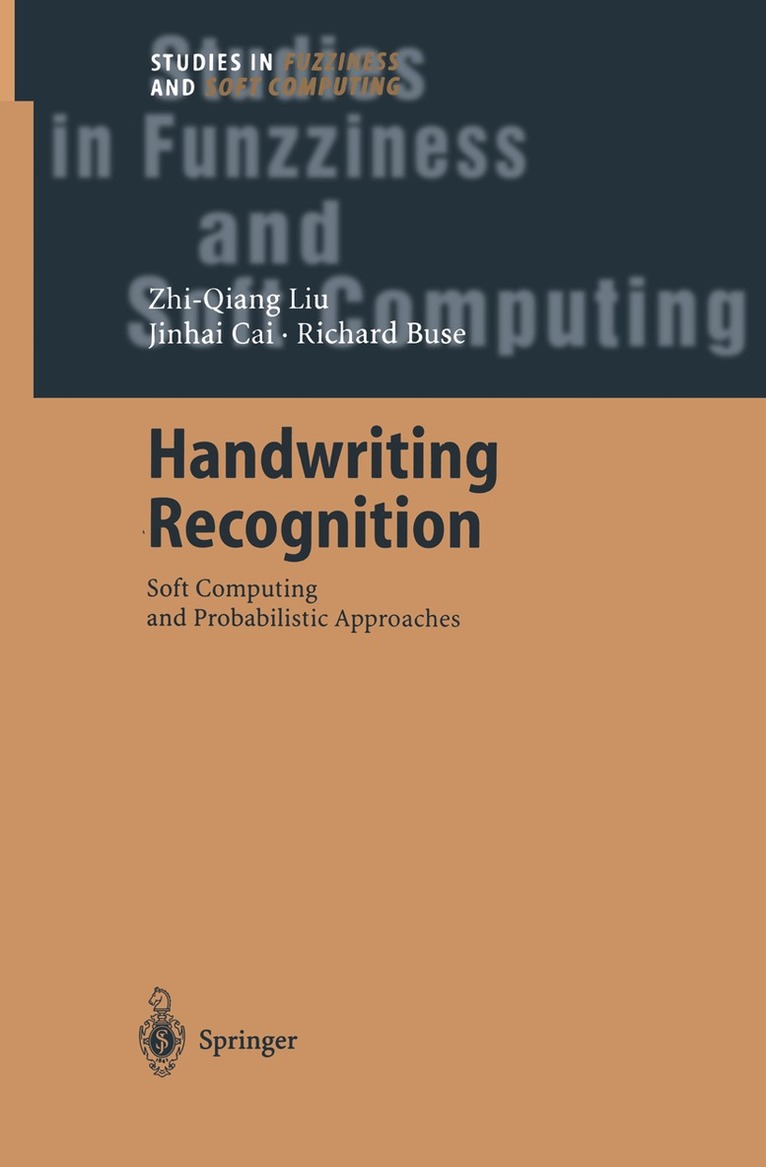
    Handwriting Recognition

    Soft Computing and Probabilistic Approaches

    AvZhi-Qiang Liu,Jin-Hai Cai

    Häftad, Engelska, 2010

    Del 133 i serien Studies in Fuzziness and Soft Computing

    1 055 kr

    Beställningsvara. Skickas inom 10-15 vardagar. Fri frakt över 249 kr.

    Fler format och utgåvor

    Inbunden

    1 086 kr

    Beskrivning

    Over the last few decades, research on handwriting recognition has made impressive progress. The research and development on handwritten word recognition are to a large degree motivated by many application areas, such as automated postal address and code reading, data acquisition in banks, text-voice conversion, security, etc. As the prices of scanners, com­ puters and handwriting-input devices are falling steadily, we have seen an increased demand for handwriting recognition systems and software pack­ ages. Some commercial handwriting recognition systems are now available in the market. Current commercial systems have an impressive performance in recognizing machine-printed characters and neatly written texts. For in­ stance, High-Tech Solutions in Israel has developed several products for container ID recognition, car license plate recognition and package label recognition. Xerox in the U. S. has developed TextBridge for converting hardcopy documents into electronic document files. In spite of the impressive progress, there is still a significant perfor­ mance gap between the human and the machine in recognizing off-line unconstrained handwritten characters and words. The difficulties encoun­ tered in recognizing unconstrained handwritings are mainly caused by huge variations in writing styles and the overlapping and the interconnection of neighboring characters. Furthermore, many applications demand very high recognition accuracy and reliability. For example, in the banking sector, although automated teller machines (ATMs) and networked banking sys­ tems are now widely available, many transactions are still carried out in the form of cheques.

    Produktinformation

    • Utgivningsdatum:2010-12-07
    • Mått:155 x 235 x 14 mm
    • Vikt:388 g
    • Format:Häftad
    • Språk:Engelska
    • Serie:Studies in Fuzziness and Soft Computing
    • Antal sidor:230
    • Förlag:Springer-Verlag Berlin and Heidelberg GmbH & Co. KG
    • ISBN:9783642072802

    Utforska kategorier

    • Systemvetenskap och AI inom Data och IT
    • Pedagogisk psykologi inom Psykologi och pedagogik
    • Artificiell intelligens inom Data och IT

    Innehållsförteckning

    • 1 Introduction.- 1.1 Feature Extraction Methods.- 1.2 Pattern Recognition Methods.- 2 Pre-processing and Feature Extraction.- 2.1 Pre-processing of Handwritten Images.- 2.2 Feature Extraction from Binarized Images.- 2.3 Feature Extraction Using Gabor Filters.- 2.4 Concluding Remarks.- 3 Hidden Markov Model-Based Method for Recognizing Handwritten Digits.- 3.1 Theory of Hidden Markov Models.- 3.2 Recognizing Handwritten Numerals Using Statistical and Structural Information.- 3.3 Experimental Results.- 3.4 Conclusion.- 4 Markov Models with Spectral Features for Handwritten Numeral Recognition.- 4.1 Related Work Using Contour Information.- 4.2 Fourier Descriptors.- 4.3 Hidden Markov Model in Spectral Space.- 4.4 Experimental Results.- 4.5 Discussion.- 5 Markov Random Field Model for Recognizing Handwritten Digits.- 5.1 Fundamentals of Markov Random Fields.- 5.2 Markov Random Field for Pattern Recognition.- 5.3 Recognition of Handwritten Numerals Using MRF Models.- 5.4 Conclusion.- 6 Markov Random Field Models for Recognizing Handwritten Words.- 6.1 Markov Random Field for Handwritten Word Recognition.- 6.2 Neighborhood Systems and Cliques.- 6.3 Clique Functions.- 6.4 Maximizing the Compatibility with Relaxation Labeling.- 6.5 Design of Weights.- 6.6 Experimental Results.- 6.7 Conclusion.- 7 A Structural and Relational Approach to Handwritten Word Recognition.- 7.1 Introduction.- 7.2 Gabor Parameter Estimation.- 7.3 Feature Extraction.- 7.4 Conditional Rule Generation System.- 7.5 Experimental Results.- 7.6 Conclusion.- 8 Handwritten Word Recognition Using Fuzzy Logic.- 8.1 Introduction.- 8.2 Extraction of Oriented Parts.- 8.3 System Training.- 8.4 Word Recognition.- 8.5 Experimental Results.- 8.6 Conclusion.- 9 Conclusion.- 9.1 Summary and Discussions.- 9.2 Future Directions.- 9.3 References.