• Fri frakt över 249 kr
  • •
  • Snabba leveranser
  • •
  • Billiga böcker
Kundservice

Du är på sajten för privatpersoner.

Företag, bibliotek eller offentlig verksamhet?

Du handlar på classic.bokus.com, där alla dina funktioner finns intakta.
Till classic.bokus.com
Bokus logotyp. Gå till startsidan.
  • Erbjudanden
  • Nyheter
  • Student
  • Topplistor
  • Barn & ungdom
  • Bokus Play
  • E-böcker
  • Pocketböcker
  • Spel & pussel

10% rabatt på allt med kod: NYSTART10 →

Sidfot

Mina sidor

    Hjälp

    • Kundservice
    • Vanliga frågor och svar
    • Frakt och leverans
    • Retur vid ångerrätt
    • Reklamera vara
    • Betalning
    • Köpvillkor
    • Allmänna villkor
    • Information om webbplatsens tillgänglighet

    Om Bokus

    • Om oss
    • Pressrum
    • För studenter
    • För företag
    • För bibliotek och offentlig verksamhet
    • För leverantörer
    • Hållbarhet

    Populärt

    • Aktuella erbjudanden
    • Presentkort
    • Studentlitteratur
    • Nya böcker
    • Topplistor
    • Signerade böcker
    • Engelska böcker

    Inspiration

    • Boktips
    • BookTok
    • Populära bokserier
    • Barnbokskaraktärer
    • Populära författare
    Logotyp för Bokus
    Följ oss på Facebook (extern länk)Följ oss på Instagram (extern länk)Följ oss på YouTube (extern länk)Följ oss på TikTok (extern länk)
    bokus @ CookiesAnpassa cookiesIntegritetspolicyKöpvillkor
    Till Citymail hemsida (extern länk)Till Budbee hemsida (extern länk)Till Postnord hemsida (extern länk)Till Schenker hemsida (extern länk)Till Early Bird hemsida (extern länk)Till Walleys hemsida (extern länk)
    1. Naturvetenskap och teknik
    2. Teknik och industri
    3. Elektronik och kommunikationer

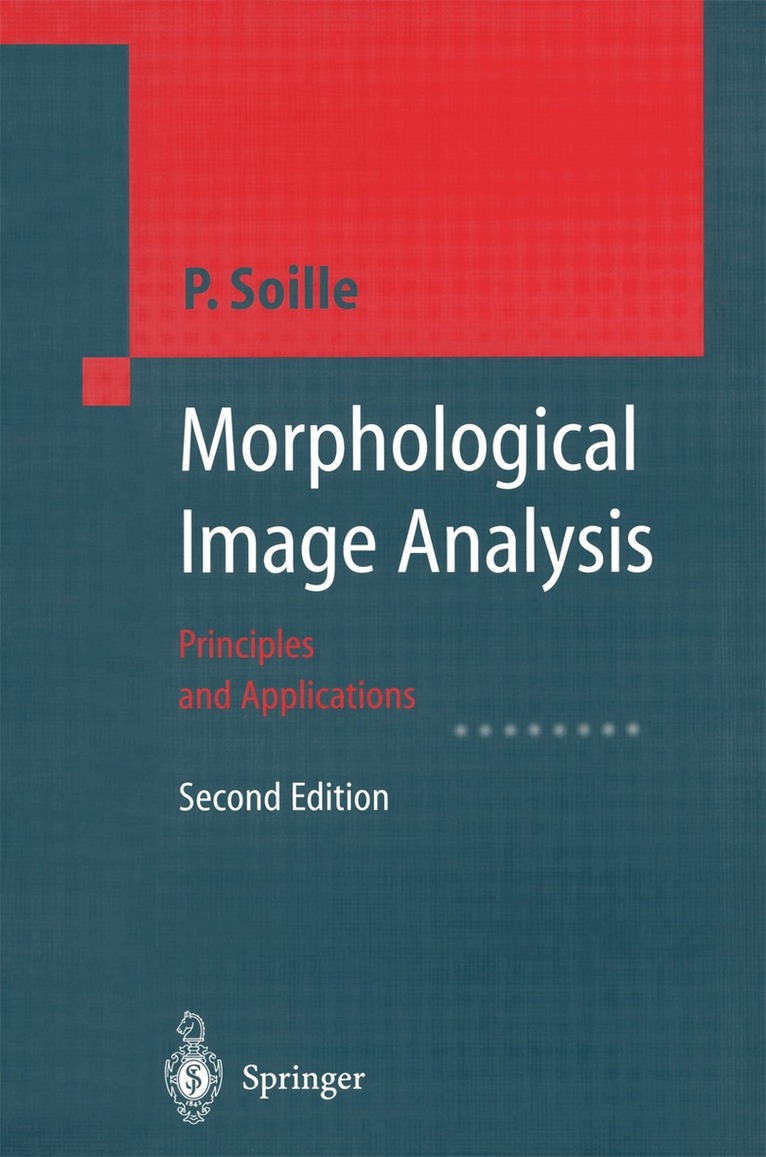
    Morphological Image Analysis

    Principles and Applications

    AvPierre Soille

    Häftad, Engelska, 2010

    2 165 kr

    Beställningsvara. Skickas inom 10-15 vardagar. Fri frakt över 249 kr.

    Fler format och utgåvor

    Inbunden

    2 230 kr

    E-bok

    1 140 kr

    E-bok

    2 833 kr

    Beskrivning

    Following the success of the first edition, recent developments in the field of morphological image analysis called for an extended second edition. The text has been fully revised with the goal of improving its clarity while introducing new concepts of interest to real image analysis applications. One chapter devoted to texture analysis has been added. Main extensions include: discussion about multichannel images and their morphological processing, ordering relations on image partitions, connected operators and levellings, homotopy for greytone images, translation-invariant implementations of erosions and dilations by line segments, reinforced emphasis on rank-based morphological operators, grey tone hit-or-miss, ordered independent homotopic thinnings and anchored skeletons, self-dual geodesic transformation and reconstruction, area based self-dual filters, anti-centre, watershed-based texture segmentation, texture models, and new scientific and industrial applications.

    Produktinformation

    • Utgivningsdatum:2010-11-30
    • Mått:155 x 235 x 26 mm
    • Vikt:690 g
    • Format:Häftad
    • Språk:Engelska
    • Antal sidor:392
    • Upplaga:2
    • Förlag:Springer-Verlag Berlin and Heidelberg GmbH & Co. KG
    • ISBN:9783642076961

    Utforska kategorier

    • Elektronik och kommunikationer inom Naturvetenskap och teknik
    • Systemvetenskap och AI inom Data och IT
    • Referensverk och tvärvetenskap inom Samhälle och politik

    Recensioner i media

    From the reviews: "This is a scholarly tour de force through the world of morphological image analysis, and, as its title indicates, it covers both the basic theory and the applications of the subject... All these concepts are well covered in this volume, with copious, very clear illustrations showing a myriad of images containing objects, textures and structures in both unprocessed and processed forms. Amongst the illustrations are also many useful diagrams, histograms, mappings and other mental aids. The subject is intricate and no stones are left unturned in explaining carefully what is meant, and relating the work to everyday experience. The author is clearly master of both the subject and its teaching ... I recommend this book unreservedly as the best one I have encountered on this particular topic..." BMVA News From the reviews of the second edition: "Faced with the success of his book, the author felt the need to revise and expand it. ... There are more algorithms and more applications, several of them coming from the author's own work. Many added illustrations improve the understanding of morphological theory, and the bibliography at the end of each chapter has become impressive. ... As its first edition, this book should appeal ... to practitioners of image processing, who will find in it a wealth of efficient methods for various problems." (Christian Ronse, Mathematical Reviews, Issue 2004 c) "This book puts the emphasis firmly on solving real world practical problems which arise in many image processing applications. ... It will be of most benefit to engineers and image processing specialists ... . Each chapter has several examples and there are a number of case studies. ... It is self-contained and aims to go well beyond an introduction ... . This is the second edition and there are a number of significant additions, which reflect the developments in the field ... ." (Stephen Marshall, IEE Proceedings Vision, Image & Signal Processing, September, 2003) "A very readable book for newcomers, written in an accessible style. ... The present work is ... much more than an introduction to the subject and it is very useful to have essays on so many branches of the subject united in a single volume. ... This in no way detracts from the value of the book for readers already familiar with the basic structure of mathematical morphology, to whom it is highly recommended." (Ultramicroscopy, Vol. 116, 2012)

    Innehållsförteckning

    • 1. Introduction.- 2. Background Notions.- 3. Erosion and Dilation.- 4. Opening and Closing.- 5. Hit-or-miss and Skeletons.- 6. Geodesic Transformations.- 7. Geodesic Metrics.- 8. Filtering.- 9. Segmentation.- 10. Classification.- 11. Texture analysis.- 12. Application Fields.- List of Symbols.- Name index.- Citation index.