• Fri frakt över 249 kr
  • •
  • Snabba leveranser
  • •
  • Billiga böcker
Kundservice

Du är på sajten för privatpersoner.

Företag, bibliotek eller offentlig verksamhet?

Du handlar på classic.bokus.com, där alla dina funktioner finns intakta.
Till classic.bokus.com
Bokus logotyp. Gå till startsidan.
  • Erbjudanden
  • Nyheter
  • Student
  • Topplistor
  • Barn & ungdom
  • Bokus Play
  • E-böcker
  • Pocketböcker
  • Spel & pussel

10% rabatt på allt med kod: NYSTART10 →

Sidfot

Mina sidor

    Hjälp

    • Kundservice
    • Vanliga frågor och svar
    • Frakt och leverans
    • Retur vid ångerrätt
    • Reklamera vara
    • Betalning
    • Köpvillkor
    • Allmänna villkor
    • Information om webbplatsens tillgänglighet

    Om Bokus

    • Om oss
    • Pressrum
    • För studenter
    • För företag
    • För bibliotek och offentlig verksamhet
    • För leverantörer
    • Hållbarhet

    Populärt

    • Aktuella erbjudanden
    • Presentkort
    • Studentlitteratur
    • Nya böcker
    • Topplistor
    • Signerade böcker
    • Engelska böcker

    Inspiration

    • Boktips
    • BookTok
    • Populära bokserier
    • Barnbokskaraktärer
    • Populära författare
    Logotyp för Bokus
    Följ oss på Facebook (extern länk)Följ oss på Instagram (extern länk)Följ oss på YouTube (extern länk)Följ oss på TikTok (extern länk)
    bokus @ CookiesAnpassa cookiesIntegritetspolicyKöpvillkor
    Till Citymail hemsida (extern länk)Till Budbee hemsida (extern länk)Till Postnord hemsida (extern länk)Till Schenker hemsida (extern länk)Till Early Bird hemsida (extern länk)Till Walleys hemsida (extern länk)
    1. Ekonomi och Ledarskap
    2. Nationalekonomi
    3. Ekonomisk politik

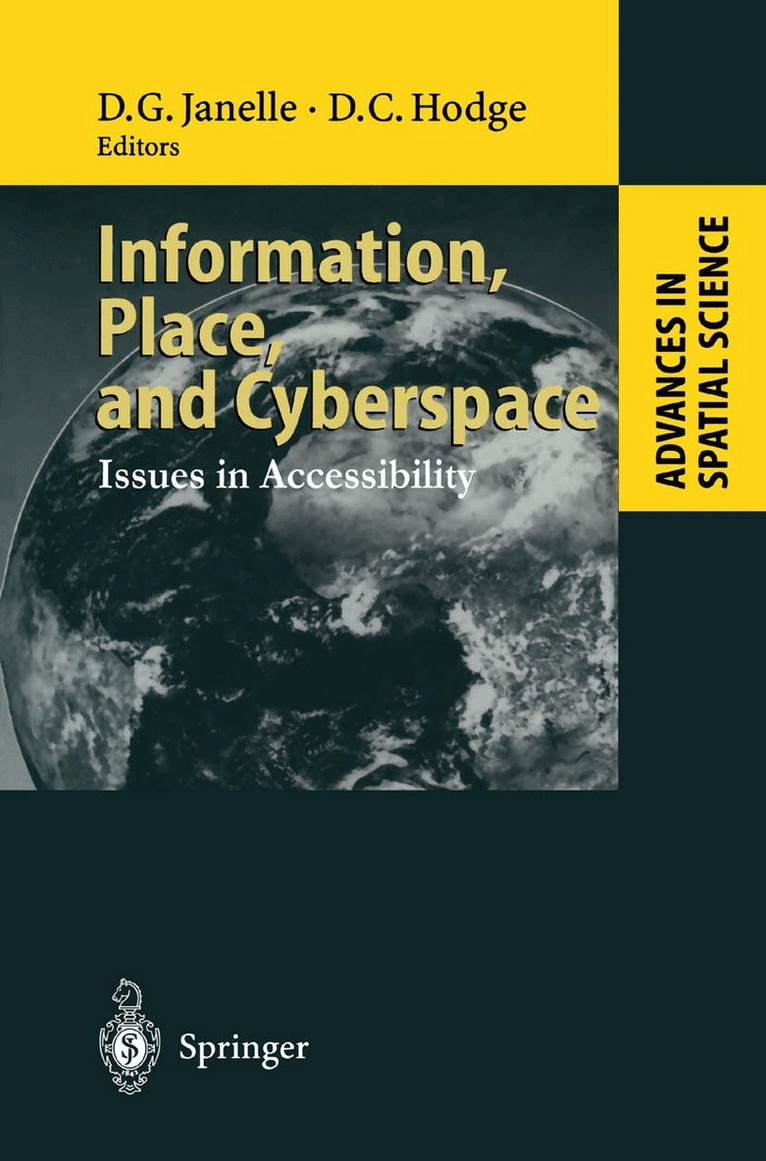
    Information, Place, and Cyberspace

    Issues in Accessibility

    AvDonald G. Janelle,David C. Hodge

    Häftad, Engelska, 2010

    Del i serien Advances in Spatial Science

    1 626 kr

    Beställningsvara. Skickas inom 10-15 vardagar. Fri frakt över 249 kr.

    Beskrivning

    This book explores how new communication and information technologies combine with transportation to modify human spatial and temporal relationships in everyday life. It targets the need to differentiate accessibility levels among a broad range of social groupings, the need to study disparities in electronic accessibility, and the need to investigate new measures and means of representing the geography of opportunity in the information age. It explores how models based on physical notions of distance and connectivity are insufficient for understanding the new structures and behaviors that characterize current regional realities, with examples drawn from Europe, New Zealand, and North America. While traditional notions of accessibility and spatial interaction remain important, information technologies are dramatically modifying and expanding the scope of these core geographical concepts.

    Produktinformation

    • Utgivningsdatum:2010-12-07
    • Mått:155 x 235 x 22 mm
    • Vikt:604 g
    • Format:Häftad
    • Språk:Engelska
    • Serie:Advances in Spatial Science
    • Antal sidor:386
    • Förlag:Springer-Verlag Berlin and Heidelberg GmbH & Co. KG
    • ISBN:9783642086922

    Utforska kategorier

    • Ekonomisk politik inom Ekonomi och Ledarskap
    • Informationsteknik: allmänt inom Data och IT
    • Geografi inom Naturvetenskap och teknik

    Innehållsförteckning

    • 1. Information, Place, Cyberspace, and Accessibility.- I: Conceptualization and Measurement.- 2. Conceptualizing and Measuring Accessibility within Physical and Virtual Spaces.- 3. Evaluating Intra-metropolitan Accessibility in the Information Age: Operational Issues, Objectives, and Implementation.- 4. Transportation, Telecommunications, and the Changing Geography of Opportunity.- 5. Space, Time and Sequencing: Substitution at the Physical / Virtual Interface.- 6. The Fuzzy Logic of Accessibility.- 7. The E-merging Geography of the Information Society: From Accessibility to Adaptability.- II: Visualization and Representation.- 8. Representing and Visualizing Physical, Virtual and Hybrid Information Spaces.- 9. Who’s Up? Global Interpersonal Temporal Accessibility.- 10. The Role of the Real City in Cyberspace: Understanding Regional Variations in Internet Accessibility.- 11. Accessibility to Information within the Internet: How can it Be Measured and Mapped?.- 12. Towards Spatial Interaction Models of Information Flows.- 13. Application of a CAD-based Accessibility Model.- 14. Human Extensibility and Individual Hybrid-accessibility in Space-time: A Multi-scale Representation Using GIS.- III: Societal Issues.- 15. Accessibility and Societal Issues in the Information Age.- 16. Reconceptualizing Accessibility.- 17. Revisiting the Concept of Accessibility: Some Comments and Research Questions.- 18. Legal Access to Geographic Information: Measuring Losses or Developing Responses?.- 19. Qualitative GIS: To Mediate, Not Dominate.- IV: Conclusion.- 20. From Sustainable Transportation to Sustainable Accessibility: Can We Avoid a New Tragedy of the Commons?.- Figures.- Tables.- Author Index.- Contributors.