• Fri frakt över 249 kr
  • •
  • Snabba leveranser
  • •
  • Billiga böcker
Kundservice

Du är på sajten för privatpersoner.

Företag, bibliotek eller offentlig verksamhet?

Du handlar på classic.bokus.com, där alla dina funktioner finns intakta.
Till classic.bokus.com
Bokus logotyp. Gå till startsidan.
  • Erbjudanden
  • Nyheter
  • Student
  • Topplistor
  • Barn & ungdom
  • Bokus Play
  • E-böcker
  • Pocketböcker
  • Spel & pussel

10% rabatt på allt med kod NYSTART10 →

Sidfot

Mina sidor

    Hjälp

    • Kundservice
    • Vanliga frågor och svar
    • Frakt och leverans
    • Retur vid ångerrätt
    • Reklamera vara
    • Betalning
    • Köpvillkor
    • Allmänna villkor
    • Information om webbplatsens tillgänglighet

    Om Bokus

    • Om oss
    • Pressrum
    • För studenter
    • För företag
    • För bibliotek och offentlig verksamhet
    • För leverantörer
    • Hållbarhet

    Populärt

    • Aktuella erbjudanden
    • Presentkort
    • Studentlitteratur
    • Nya böcker
    • Topplistor
    • Signerade böcker
    • Engelska böcker

    Inspiration

    • Boktips
    • BookTok
    • Populära bokserier
    • Barnbokskaraktärer
    • Populära författare
    Logotyp för Bokus
    Följ oss på Facebook (extern länk)Följ oss på Instagram (extern länk)Följ oss på YouTube (extern länk)Följ oss på TikTok (extern länk)
    bokus @ CookiesAnpassa cookiesIntegritetspolicyKöpvillkor
    Till Citymail hemsida (extern länk)Till Budbee hemsida (extern länk)Till Postnord hemsida (extern länk)Till Schenker hemsida (extern länk)Till Early Bird hemsida (extern länk)Till Walleys hemsida (extern länk)
    1. Naturvetenskap och teknik
    2. Matematik och naturvetenskap
    3. Fysik
    4. Tillämpad fysik

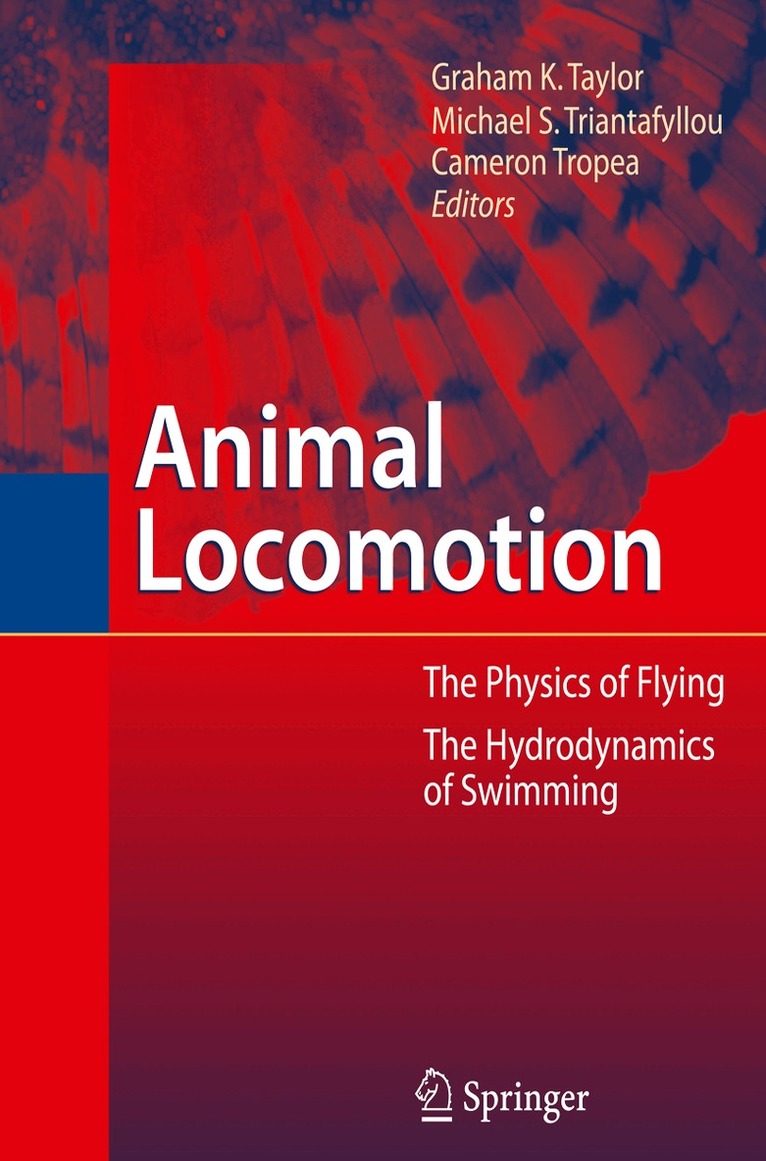
    Animal Locomotion

    AvGraham Taylor,Michael S. Triantafyllou

    Inbunden, Engelska, 2010

    2 485 kr

    Beställningsvara. Skickas inom 10-15 vardagar. Fri frakt över 249 kr.

    Beskrivning

    The physical principles of swimming and flying in animals are intriguingly different from those of ships and airplanes. The study of animal locomotion therefore holds a special place not only at the frontiers of pure fluid dynamics research, but also in the applied field of biomimetics, which aims to emulate salient aspects of the performance and function of living organisms. For example, fluid dynamic loads are so significant for swimming fish that they are expected to have developed efficient flow control procedures through the evolutionary process of adaptation by natural selection, which might in turn be applied to the design of robotic swimmers. And yet, sharply contrasting views as to the energetic efficiency of oscillatory propulsion – especially for marine animals – demand a careful assessment of the forces and energy expended at realistic Reynolds numbers. For this and many other research questions, an experimental approach is often the most appropriate methodology. This holds as much for flying animals as it does for swimming ones, and similar experimental challenges apply – studying tethered as opposed to free locomotion, or studying the flow around robotic models as opposed to real animals. This book provides a wide-ranging snapshot of the state-of-the-art in experimental research on the physics of swimming and flying animals. The resulting picture reflects not only upon the questions that are of interest in current pure and applied research, but also upon the experimental techniques that are available to answer them.

    Produktinformation

    • Utgivningsdatum:2010-05-17
    • Mått:210 x 279 x 29 mm
    • Vikt:1 357 g
    • Format:Inbunden
    • Språk:Engelska
    • Antal sidor:443
    • Upplaga:2010
    • Förlag:Springer-Verlag Berlin and Heidelberg GmbH & Co. KG
    • ISBN:9783642116322

    Utforska kategorier

    • Tillämpad fysik inom Naturvetenskap och teknik
    • Klassisk mekanik inom Naturvetenskap och teknik
    • Zoologi inom Naturvetenskap och teknik

    Recensioner i media

    From the reviews: "This book is a collection of biomechanics locomotion papers, broadly grouped into 'those that swim', and 'those that fly'. ... Engineering-based research is strongly threaded throughout the book. ... The variety of research being carried out in this sub-section of biomechanics is fairly represented and for those wishing to find out some of the recent advances in the field, this is an excellent starting point." (Anna Carruthers, Aeronautical Journal, June, 2011)

    Innehållsförteckning

    • The Hydrodynamics of Swimming.- Swimming hydrodynamics: ten questions and the technical approaches needed to resolve them.- A potential-flow, deformable-body model for fluid-structure interactions with compact vorticity: application to animal swimming measurements.- Wake visualization of a heaving and pitching foil in a soap film.- A harmonic model of hydrodynamic forces produced by a flapping fin.- Flowfield measurements in the wake of a robotic lamprey.- Impulse generated during unsteady maneuvering of swimming fish.- Do trout swim better than eels? Challenges for estimating performance based on the wake of self-propelled bodies.- Time resolved measurements of the flow generated by suction feeding fish.- Powered control mechanisms contributing to dynamically stable swimming in porcupine puffers (Teleostei: Diodon holocanthus).- Fluid dynamics of self-propelled microorganisms, from individuals to concentrated populations.- Swimming by microscopic organisms in ambient water flow.- Water-walking devices.- Flapping flexible fish.- Vortex dynamics in the wake of a mechanical fish.- Investigation of flow mechanism of a robotic fish swimming by using flow visualization synchronized with hydrodynamic force measurement.- The Physics of Flying.- PIV-based investigations of animal flight.- Wing–wake interaction reduces power consumption in insect tandem wings.- Experimental investigation of some aspects of insect-like flapping flight aerodynamics for application to micro air vehicles.- Design and development considerations for biologically inspired flapping-wing micro air vehicles.- Smoke visualization of free-flying bumblebees indicates independent leading-edge vortices on each wing pair.- The influence of airfoil kinematics on the formation of leading-edge vortices inbio-inspired flight.- Wake patterns of the wings and tail of hovering hummingbirds.- Characterization of vortical structures and loads based on time-resolved PIV for asymmetric hovering flapping flight.- Unsteady fluid-structure interactions of membrane airfoils at low Reynolds numbers.- Aerodynamic and functional consequences of wing compliance.- Shallow and deep dynamic stall for flapping low Reynolds number airfoils.- High-fidelity simulations of moving and flexible airfoils at low Reynolds numbers.- High-speed stereo DPIV measurement of wakes of two bat species flying freely in a wind tunnel.- Time-resolved wake structure and kinematics of bat flight.- Experimental investigation of a flapping wing model.- Aerodynamics of intermittent bounds in flying birds.- Experimental analysis of the flow field over a novel owl based airfoil.- The aerodynamic forces and pressure distribution of a revolving pigeon wing.