• Fri frakt över 249 kr
  • •
  • Snabba leveranser
  • •
  • Billiga böcker
Kundservice

Du är på sajten för privatpersoner.

Företag, bibliotek eller offentlig verksamhet?

Du handlar på classic.bokus.com, där alla dina funktioner finns intakta.
Till classic.bokus.com
Bokus logotyp. Gå till startsidan.
  • Erbjudanden
  • Nyheter
  • Student
  • Topplistor
  • Barn & ungdom
  • Bokus Play
  • E-böcker
  • Pocketböcker
  • Spel & pussel

10% rabatt på allt med kod NYSTART10 →

Sidfot

Mina sidor

    Hjälp

    • Kundservice
    • Vanliga frågor och svar
    • Frakt och leverans
    • Retur vid ångerrätt
    • Reklamera vara
    • Betalning
    • Köpvillkor
    • Allmänna villkor
    • Information om webbplatsens tillgänglighet

    Om Bokus

    • Om oss
    • Pressrum
    • För studenter
    • För företag
    • För bibliotek och offentlig verksamhet
    • För leverantörer
    • Hållbarhet

    Populärt

    • Aktuella erbjudanden
    • Presentkort
    • Studentlitteratur
    • Nya böcker
    • Topplistor
    • Signerade böcker
    • Engelska böcker

    Inspiration

    • Boktips
    • BookTok
    • Populära bokserier
    • Barnbokskaraktärer
    • Populära författare
    Logotyp för Bokus
    Följ oss på Facebook (extern länk)Följ oss på Instagram (extern länk)Följ oss på YouTube (extern länk)Följ oss på TikTok (extern länk)
    bokus @ CookiesAnpassa cookiesIntegritetspolicyKöpvillkor
    Till Citymail hemsida (extern länk)Till Budbee hemsida (extern länk)Till Postnord hemsida (extern länk)Till Schenker hemsida (extern länk)Till Early Bird hemsida (extern länk)Till Walleys hemsida (extern länk)
    1. Data och IT
    2. Systemvetenskap och AI
    3. Artificiell intelligens

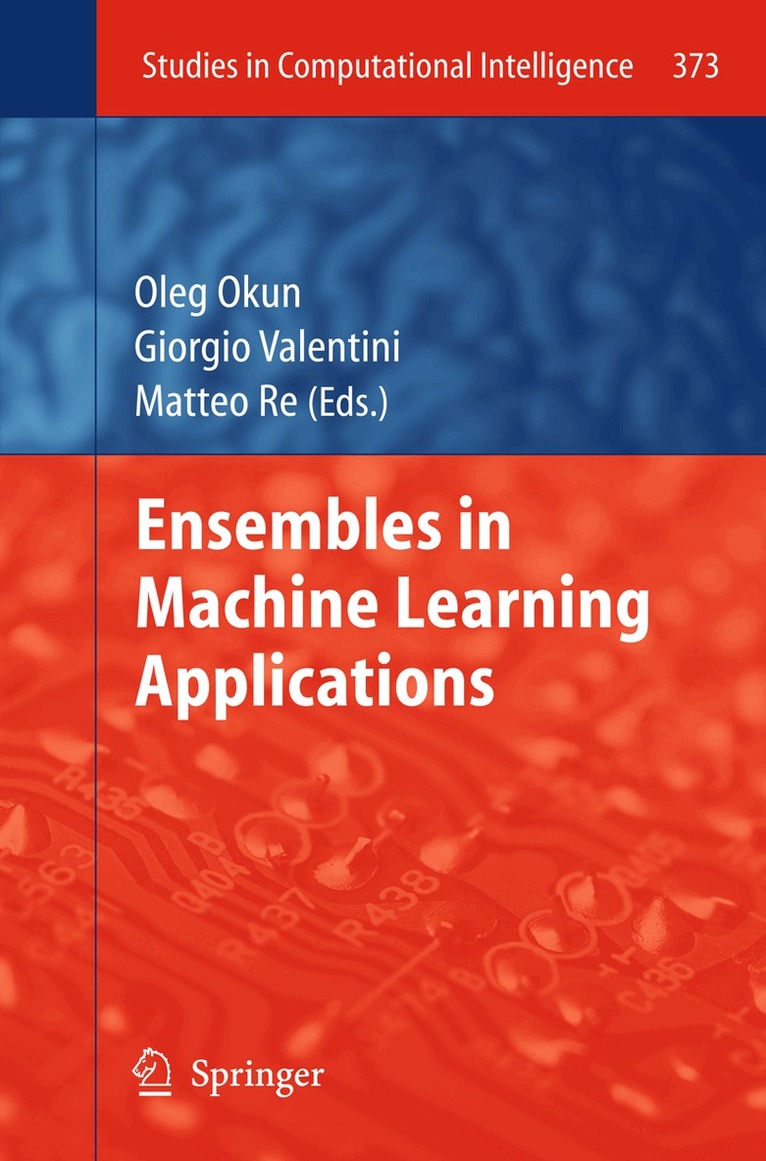
    Ensembles in Machine Learning Applications

    AvOleg Okun,Giorgio Valentini

    Inbunden, Engelska, 2011

    Del 373 i serien Studies in Computational Intelligence

    1 118 kr

    Beställningsvara. Skickas inom 10-15 vardagar. Fri frakt över 249 kr.

    Beskrivning

    This book contains the extended papers presented at the 3rd Workshop on Supervised and Unsupervised Ensemble Methods and their Applications (SUEMA) that was held in conjunction with the European Conference on Machine Learning and Principles and Practice of Knowledge Discovery in Databases (ECML/PKDD 2010, Barcelona, Catalonia, Spain). As its two predecessors, its main theme was ensembles of supervised and unsupervised algorithms – advanced machinelearning and data mining technique. Unlike a single classification or clustering algorithm, an ensemble is a groupof algorithms, each of which first independently solves the task at hand by assigning a class or cluster label (voting) to instances in a dataset and after that all votes are combined together to produce the final class or cluster membership. As a result, ensembles often outperform best single algorithms in many real-world problems. This book consists of 14 chapters, each of which can be read independently of the others. In addition to two previous SUEMA editions, also published by Springer, many chapters in the current book include pseudo code and/or programming code of the algorithms described in them. This was done in order to facilitate ensemble adoption in practice and to help to both researchers and engineers developing ensemble applications.

    Produktinformation

    • Utgivningsdatum:2011-09-07
    • Mått:155 x 235 x 22 mm
    • Vikt:626 g
    • Format:Inbunden
    • Språk:Engelska
    • Serie:Studies in Computational Intelligence
    • Antal sidor:252
    • Förlag:Springer-Verlag Berlin and Heidelberg GmbH & Co. KG
    • ISBN:9783642229091

    Utforska kategorier

    • Artificiell intelligens inom Data och IT

    Innehållsförteckning

    • From the content: Facial Action Unit Recognition Using Filtered Local Binary Pattern Features with Bootstrapped and Weighted ECOC Classifiers.- On the Design of Low Redundancy Error-Correcting Output Codes.- Minimally-Sized Balanced Decomposition Schemes for Multi-ClassClassification.- Bias-Variance Analysis of ECOC and Bagging Using Neural Nets.- Fast-ensembles of Minimum Redundancy Feature Selection.