• Fri frakt över 249 kr
  • •
  • Snabba leveranser
  • •
  • Billiga böcker
Kundservice

Du är på sajten för privatpersoner.

Företag, bibliotek eller offentlig verksamhet?

Du handlar på classic.bokus.com, där alla dina funktioner finns intakta.
Till classic.bokus.com
Bokus logotyp. Gå till startsidan.
  • Erbjudanden
  • Student
  • Topplistor
  • Barn & ungdom
  • Bokus Play
  • E-böcker
  • Ljudböcker
  • Pocketböcker
  • Spel och pussel

Pocketfynda! Hundratals böcker för 49 kr/st →

Sidfot

Mina sidor

    Hjälp

    • Kundservice
    • Vanliga frågor och svar
    • Frakt och leverans
    • Retur vid ångerrätt
    • Reklamera vara
    • Betalning
    • Köpvillkor
    • Allmänna villkor
    • Information om webbplatsens tillgänglighet

    Om Bokus

    • Om oss
    • Pressrum
    • För studenter
    • För företag
    • För bibliotek och offentlig verksamhet
    • För leverantörer
    • Hållbarhet

    Populärt

    • Aktuella erbjudanden
    • Presentkort
    • Studentlitteratur
    • Nya böcker
    • Topplistor
    • Signerade böcker
    • Engelska böcker

    Inspiration

    • Boktips
    • BookTok
    • Barnbokskaraktärer
    • Populära författare
    Logotyp för Bokus
    Följ oss på Facebook (extern länk)Följ oss på Instagram (extern länk)Följ oss på YouTube (extern länk)Följ oss på TikTok (extern länk)
    bokus @ CookiesAnpassa cookiesIntegritetspolicyKöpvillkor
    Till Citymail hemsida (extern länk)Till Budbee hemsida (extern länk)Till Postnord hemsida (extern länk)Till Schenker hemsida (extern länk)Till Early Bird hemsida (extern länk)Till Walleys hemsida (extern länk)
    1. Data och IT
    2. Systemvetenskap och AI

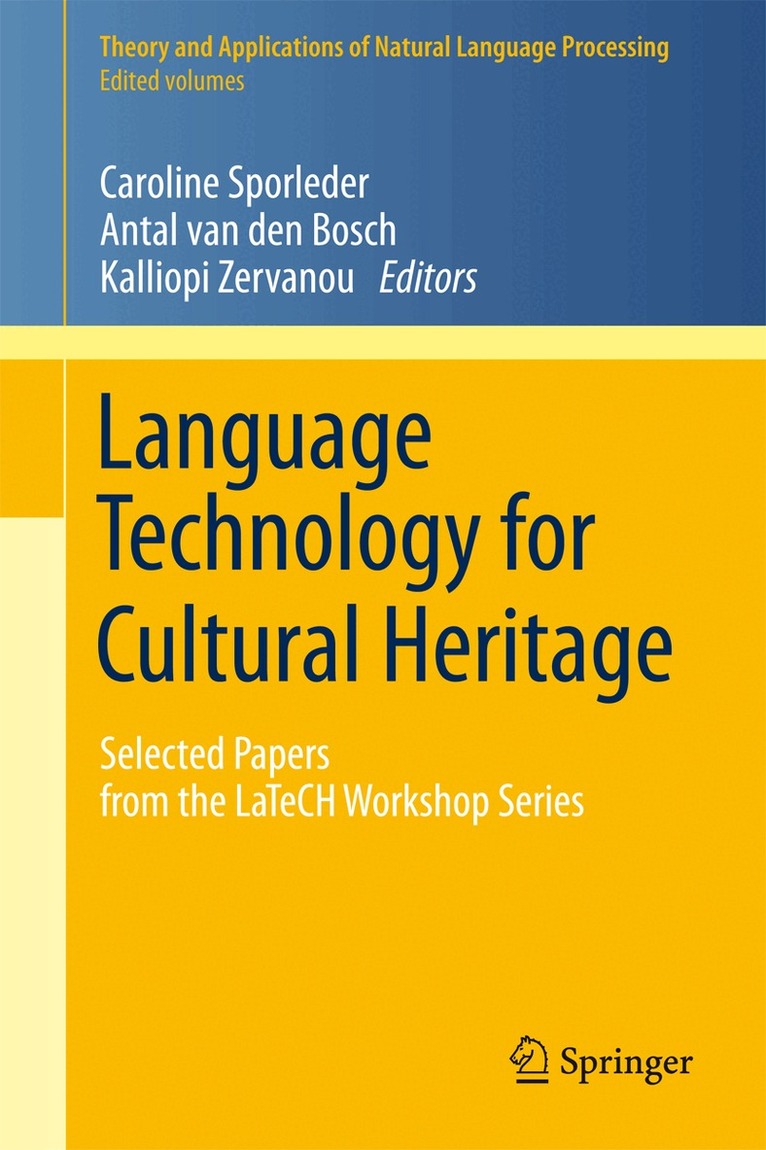
    Language Technology for Cultural Heritage

    Selected Papers from the LaTeCH Workshop Series

    AvCaroline Sporleder,Antal van den Bosch

    Häftad, Engelska, 2013

    Del i serien Theory and Applications of Natural Language Processing

    1 110 kr

    Beställningsvara. Skickas inom 10-15 vardagar. Fri frakt över 249 kr.

    Beskrivning

    The digital age has had a profound effect on our cultural heritage and the academic research that studies it. Staggering amounts of objects, many of them of a textual nature, are being digitised to make them more readily accessible to both experts and laypersons. Besides a vast potential for more effective and efficient preservation, management, and presentation, digitisation offers opportunities to work with cultural heritage data in ways that were never feasible or even imagined.  To explore and exploit these possibilities, an interdisciplinary approach is needed, bringing together experts from cultural heritage, the social sciences and humanities on the one hand, and information technology on the other. Due to a prevalence of textual data in these domains, language technology has a crucial role to play in this endeavour. Language technology can break through the "Google barrier" by offering the potential to analyse texts at advanced levels, extracting information and knowledge at the level of the humanities or social sciences researcher, who wants to know about the who, what, where, and when, but also the how and the why. At the same time cultural heritage data poses considerable challenges for existing language technology: technology aimed at "generic" language has to face such disparate problems as historical language variation, OCR digitisation errors, and near-extinct academic expertise.  This book is primarily intended for researchers in information technology and language processing who would like to receive a state-of-the-art overview of the whole breadth of the new and vibrant field of language technology for cultural heritage and its associated academic research in the humanities and social sciences. Researchers working in the target domains of cultural heritage, the social sciences and humanities will also find this book useful, as it provides an overview of how language technology can help them with their informationneeds. The book covers applications ranging from pre-processing and data cleaning, to the adaptation and compilation of linguistic resources, to personalisation, narrative analysis, visualisation and retrieval.

    Produktinformation

    • Utgivningsdatum:2013-10-07
    • Mått:155 x 235 x 15 mm
    • Vikt:406 g
    • Format:Häftad
    • Språk:Engelska
    • Serie:Theory and Applications of Natural Language Processing
    • Antal sidor:232
    • Upplaga:2011
    • Förlag:Springer-Verlag Berlin and Heidelberg GmbH & Co. KG
    • ISBN:9783642269882

    Utforska kategorier

    • Systemvetenskap och AI inom Data och IT
    • Databaser inom Data och IT

    Mer om författaren

    Caroline Sporleder leads a junior research group in the Cluster of Excellence “Multimodal Computing and Interaction” at Saarland University, Germany. Her research interests include text mining and error detection for cultural heritage data, cross-domain language processing, and computational modelling of semantics and discourse. Before coming to Saarland University, she worked as a post-doctoral researcher on the MITCH project (Mining for Information from the Cultural Heritage), a joint research project between Tilburg University, and Naturalis, the Dutch National Museum of Natural History. The project aimed at developing technology to clean, enrich and structure field books and other natural history data sources.Antal van den Bosch is a full professor of computational linguistics and artificial intelligence at Tilburg University. His research interests include machine learning of natural language; historical and heritage text mining; proofing and recommendation; and machine translation. He helped create the Dutch CATCH programme (Continuous Access to Cultural Heritage) funded by the Netherlands Organization for Scientific Research, and has been PI of two CATCH projects: the aforementioned MITCH (with Caroline Sporleder) and the current HitiMe project (with Kalliopi Zervanou). He was guest editor of the special issue of the Interdisciplinary Science Review journal on “Continuous access to cultural heritage” published in 2009.Kalliopi A. Zervanou is a post-doctoral researcher in the HiTiME project (Historical Timeline Mining and Extraction), a joint research project by Tilburg University’s Centre for Cognition and Communication (TiCC) and the International Institute of Social History. The project aims at the development of a text analysis system for the recognition and extraction of historical events and facts from a variety of primary and secondary historical sources. Previous to HiTiME, she worked as aresearcher at the University of Manchester, and the Technical University of Crete, in various information management and text mining projects. Her research interests include information extraction, knowledge acquisition and representation techniques, automatic term extraction and abstracting.

    Innehållsförteckning

    • Foreword by Willard McCarty.- Language Technology for Cultural Heritage, Social Sciences and Humanities: Chances and Challenges. Caroline Sporleder, Antal van den Bosch and Kalliopi Zervanou.- Part I Pre-Processing.- Strategies for Reducing and Correcting OCR Errors. Martin Volk, Lenz Furrer and Rico Sennrich.- Alignment between Text Images and their Transcripts for Handwritten Documents. Alejandro H. Toselli, Verónica Romero and Enrique Vidal.- Part II Adapting NLP Tools to Older Language Varieties.- A Diachronic Computational Lexical Resource for 800 Years of Swedish. Lars Borin and Markus Forsberg.- Morphosyntactic Tagging of Old Icelandic Texts and Its Use in Studying Syntactic Variation and Change. Eiríkur Rögnvaldsson and Sigrún Helgadóttir.- Part III Linguistic Resources for CH/SSH.- The Ancient Greek and Latin Dependency Treebanks. David Bamman and Gregory Crane.- A Parallel Greek-Bulgarian Corpus: A Digital Resource of the Shared Cultural Heritage. Voula Giouli, Kiril Simov and Petya Osenova.- Part IV Personalisation.- Authoring Semantic and Linguistic Knowledge for the Dynamic Generation of Personalized Descriptions. Stasinos Konstantopoulos, Vangelis Karkaletsis, Dimitrios Vogiatzis and Dimitris Bilidas.- Part V Structural and Narrative Analysis Automatic Pragmatic Text Segmentation of Historical Letters. Iris Hendrickx, Michel Généreux and Rita Marquilhas.- Proppian Content Descriptors in an Integrated Annotation Schema for Fairy Tales. Thierry Declerck, Antonia Scheidel and Piroska Lendvai.- Adapting NLP Tools and Frame-Semantic Resources for the Semantic Analysis of Ritual Descriptions. Nils Reiter, Oliver Hellwig, Anette Frank, Irina Gossmann, Borayin Maitreya Larios, Julio Rodrigues and Britta Zeller.- Part VI Data Management, Visualisation and Retrieval.- Information Retrieval and Visualization for the Historical Domain. Yevgeni Berzak, Michal Richter, Carsten Ehrler and Todd Shore.- IntegratingWiki Systems, Natural LanguageProcessing, and Semantic Technologies for Cultural Heritage Data Management. René Witte, Thomas Kappler, Ralf Krestel, and Peter C. Lockemann.