• Fri frakt över 249 kr
  • •
  • Snabba leveranser
  • •
  • Billiga böcker
Kundservice

Du är på sajten för privatpersoner.

Företag, bibliotek eller offentlig verksamhet?

Du handlar på classic.bokus.com, där alla dina funktioner finns intakta.
Till classic.bokus.com
Bokus logotyp. Gå till startsidan.
  • Erbjudanden
  • Student
  • Topplistor
  • Barn & ungdom
  • Bokus Play
  • E-böcker
  • Ljudböcker
  • Pocketböcker
  • Spel och pussel

5% studentrabatt – använd koden KURSBOK27 →

Sidfot

Mina sidor

    Hjälp

    • Kundservice
    • Vanliga frågor och svar
    • Frakt och leverans
    • Retur vid ångerrätt
    • Reklamera vara
    • Betalning
    • Köpvillkor
    • Allmänna villkor
    • Information om webbplatsens tillgänglighet

    Om Bokus

    • Om oss
    • Pressrum
    • För studenter
    • För företag
    • För bibliotek och offentlig verksamhet
    • För leverantörer
    • Hållbarhet

    Populärt

    • Aktuella erbjudanden
    • Presentkort
    • Studentlitteratur
    • Nya böcker
    • Topplistor
    • Signerade böcker
    • Engelska böcker

    Inspiration

    • Boktips
    • BookTok
    • Barnbokskaraktärer
    • Populära författare
    Logotyp för Bokus
    Följ oss på Facebook (extern länk)Följ oss på Instagram (extern länk)Följ oss på YouTube (extern länk)Följ oss på TikTok (extern länk)
    bokus @ CookiesAnpassa cookiesIntegritetspolicyKöpvillkor
    Till Citymail hemsida (extern länk)Till Budbee hemsida (extern länk)Till Postnord hemsida (extern länk)Till Schenker hemsida (extern länk)Till Early Bird hemsida (extern länk)Till Walleys hemsida (extern länk)
    1. Naturvetenskap och teknik
    2. Teknik och industri
    3. Teknik: allmänt

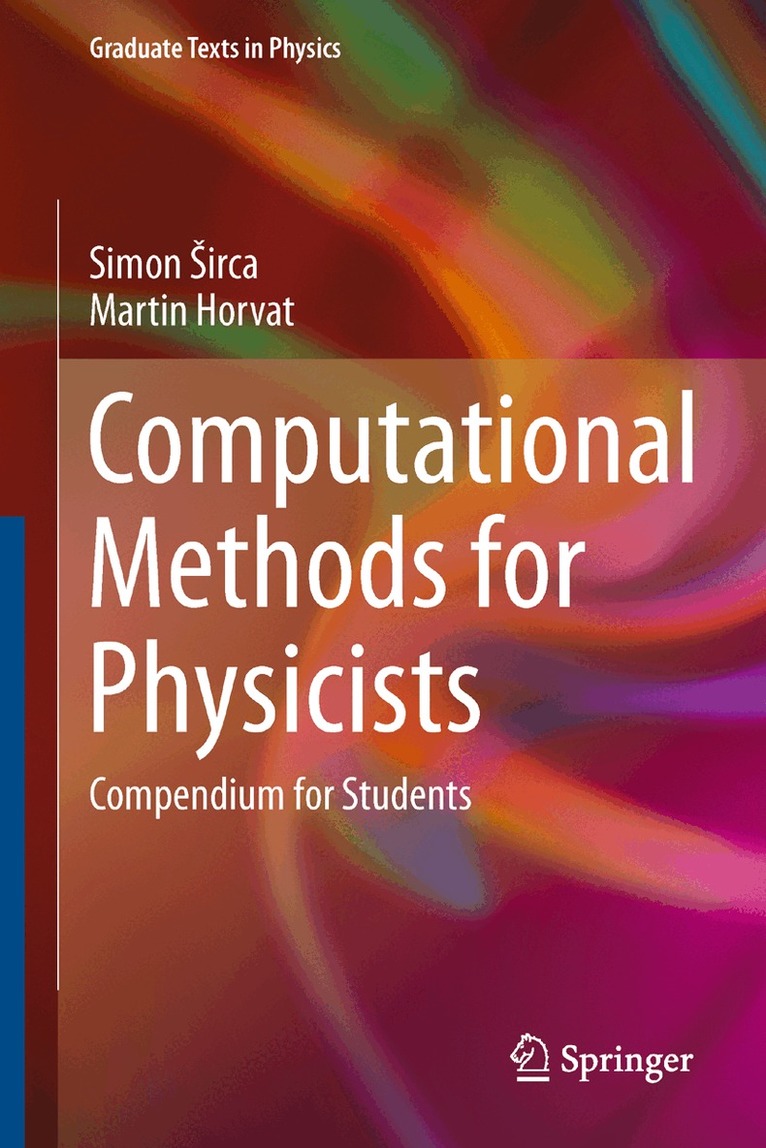
    Computational Methods for Physicists

    Compendium for Students

    AvSimon Sirca,Martin Horvat

    Inbunden, Engelska, 2012

    Del i serien Graduate Texts in Physics

    727 kr

    Beställningsvara. Skickas inom 5-8 vardagar. Fri frakt över 249 kr.

    Beskrivning

    This book helps advanced undergraduate, graduate and postdoctoral students in their daily work by offering them a compendium of numerical methods. The choice of methods pays  significant attention to error estimates, stability and convergence issues as well as to the ways to optimize program execution speeds. Many examples are given throughout the chapters, and each chapter is followed by at least a handful of more comprehensive problems which may be dealt with, for example, on a weekly basis in a one- or two-semester course. In these end-of-chapter problems the physics background is pronounced, and the main text preceding them is intended as an introduction or as a later reference. Less stress is given to the explanation of individual algorithms. It is tried to induce in the reader an own independent thinking and a certain amount of scepticism and scrutiny instead of blindly following readily available commercial tools.

    Produktinformation

    • Utgivningsdatum:2012-12-17
    • Mått:155 x 235 x undefined mm
    • Vikt:1 256 g
    • Format:Inbunden
    • Språk:Engelska
    • Serie:Graduate Texts in Physics
    • Antal sidor:716
    • Upplaga:2013
    • Förlag:Springer-Verlag Berlin and Heidelberg GmbH & Co. KG
    • ISBN:9783642324772

    Utforska kategorier

    • Teknik: allmänt inom Naturvetenskap och teknik
    • Fysikalisk kemi inom Naturvetenskap och teknik
    • Matematisk fysik inom Naturvetenskap och teknik

    Mer om författaren

    Simon Sirca was born on February 27, 1969, in Ljubljana, Slovenia. He studied physics at the Faculty of Mathematics and Physics, University of Ljubljana, and acquired his first research experience as a young researcher at the Jozef Stefan Institute in Ljubljana and the Institute for Nuclear Physics at the University of Mainz, Germany, concluding his PhD work with the thesis Axial form-factor of the nucleon from coincidence pion electroproduction at low Q2. He was a postdoctoral research associate at the Massachusetts Institute of Technology and the Thomas Je_erson National Accelerator Facility (Jefferson Lab) in the USA. His main research is in the field of hadronic structure and dynamics as explored by scattering of electrons on light nuclei, exploiting state-of-the-art polarized beams, polarized targets, and techniques of recoil polarimetry. He is also involved in theoretical work on quark models of hadrons, with the focus on electroweak processes like pion electroproduction in the nucleon resonance region. He is the head of the research group Structure of Hadronic Systems that has been active in the OOPS and BLAST Collaborations at MIT, Hall A Collaboration at Je_erson Lab, and the A1 Collaboration at Mainz. He is an Associate Professor at the Faculty of Mathematics and Physics, University of Ljubljana, where he has been teaching numerous courses in Mathematical Physics, Modern Physics I and II, and Mathematical Physics Practicum (Computational Physics). Martin Horvat was born on April 25, 1977, in Maribor, Slovenia. He completed his physics studies at the Faculty of Mathematics and Physics, University of Ljubljana, Slovenia, with the PhD thesis Uni-directional transport in billiard chains, and continued as a postdoctoral research associate at the Department of Mathematics, University of Bologna, Italy. His research work is devoted to classical and quantum non-linear dynamics, to transport properties in extended systems, to the quantum-classical correspondence, to theoretical and applied aspects of quantum mechanics on the classical phase space, as well as to statistical mechanics and its origin in dynamics. As a teaching assistant at the Faculty of Mathematics and Physics he has led the Physical Laboratory Course II and has taught the courses in Basic Applied Mathematics, Physics I, and Physics II.

    Recensioner i media

    From the reviews: "This is a well designed textbook that offers a generous compendium of numerical analysis, at a medium level of training in mathematics. The exposition style is attractive, and theoretical aspects are illustrated by relevant examples. ... The book is recommended to students and researchers whose interests go beyond 'successful recipes', towards consistent insights into the mathematical support. Educators may also find interesting applications and case studies for lectures or laboratory sessions." (Octavian Pastravanu, zbMATH, Vol. 1284, 2014)

    Innehållsförteckning

    • Basics of numerical analysis.- Solution of nonlinear equations.- Matrix methods.- Transformations of functions and signals.- Statistical description and modeling of data.- Modeling and analysis of time series.- Initial-value problems for ordinary differential equations.- Boundary-value problems for ordinary differential equations.- Difference methods for one-dimensional partial differential equations.- Difference methods for partial differential equations in more than one dim.- Spectral methods for partial differential equations.