• Fri frakt över 249 kr
  • •
  • Snabba leveranser
  • •
  • Billiga böcker
Kundservice

Du är på sajten för privatpersoner.

Företag, bibliotek eller offentlig verksamhet?

Du handlar på classic.bokus.com, där alla dina funktioner finns intakta.
Till classic.bokus.com
Bokus logotyp. Gå till startsidan.
  • Erbjudanden
  • Student
  • Topplistor
  • Barn & ungdom
  • Bokus Play
  • E-böcker
  • Ljudböcker
  • Pocketböcker
  • Spel och pussel

Pocketfynda! Hundratals böcker för 49 kr/st →

Sidfot

Mina sidor

    Hjälp

    • Kundservice
    • Vanliga frågor och svar
    • Frakt och leverans
    • Retur vid ångerrätt
    • Reklamera vara
    • Betalning
    • Köpvillkor
    • Allmänna villkor
    • Information om webbplatsens tillgänglighet

    Om Bokus

    • Om oss
    • Pressrum
    • För studenter
    • För företag
    • För bibliotek och offentlig verksamhet
    • För leverantörer
    • Hållbarhet

    Populärt

    • Aktuella erbjudanden
    • Presentkort
    • Studentlitteratur
    • Nya böcker
    • Topplistor
    • Signerade böcker
    • Engelska böcker

    Inspiration

    • Boktips
    • BookTok
    • Barnbokskaraktärer
    • Populära författare
    Logotyp för Bokus
    Följ oss på Facebook (extern länk)Följ oss på Instagram (extern länk)Följ oss på YouTube (extern länk)Följ oss på TikTok (extern länk)
    bokus @ CookiesAnpassa cookiesIntegritetspolicyKöpvillkor
    Till Citymail hemsida (extern länk)Till Budbee hemsida (extern länk)Till Postnord hemsida (extern länk)Till Schenker hemsida (extern länk)Till Early Bird hemsida (extern länk)Till Walleys hemsida (extern länk)
    1. Data och IT
    2. Systemvetenskap och AI

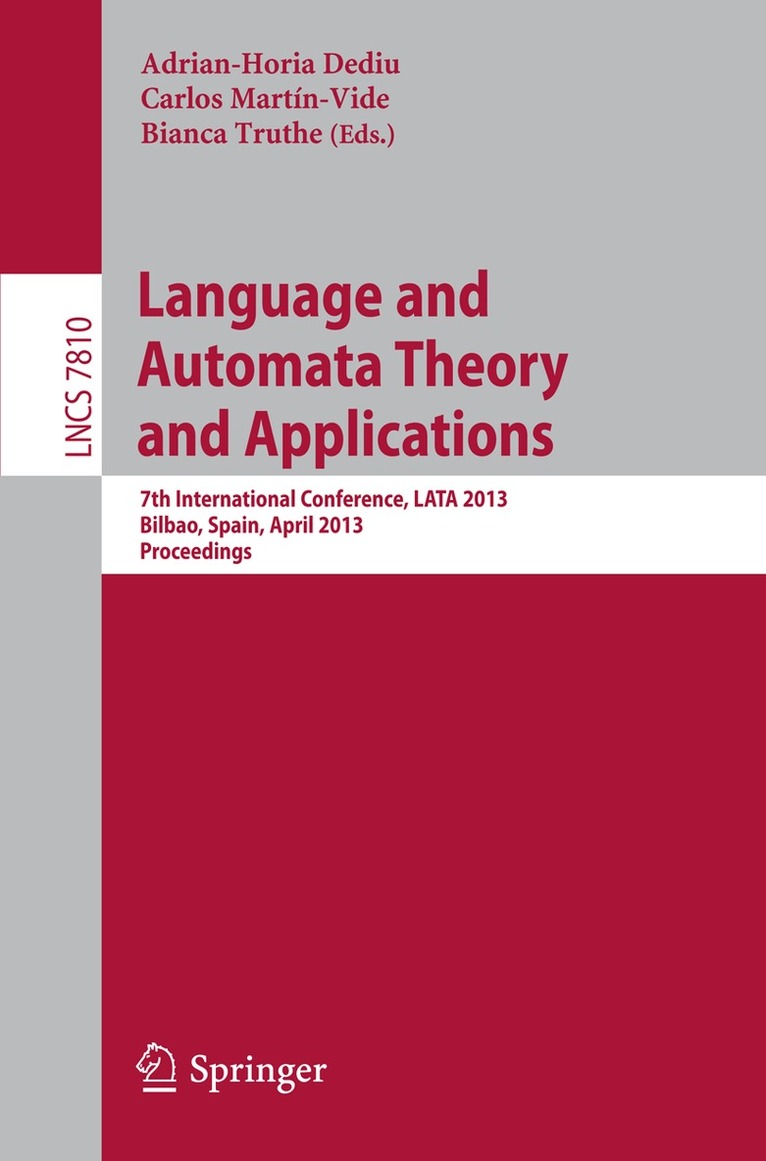
    Language and Automata Theory and Applications

    7th International Conference, LATA 2013, Bilbao, Spain, April 2-5, 2013, Proceedings

    AvAdrian-Horia Dediu,Carlos Martín-Vide

    Häftad, Engelska, 2013

    Del i serien Lecture Notes in Computer Science

    542 kr

    Beställningsvara. Skickas inom 10-15 vardagar. Fri frakt över 249 kr.

    Beskrivning

    This book constitutes the refereed proceedings of the 7th International Conference on Language and Automata Theory and Applications, LATA 2013, held in Bilbao, Spain in April 2013. The 45 revised full papers presented together with 5 invited talks were carefully reviewed and selected from 97 initial submissions. The volume features contributions from both classical theory fields and application areas (bioinformatics, systems biology, language technology, artificial intelligence, etc.). Among the topics covered are algebraic language theory; algorithms for semi-structured data mining; algorithms on automata and words; automata and logic; automata for system analysis and program verification; automata, concurrency and Petri nets; automatic structures; cellular automata; combinatorics on words; computability; computational complexity; computational linguistics; data and image compression; decidability questions on words and languages; descriptional complexity; DNA and other models of bio-inspired computing; document engineering; foundations of finite state technology; foundations of XML; fuzzy and rough languages; grammars (Chomsky hierarchy, contextual, multidimensional, unification, categorial, etc.); grammars and automata architectures; grammatical inference and algorithmic learning; graphs and graph transformation; language varieties and semigroups; language-based cryptography; language-theoretic foundations of artificial intelligence and artificial life; parallel and regulated rewriting; parsing; pattern recognition; patterns and codes; power series; quantum, chemical and optical computing; semantics; string and combinatorial issues in computational biology and bioinformatics; string processing algorithms; symbolic dynamics; symbolic neural networks; term rewriting; transducers; trees, tree languages and tree automata; weighted automata.

    Produktinformation

    • Utgivningsdatum:2013-02-20
    • Mått:155 x 235 x 32 mm
    • Vikt:890 g
    • Format:Häftad
    • Språk:Engelska
    • Serie:Lecture Notes in Computer Science
    • Antal sidor:580
    • Upplaga:2013
    • Förlag:Springer-Verlag Berlin and Heidelberg GmbH & Co. KG
    • ISBN:9783642370632

    Utforska kategorier

    • Systemvetenskap och AI inom Data och IT
    • Artificiell intelligens inom Data och IT
    • Tillämpad datateknik inom Data och IT

    Innehållsförteckning

    • Complexity Dichotomy for Counting Problems.- Algorithms for Analyzing and Verifying Infinite-State Recursive Probabilistic Systems.- Recursion Schemes, Collapsible Pushdown Automata and Higher-Order Model Checking.- Discrete Linear Dynamical Systems.- XML Schema Management: A Challenge for Automata Theory.- On the Complexity of Shortest Path Problems on Discounted Cost Graphs.- Termination of Rule-Based Calculi for Uniform Semi-Unification.- Deciding WQO for Factorial Languages.- On the Construction of a Family of Automata That Are Generically Non-minimal.- Limited Non-determinism Hierarchy of Counter Automata.- Unambiguous Automata Denoting Finitely Sequential Functions.- Duplication-Loss Genome Alignment: Complexity and Algorithm.- Maximizing Entropy over Markov Processes.- MAT Learning of Universal Automata.- A Graph Polynomial Approach to Primitivity.- Suffix Trees for Partial Words and the Longest Common Compatible Prefix Problem.- Dynamic Communicating Automata and Branching High-Level MSCs.- Visibly Pushdown Automata: Universality and Inclusion via Antichains.- Two-Sided Derivatives for Regular Expressions and for Hairpin Expressions.- How to Travel between Languages.- Execution Information Rate for Some Classes of Automata.- Decidability and Complexity Results for Verification of Asynchronous Broadcast Networks.- The Buffered π-Calculus: A Model for Concurrent Languages.- Mix-Automatic Sequences.- A Multivariate Analysis of Some DFA Problems.- On the Size Complexity of Deterministic Frequency Automata.- On the Number of Unbordered Factors.- Primitive Words and Lyndon Words in Automatic and Linearly Recurrent Sequences.- Efficient Submatch Extraction for Practical Regular Expressions.- Determinacy and Subsumption for Single-Valued Bottom-Up Tree Transducers.- Revealing vs. Concealing: More Simulation Games for Büchi Inclusion.- On Bounded Languages and Reversal-Bounded Automata.- Rewrite Closure and CF HedgeAutomata.- Linear-Time Version of Holub’s Algorithm for Morphic Imprimitivity Testing.-From Regular Tree Expression to Position Tree Automaton.- Convergence of Newton’s Method over Commutative Semirings.- Counting Minimal Symmetric Difference NFAs.- Interval Logics and ωB-Regular Languages.- Eliminating Stack Symbols in Push-Down Automata and Linear Indexed Grammars.- Asynchronous PC Systems of Pushdown Automata.- Model Checking Metric Temporal Logic over Automata with One Counter.- Coinductive Proof Techniques for Language Equivalence.- Ostrowski Numeration and the Local Period of Sturmian Words.- Boolean Algebras of Regular ω-Languages.- Pumping, Shrinking and Pronouns: From Context Free to Indexed Grammars.- Online Matching of Multiple Regular Patterns with Gaps and Character Classes.- Infiniteness and Boundedness in 0L, DT0L, and T0L Systems.- Uniformisation of Two-Way Transducers.- A Conditional Superpolynomial Lower Bound for Extended Resolution.- A Turing Machine Distance Hierarchy.Algorithms for Analyzing and Verifying Infinite-State Recursive Probabilistic Systems.- Recursion Schemes, Collapsible Pushdown Automata and Higher-Order Model Checking.- Discrete Linear Dynamical Systems.- XML Schema Management: A Challenge for Automata Theory.- On the Complexity of Shortest Path Problems on Discounted Cost Graphs.- Termination of Rule-Based Calculi for Uniform Semi-Unification.- Deciding WQO for Factorial Languages.- On the Construction of a Family of Automata That Are Generically Non-minimal.- Limited Non-determinism Hierarchy of Counter Automata.- Unambiguous Automata Denoting Finitely Sequential Functions.- Duplication-Loss Genome Alignment: Complexity and Algorithm.- Maximizing Entropy over Markov Processes.- MAT Learning of Universal Automata.- A Graph Polynomial Approach to Primitivity.- Suffix Trees for Partial Words and the Longest Common Compatible Prefix Problem.- Dynamic Communicating Automata andBranching High-Level MSCs.- Visibly Pushdown Automata: Universality and Inclusion via Antichains.- Two-Sided Derivatives for Regular Expressions and for Hairpin Expressions.- How to Travel between Languages.- Execution Information Rate for Some Classes of Automata.- Decidability and Complexity Results for Verification of Asynchronous Broadcast Networks.- The Buffered π-Calculus: A Model for Concurrent Languages.- Mix-Automatic Sequences.- A Multivariate Analysis of Some DFA Problems.- On the Size Complexity of Deterministic Frequency Automata.- On the Number of Unbordered Factors.- Primitive Words and Lyndon Words in Automatic and Linearly Recurrent Sequences.- Efficient Submatch Extraction for Practical Regular Expressions.- Determinacy and Subsumption for Single-Valued Bottom-Up Tree Transducers.- Revealing vs. Concealing: More Simulation Games for Büchi Inclusion.- On Bounded Languages and Reversal-Bounded Automata.- Rewrite Closure and CF Hedge Automata.- Linear-Time Version of Holub’s Algorithm for Morphic Imprimitivity Testing.-From Regular Tree Expression to Position Tree Automaton.- Convergence of Newton’s Method over Commutative Semirings.- Counting Minimal Symmetric Difference NFAs.- Interval Logics and ωB-Regular Languages.- Eliminating Stack Symbols in Push-Down Automata and Linear Indexed Grammars.- Asynchronous PC Systems of Pushdown Automata.- Model Checking Metric Temporal Logic over Automata with One Counter.- Coinductive Proof Techniques for Language Equivalence.- Ostrowski Numeration and the Local Period of Sturmian Words.- Boolean Algebras of Regular ω-Languages.- Pumping, Shrinking and Pronouns: From Context Free to Indexed Grammars.- Online Matching of Multiple Regular Patterns with Gaps and Character Classes.- Infiniteness and Boundedness in 0L, DT0L, and T0L Systems.- Uniformisation of Two-Way Transducers.- A Conditional Superpolynomial Lower Bound for Extended Resolution.- A Turing MachineDistance Hierarchy.