E-bok, Engelska, 2019
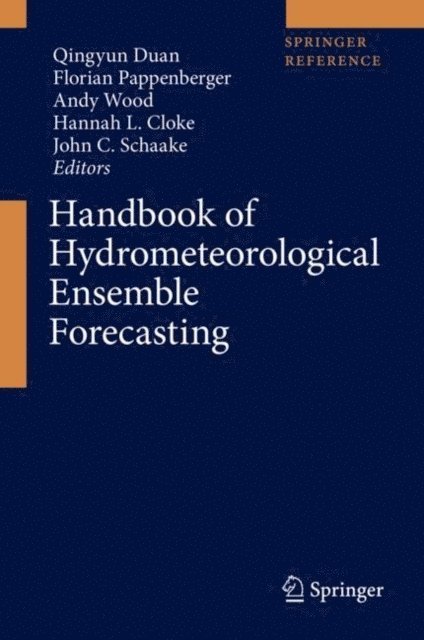
Handbook of Hydrometeorological Ensemble Forecasting
Av John C. Schaake, Hannah L. Cloke, Andy Wood, Florian Pappenberger, Qingyun Duan
10592 kr
Läs direkt i Bokus Reader – eller ladda ned till din enhet
Beskrivning
Hydrometeorological prediction involves the forecasting of the state and variation of hydrometeorological elements -- including precipitation, temperature, humidity, soil moisture, river discharge, groundwater, etc.-- at different space and time scales. Such forecasts form an important scientific basis for informing public of natural hazards such as cyclones, heat waves, frosts, droughts and floods. Traditionally, and at most currently operational centers, hydrometeorological forecasts are deterministic, “single-valued” outlooks: i.e., the weather and hydrological models provide a single best guess of the magnitude and timing of the impending events. These forecasts suffer the obvious drawback of lacking uncertainty information that would help decision-makers assess the risks of forecast use. Recently, hydrometeorological ensemble forecast approaches have begun to be developed and used by operational hydrometeorological services. In contrast to deterministic forecasts, ensemble forecasts are a multiple forecasts of the same events. The ensemble forecasts are generated by perturbing uncertain factors such as model forcings, initial conditions, and/or model physics. Ensemble techniques are attractive because they not only offer an estimate of the most probable future state of the hydrometeorological system, but also quantify the predictive uncertainty of a catastrophic hydrometeorological event occurring. The Hydrological Ensemble Prediction Experiment (HEPEX), initiated in 2004, has signaled a new era of collaboration toward the development of hydrometeorological ensemble forecasts. By bringing meteorologists, hydrologists and hydrometeorological forecast users together, HEPEX aims to improve operational hydrometeorological forecast approaches to a standard that can be used with confidence by emergencies and water resources managers. HEPEX advocates a hydrometeorological ensemble prediction system (HEPS) framework that consists of several basic building blocks. These components include:(a) an approach (typically statistical) for addressing uncertainty in meteorological inputs and generating statistically consistent space/time meteorological inputs for hydrological applications; (b) a land data assimilation approach for leveraging observation to reduce uncertainties in the initial and boundary conditions of the hydrological system; (c) approaches that address uncertainty in model parameters (also called ‘calibration’); (d) a hydrologic model or other approach for converting meteorological inputs into hydrological outputs; and finally (e) approaches for characterizing hydrological model output uncertainty. Also integral to HEPS is a verification system that can be used to evaluate the performance of all of its components. HEPS frameworks are being increasingly adopted by operational hydrometeorological agencies around the world to support risk management related to flash flooding, river and coastal flooding, drought, and water management. Real benefits of ensemble forecasts have been demonstrated in water emergence management decision making, optimization of reservoir operation, and other applications.
Produktinformation
- Utgivningsdatum: 2019-01-04
- Språk: Engelska
- Filformat: EPUB
- Kopieringsskydd: LCP
- ISBN: 9783642399251
- Förlag: Springer Berlin Heidelberg
Utforska kategorier
Betyg & recensioner
0 recensioner
Inga recensioner tillgängliga.