Häftad, Engelska, 2014
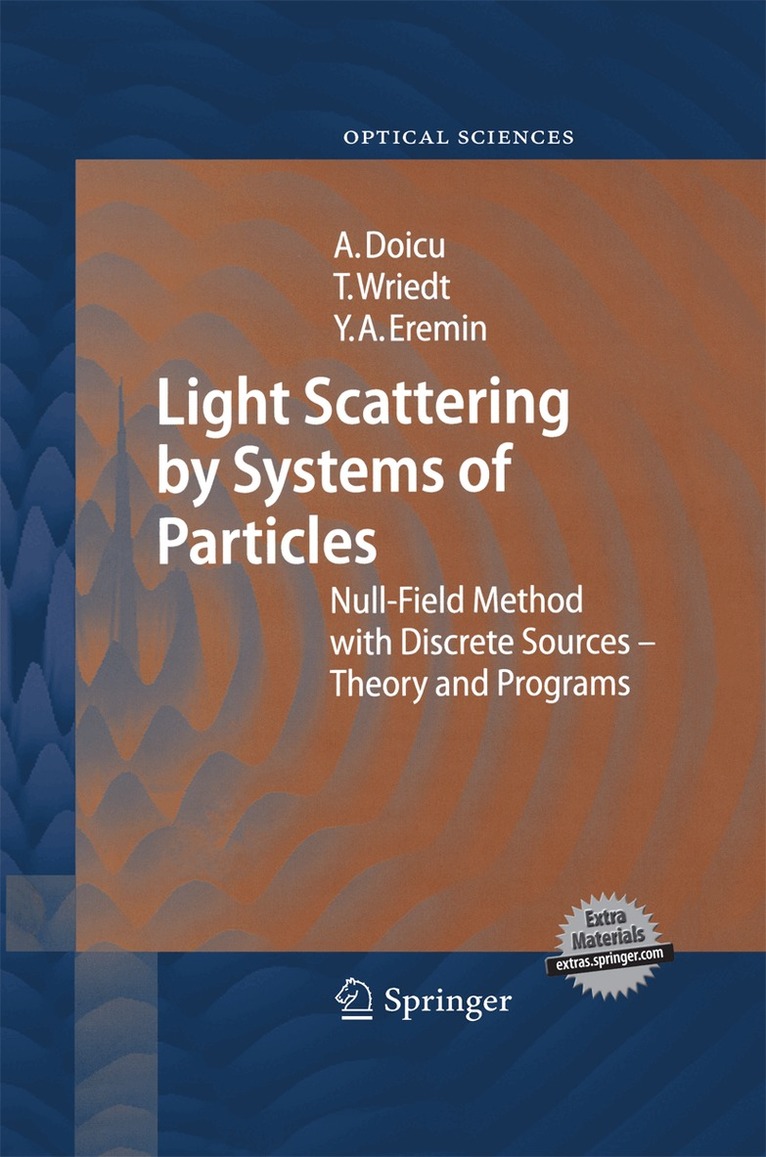
Light Scattering by Systems of Particles
Null-Field Method with Discrete Sources: Theory and Programs
Av Adrian Doicu, Thomas Wriedt, Yuri A. Eremin
Del 124 i serien Springer Series in Optical Sciences
2480 kr
Beställningsvara. Skickas inom 10-15 vardagar. Fri frakt över 249 kr.
Beskrivning
Produktinformation
- Utgivningsdatum: 2014-10-30
- Mått: 155 x 235 x 19 mm
- Vikt: 517 g
- Format: Häftad
- Språk: Engelska
- Serie: Springer Series in Optical Sciences
- Antal sidor: 322
- Upplaga: 2006
- Förlag: Springer-Verlag Berlin and Heidelberg GmbH & Co. KG
- ISBN: 9783642447280
Utforska kategorier
Mer om författaren
Adrian Doicu is Research Scientist at the Remote Sensing Technology Institute, DLR Deutsches Zentrum für Luft- und Raumfahrt e. V., Oberpfaffenhofen, Germany, prior to this he was Research Scientists at the Department of Chemical and Process Engineering, University of Bremen, Bremen, Germany. Thomas Wriedt is Head of the Particle Technology and Particle Characterization Department of the Institut für Werkstofftechnik, Bremen, Germany.Yuri Eremin is Research Professor at the Applied Mathematics and Computer Science Faculty, Moscow State University, Moscow, Russia.
Recensioner i media
From the reviews: "The well-written book is devoted to the light scattering of diverse particles encountered in practical applications. ... the book is written for physics and engineering students, and for practical researchers ... . The development of the subject of the monograph is well-documented by a comprehensive bibliography. An Index contains the most important terms used in the book." (Georg Hebermehl, Zentralblatt MATH, Vol. 1163, 2009)
Betyg & recensioner
0 recensioner
Inga recensioner tillgängliga.