• Fri frakt över 249 kr
  • •
  • Snabba leveranser
  • •
  • Billiga böcker
Kundservice

Du är på sajten för privatpersoner.

Företag, bibliotek eller offentlig verksamhet?

Du handlar på classic.bokus.com, där alla dina funktioner finns intakta.
Till classic.bokus.com
Bokus logotyp. Gå till startsidan.
  • Erbjudanden
  • Nyheter
  • Student
  • Topplistor
  • Barn & ungdom
  • Bokus Play
  • E-böcker
  • Pocketböcker
  • Spel & pussel

10% rabatt på allt med kod: NYSTART10 →

Sidfot

Mina sidor

    Hjälp

    • Kundservice
    • Vanliga frågor och svar
    • Frakt och leverans
    • Retur vid ångerrätt
    • Reklamera vara
    • Betalning
    • Köpvillkor
    • Allmänna villkor
    • Information om webbplatsens tillgänglighet

    Om Bokus

    • Om oss
    • Pressrum
    • För studenter
    • För företag
    • För bibliotek och offentlig verksamhet
    • För leverantörer
    • Hållbarhet

    Populärt

    • Aktuella erbjudanden
    • Presentkort
    • Studentlitteratur
    • Nya böcker
    • Topplistor
    • Signerade böcker
    • Engelska böcker

    Inspiration

    • Boktips
    • BookTok
    • Populära bokserier
    • Barnbokskaraktärer
    • Populära författare
    Logotyp för Bokus
    Följ oss på Facebook (extern länk)Följ oss på Instagram (extern länk)Följ oss på YouTube (extern länk)Följ oss på TikTok (extern länk)
    bokus @ CookiesAnpassa cookiesIntegritetspolicyKöpvillkor
    Till Citymail hemsida (extern länk)Till Budbee hemsida (extern länk)Till Postnord hemsida (extern länk)Till Schenker hemsida (extern länk)Till Early Bird hemsida (extern länk)Till Walleys hemsida (extern länk)
    1. Naturvetenskap och teknik
    2. Matematik och naturvetenskap
    3. Matematik
    4. Talteori

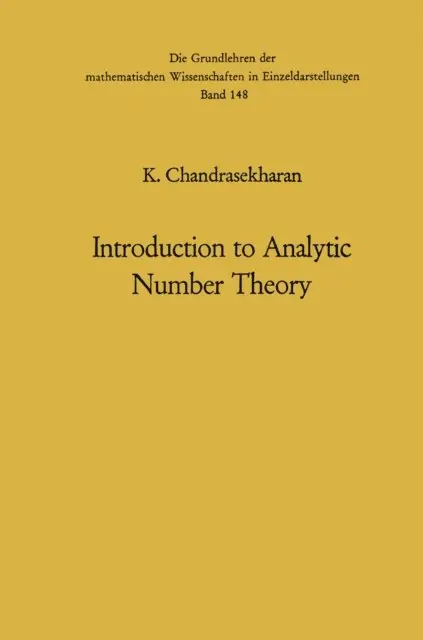
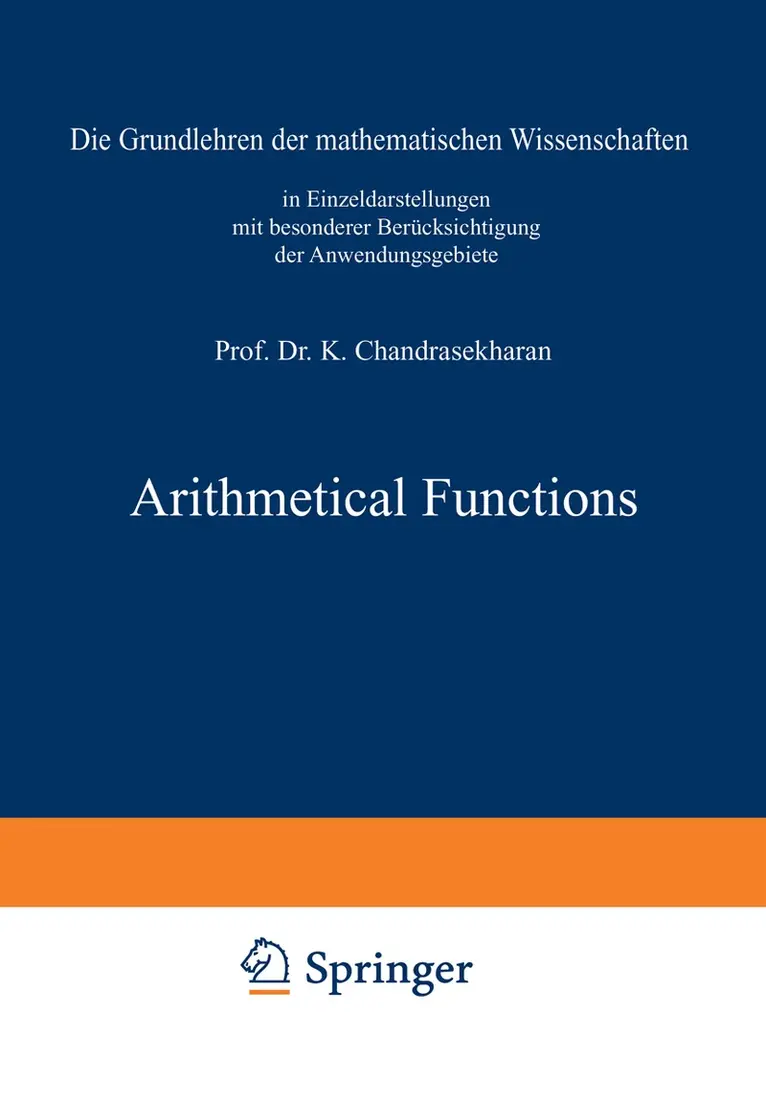
    Introduction to Analytic Number Theory

    AvKomaravolu Chandrasekharan

    Häftad, Engelska, 2012

    Del 148 i serien Grundlehren der mathematischen Wissenschaften

    1 302 kr

    Beställningsvara. Skickas inom 10-15 vardagar. Fri frakt över 249 kr.

    Fler format och utgåvor

    E-bok

    1 728 kr

    Beskrivning

    This book has grown out of a course of lectures I have given at the Eidgenossische Technische Hochschule, Zurich. Notes of those lectures, prepared for the most part by assistants, have appeared in German. This book follows the same general plan as those notes, though in style, and in text (for instance, Chapters III, V, VIII), and in attention to detail, it is rather different. Its purpose is to introduce the non-specialist to some of the fundamental results in the theory of numbers, to show how analytical methods of proof fit into the theory, and to prepare the ground for a subsequent inquiry into deeper questions. It is pub­ lished in this series because of the interest evinced by Professor Beno Eckmann. I have to acknowledge my indebtedness to Professor Carl Ludwig Siegel, who has read the book, both in manuscript and in print, and made a number of valuable criticisms and suggestions. Professor Raghavan Narasimhan has helped me, time and again, with illuminating comments. Dr. Harold Diamond has read the proofs, and helped me to remove obscurities. I have to thank them all. K.C.

    Produktinformation

    • Utgivningsdatum:2012-03-01
    • Mått:155 x 235 x 12 mm
    • Vikt:248 g
    • Format:Häftad
    • Språk:Engelska
    • Serie:Grundlehren der mathematischen Wissenschaften
    • Antal sidor:144
    • Förlag:Springer-Verlag Berlin and Heidelberg GmbH & Co. KG
    • ISBN:9783642461262

    Utforska kategorier

    • Talteori inom Naturvetenskap och teknik

    Innehållsförteckning

    • I The unique factorization theorem.- § 1. Primes.- § 2. The unique factorization theorem.- § 3. A second proof of Theorem 2.- §4. Greatest common divisor and least common multiple.- § 5. Farey sequences.- § 6. The infinitude of primes.- II Congruences.- § 1. Residue classes.- § 2. Theorems of Euler and of Fermat.- § 3. The number of solutions of a congruence.- III Rational approximation of irrationals and Hurwitz’s theorem.- § 1. Approximation of irrationals.- § 2. Sums of two squares.- § 3. Primes of the form 4k±.- §4. Hurwitz’s theorem.- IV Quadratic residues and the representation of a number as a sum of four squares.- § 1. The Legendre symbol.- § 2. Wilson’s theorem and Euler’s criterion.- § 3. Sums of two squares.- § 4. Sums of four squares.- V The law of quadratic reciprocity.- § 1. Quadratic reciprocity.- § 2. Reciprocity for generalized Gaussian sums.- § 3. Proof of quadratic reciprocity.- § 4. Some applications.- VI Arithmetical functions and lattice points.- § 1. Generalities.- § 2. The lattice point function r(n).- § 3. The divisor function d(n).- § 4. The functions ?(n).- § 5. The Möbius functions ?(n).- § 6. Euler’s function ?(n).- VII Chebyshev’s therorem on the distribution of prime numbers.- § 1. The Chebyshev functions.- § 2. Chebyshev’s theorem.- § 3. Bertrand’s postulate.- § 4. Euler’s identity.- § 5. Some formulae of Mertens.- VIII Weyl’s theorems on uniforms distribution and Kronecker’s theorem.- § 1. Introduction.- § 2. Uniform distribution in the unit interval.- § 3. Uniform distribution modulo 1.- § 4. Weyl’s theorems.- § 5. Kronecker’s theorem.- IX Minkowski’s theorem on lattice points in convex sets.- § 1. Convex sets.- § 2. Minkowski’s theorem.- § 3. Applications.- XDirichlet’s theorem on primes in an arithmetical progression.- § 1. Introduction.- § 2. Characters.- § 3. Sums of characters, orthogonality relations.- § 4. Dirichlet series, Landau’s theorem.- § 5. Dirichlet’s theorem.- XI The prime number theorem.- § 1. The non-vanishing of ? (1 + it).- § 2. The Wiener-Ikehara theorem.- § 3. The prime number theorem.- A list of books.- Notes.