• Fri frakt över 249 kr
  • •
  • Snabba leveranser
  • •
  • Billiga böcker
Kundservice

Du är på sajten för privatpersoner.

Företag, bibliotek eller offentlig verksamhet?

Du handlar på classic.bokus.com, där alla dina funktioner finns intakta.
Till classic.bokus.com
Bokus logotyp. Gå till startsidan.
  • Erbjudanden
  • Nyheter
  • Student
  • Topplistor
  • Barn & ungdom
  • Bokus Play
  • E-böcker
  • Pocketböcker
  • Spel & pussel

10% rabatt på allt med kod: NYSTART10 →

Sidfot

Mina sidor

    Hjälp

    • Kundservice
    • Vanliga frågor och svar
    • Frakt och leverans
    • Retur vid ångerrätt
    • Reklamera vara
    • Betalning
    • Köpvillkor
    • Allmänna villkor
    • Information om webbplatsens tillgänglighet

    Om Bokus

    • Om oss
    • Pressrum
    • För studenter
    • För företag
    • För bibliotek och offentlig verksamhet
    • För leverantörer
    • Hållbarhet

    Populärt

    • Aktuella erbjudanden
    • Presentkort
    • Studentlitteratur
    • Nya böcker
    • Topplistor
    • Signerade böcker
    • Engelska böcker

    Inspiration

    • Boktips
    • BookTok
    • Populära bokserier
    • Barnbokskaraktärer
    • Populära författare
    Logotyp för Bokus
    Följ oss på Facebook (extern länk)Följ oss på Instagram (extern länk)Följ oss på YouTube (extern länk)Följ oss på TikTok (extern länk)
    bokus @ CookiesAnpassa cookiesIntegritetspolicyKöpvillkor
    Till Citymail hemsida (extern länk)Till Budbee hemsida (extern länk)Till Postnord hemsida (extern länk)Till Schenker hemsida (extern länk)Till Early Bird hemsida (extern länk)Till Walleys hemsida (extern länk)
    1. Naturvetenskap och teknik
    2. Matematik och naturvetenskap
    3. Kemi
    4. Fysikalisk kemi

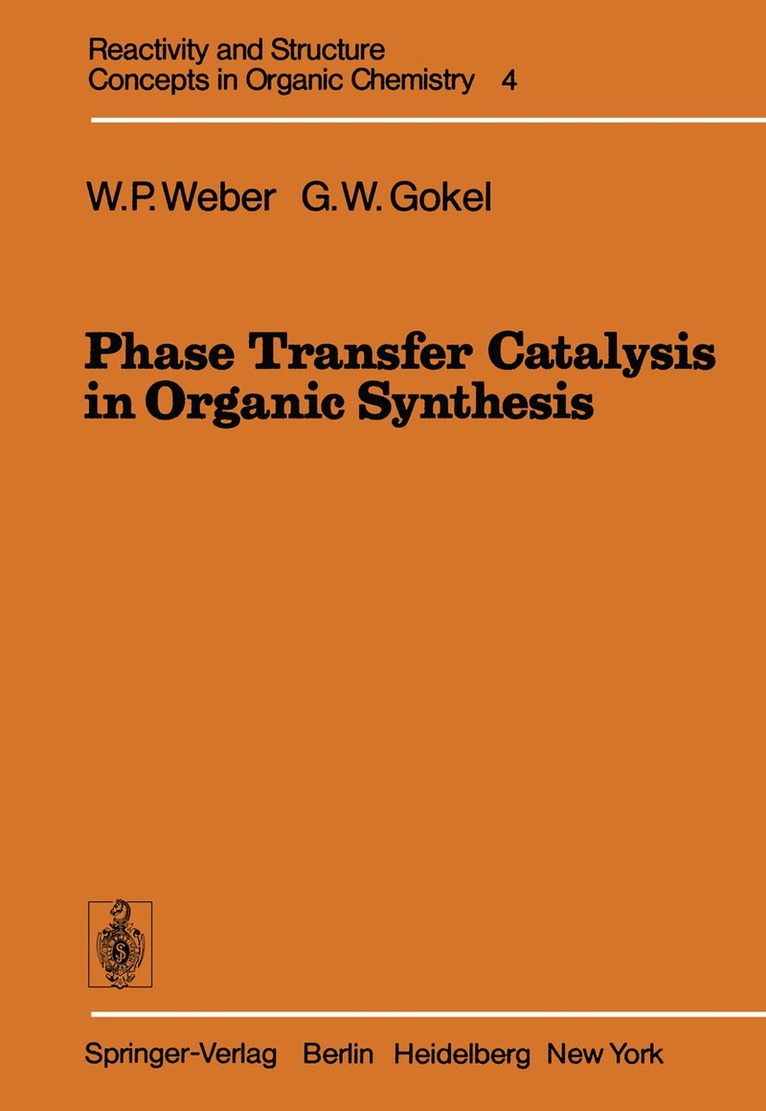
    Phase Transfer Catalysis in Organic Synthesis

    AvWilliam P. Weber,George W. Gokel

    Häftad, Engelska, 2012

    Del i serien Reactivity and Structure: Concepts in Organic Chemistry

    1 086 kr

    Beställningsvara. Skickas inom 10-15 vardagar. Fri frakt över 249 kr.

    Beskrivning

    The field of phase transfer catalysis is a tribute to the chemists involved in process development research. Phase transfer catalysis is a solution to numerous cost and yield problems encountered regularly in industrial laboratories. In fact, much of the early work in this area was conducted by industrial chemists although the work was not labelled phase transfer catalysis at the time. We certainly do not intend to minimize the contributions of academic chemists to this field, but it is an unalterable fact that much of the early understanding and many of the early advances came from industrial laboratories. A special tribute is due to Dr. Charles Starks of the Continental Oil Company. By the mid sixties, Starks had formulated the principles of phase transfer catalysis and had applied for patents on many reactions that others were later to examine in somewhat greater detail. His mechanistic model of phase transfer catalysis still stands up well today and is a model for much of the thinking in this area. It is fitting that Starks suggested the name "phase transfer catalysis" by which the whole field is now known. We wish to thank a number of people who have aided us in many ways in the preparation of this volume. We very much appreciate the helpful discussions and insights provided by Drs. Henry Stevens and Andrew Kaman of PPG Industries in Barberton, Ohio. We also thank Dr. L. A.

    Produktinformation

    • Utgivningsdatum:2012-03-08
    • Mått:170 x 244 x 17 mm
    • Vikt:528 g
    • Format:Häftad
    • Språk:Engelska
    • Serie:Reactivity and Structure: Concepts in Organic Chemistry
    • Antal sidor:282
    • Förlag:Springer-Verlag Berlin and Heidelberg GmbH & Co. KG
    • ISBN:9783642463594

    Utforska kategorier

    • Fysikalisk kemi inom Naturvetenskap och teknik
    • Organisk kemi inom Naturvetenskap och teknik

    Innehållsförteckning

    • 1. Introduction and Principles.- 1.1 Introduction.- 1.2 Early Examples.- 1.3 The Coalescence of Ideas.- 1.4 The Principle of Phase Transfer Catalysis.- 1.5 Evidence for the Mechanism of Phase Transfer Catalysis.- 1.6 Charged Catalysts: Quaternary Ions.- 1.7 Uncharged Catalysts: The Amines.- 1.8 Uncharged Catalysts: The Crown Ethers.- 1.9 Uncharged Catalysts: The Cryptands.- 1.10 Catalyst Comparisons.- 1.11 Solvents.- 1.12 The Role of Water in Phase Transfer Catalysis.- 1.13 Summary.- References.- 2. The Reaction of Dichlorocarbene With Olefins.- 2.1 Introduction.- 2.2 The Mechanism of the Dichlorocyclopropanation Reaction.- 2.3 Catalytic Cyclopropanation.- 2.4 Dichlorocyclopropanation of Simple Olefins.- 2.5 Cyclopropanation of Enamines.- 2.6 Dichlorocyclopropanation Followed by Rearrangement.- 2.7 Carbene Addition to Indoles.- 2.8 Carbene Addition to Furans and Thiophenes.- 2.9 Carbene Addition to Polycyclic Aromatics.- 2.10 Carbene Addition to Conjugated Olefins.- 2.11 Michael Addition of the Trichloromethyl Anion.- 2.12 Dichlorocarbene Addition to Allylic Alcohols: A Cyclopentenone Synthon.- 2.13 Dichlorocarbene to Phenols: Reimer-Tiemann Reactions.- References.- 3. Reactions of Dichlorocarbene With Non-Olefinic Substrates.- 3.1 Introduction.- 3.2 C — H Insertion Reactions.- 3.3 Reaction With Alcohols: Synthesis of Chlorides.- 3.4 Carbene Addition to Imines.- 3.5 Addition to Primary Amines: Synthesis of Isonitriles...- 3.6 Reaction With Hydrazine, Secondary, and Tertiary Amines.- 3.7 Dehydration With Dichlorocarbene.- 3.8 Miscellaneous Reactions of Dichlorocarbene.- References.- 4. Dibromocarbene and Other Carbenes.- 4.1 Introduction.- 4.2 Dibromocarbene Addition to Simple Olefins.- 4.3 Dibromocarbene Addition to Strained Alkenes.- 4.4 Dibromocarbene Addition toIndoles.- 4.5 Dibromocarbene Addition to Michael Acceptors.- 4.6 Other Reactions of Dibromocarbene.- 4.7 Other Halocarbenes.- 4.8 Phenylthio- and Phenylthio(chloro)carbene.- 4.9 Unsaturated Carbenes.- References.- 5. Synthesis of Ethers.- 5.1 Introduction.- 5.2 Mixed Ethers: The Mechanism.- 5.3 Rate Enhancement in the Williamson Reaction.- 5.4 Methylation.- 5.5 Phenyl Ethers.- 5.6 Methoxymethyl Ethers of Phenol.- 5.7 Diethers From Dihalomethanes.- 5.8 The Koenigs-Knorr Reaction.- 5.9 Epoxides.- References.- 6. Synthesis of Esters.- 6.1 Introduction.- 6.2 Tertiary Amines and Quaternary Ammonium Salts.- 6.3 Noncatalytic Esterification in the Presence of Ammonium Salts.- 6.4 Polycarbonate Formation.- 6.5 Crown Catalyzed Esterification.- 6.6 Crown Catalyzed Phenacyl Ester Synthesis.- 6.7 Crown Catalyzed Esterification of BOC-Amino Acid to Chloromethylated Resins.- 6.8 Cryptate and Resin Catalyzed Esterifications.- 6.9 Synthesis of Sulfonate and Phosphate Esters by PTC.- References.- 7. Reactions of Cyanide Ion.- 7.1 Introduction.- 7.2 The Mechanism and General Features of the Cyanide Displacement Reaction.- 7.3 The Formation of Alkyl Cyanides.- 7.4 Formation of Acyl Nitriles.- 7.5 Synthesis of Cyanoformates.- 7.6 Cyanohydrin Formation.- 7.7 The Benzoin Condensation.- 7.8 Hydrocyanation, Cyanosilylation, and Other Reactions.- References.- 8. Reactions of Superoxide Ions.- 8.1 Introduction.- 8.2 Reactions at Saturated Carbon.- 8.3 Additions to Carbonyl Groups.- 8.4 Reactions With Aryl Halides.- References.- 9. Reactions of Other Nucleophiles.- 9.1 Introduction.- 9.2 Halide Ions.- 9.3 Azide Ions.- 9.4 Nucleophile Induced Elimination Reactions.- 9.5 Nitrite Ion.- 9.6 Hydrolysis Reactions.- 9.7 Anionic Polymerization Initiation.- 9.8 Organometallic Systems.- 9.9 Isotopic Exchange.- References.- 10. Alkylation Reactions.- 10.1 Introduction.- 10.2 The Substances Alkylated.- 10.3 Phase Transfer Alkylating Agents.- 10.4 Alkylation of Reissert’s Compound.- References.- 11. Oxidation Reactions.- 11.1 Introduction.- 11.2 Permanganate Ion.- 11.3 Chromate Ion.- 11.4 Hypochlorite Ion.- 11.5 Catalytic Oxidation.- 11.6 Singlet Oxygen.- 11.7 Oxidation of Anions.- 11.8 Phosphorylation.- References.- 12. Reduction Techniques.- 12.1 Introduction.- 12.2 Borohydrides.- 12.3 Stoichiometric Reduction Systems.- 12.4 Other Catalytic Reductions.- 12.5 Altered Reactivity.- References.- 13. Preparation and Reactions of Sulfur Containing Substrates.- 13.1 Introduction.- 13.2 Preparation of Symmetrical Thioethers.- 13.3 Preparation of Mixed Sulfides.- 13.4 Preparation of Sulfides From Thiocyanates.- 13.5 Preparation of Alkylthiocyanates.- 13.6 Sulfides Resulting From Michael Additions.- 13.7 Synthesis of ?, ?-Unsaturated Sulfur Compounds.- 13.8 Other Phase Transfer Reactions of Sulfur Containing Substances.- References.- 14. Ylids.- 14.1 Introduction.- 14.2 Phase Transfer Wittig Reactions.- 14.3 The Wittig-Horner-Emmons Reaction.- 14.4 Sulfur Stabilized Ylids.- References.- 15. Altered Reactivity.- 15.1 Introduction.- 15.2 Cation Effects.- 15.3 Affected Anions.- 15.4 Ambident Nucleophiles.- References.- 16. Addendum: Recent Developments in Phase Transfer Catalysis.- Author Index.