• Fri frakt över 249 kr
  • •
  • Snabba leveranser
  • •
  • Billiga böcker
Kundservice

Du är på sajten för privatpersoner.

Företag, bibliotek eller offentlig verksamhet?

Du handlar på classic.bokus.com, där alla dina funktioner finns intakta.
Till classic.bokus.com
Bokus logotyp. Gå till startsidan.
  • Erbjudanden
  • Nyheter
  • Student
  • Topplistor
  • Barn & ungdom
  • Bokus Play
  • E-böcker
  • Pocketböcker
  • Spel & pussel

10% rabatt på allt med kod: NYSTART10 →

Sidfot

Mina sidor

    Hjälp

    • Kundservice
    • Vanliga frågor och svar
    • Frakt och leverans
    • Retur vid ångerrätt
    • Reklamera vara
    • Betalning
    • Köpvillkor
    • Allmänna villkor
    • Information om webbplatsens tillgänglighet

    Om Bokus

    • Om oss
    • Pressrum
    • För studenter
    • För företag
    • För bibliotek och offentlig verksamhet
    • För leverantörer
    • Hållbarhet

    Populärt

    • Aktuella erbjudanden
    • Presentkort
    • Studentlitteratur
    • Nya böcker
    • Topplistor
    • Signerade böcker
    • Engelska böcker

    Inspiration

    • Boktips
    • BookTok
    • Populära bokserier
    • Barnbokskaraktärer
    • Populära författare
    Logotyp för Bokus
    Följ oss på Facebook (extern länk)Följ oss på Instagram (extern länk)Följ oss på YouTube (extern länk)Följ oss på TikTok (extern länk)
    bokus @ CookiesAnpassa cookiesIntegritetspolicyKöpvillkor
    Till Citymail hemsida (extern länk)Till Budbee hemsida (extern länk)Till Postnord hemsida (extern länk)Till Schenker hemsida (extern länk)Till Early Bird hemsida (extern länk)Till Walleys hemsida (extern länk)
    1. Ekonomi och Ledarskap
    2. Nationalekonomi

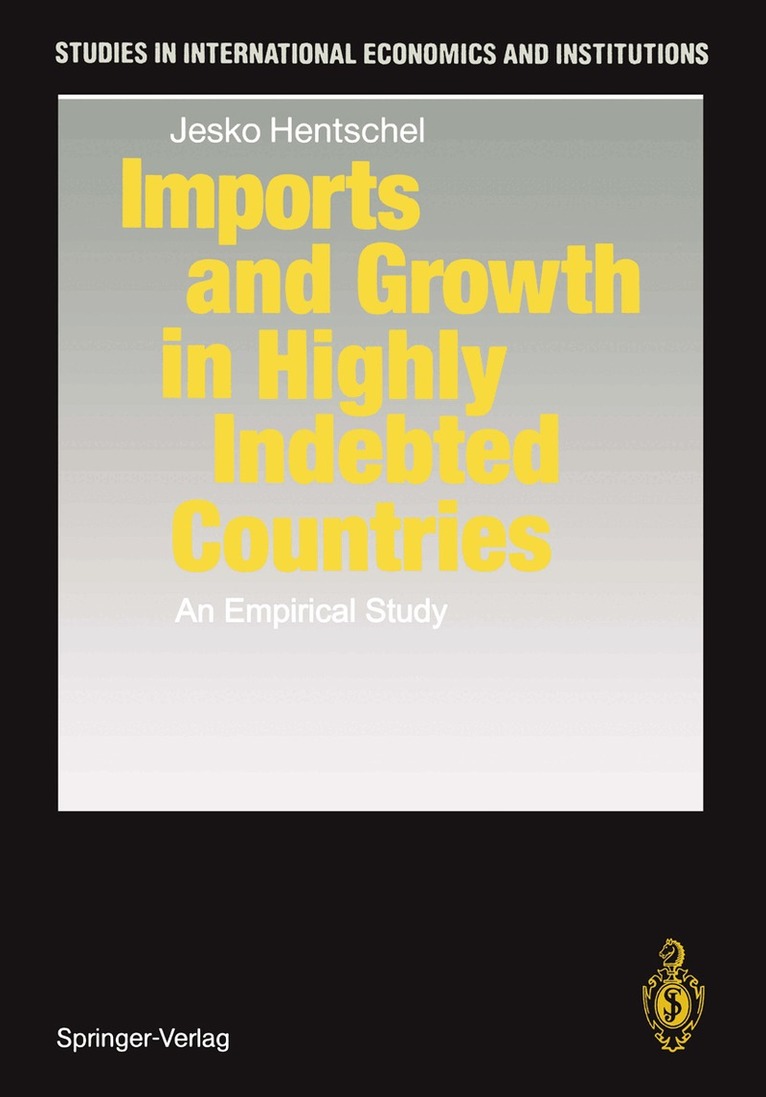
    Imports and Growth in Highly Indebted Countries

    An Empirical Study

    AvJesko Hentschel

    Häftad, Engelska, 2012

    Del i serien Studies in International Economics and Institutions

    1 119 kr

    Beställningsvara. Skickas inom 10-15 vardagar. Fri frakt över 249 kr.

    Fler format och utgåvor

    E-bok

    1 459 kr

    Beskrivning

    A real imports of capital and intermediate goods declinedsharply for highlyindebted countries in the 1980s, theseeconomies were faced with the need tosubstitute previouslyimported factors of production with domestic capital andlabor. The study empirically analyzes the degree of importdependence of twelve developing countries. Estimates of theshort-run elasticity of substitution characterize bothimported capital and intermediate goods to behave likecomplements in the production process in the developingcountries. Long-run substitution elasticites differconsiderably among the group of economies, especially forimported machinery and equipment. The results indicate thatinward-oriented strategies have not achieved the aim ofreducing the import dependence of the developing economies.In order to visualize theimplications of the differingdegree of import dependence, a partial equilibriumeconometric model is used to analyze the reaction of thetrade account on external shocks and domestic policies inColumbia and Ecuador. Simulations show that the dependenceon imported production means can transform an "adjustmentwith growth" of the external account intoan "adjustment orgrowth" controversy.

    Produktinformation

    • Utgivningsdatum:2012-03-08
    • Mått:170 x 244 x 13 mm
    • Vikt:402 g
    • Format:Häftad
    • Språk:Engelska
    • Serie:Studies in International Economics and Institutions
    • Antal sidor:209
    • Förlag:Springer-Verlag Berlin and Heidelberg GmbH & Co. KG
    • ISBN:9783642467721

    Utforska kategorier

    • Nationalekonomi inom Ekonomi och Ledarskap
    • Internationell ekonomi inom Ekonomi och Ledarskap

    Innehållsförteckning

    • 1. Introduction.- 1.1. The debt crisis, imports, and growth.- 1.2. Structure of the study.- 2. The importance of imported factors of production in developing countries.- 2.1. Introductory remarks.- 2.2. The composition of imports.- 2.3. Factors impeding perfect import substitutability.- 2.4. Capital goods.- 2.5. Intermediate goods.- 2.6. Development strategies and the role of imports.- 2.7. Summary.- 3. Import models: issues and problems.- 3.1. Introduction.- 3.2. The theoretical background: imports and growth.- 3.3. The standard import function, foreign exchange availability, and disaggregate import analyses.- 3.4. Empirical studies of imports as factors of production in developing countries.- 3.5. Concluding remarks.- 4. Macroeconomic production functions and elasticities of substitution between imported and domestic factors of production.- 4.1. Introduction.- 4.2. Aggregate production functions and the elasticity of substitution.- 4.3. The nested production function.- 4.4. Summary.- 5. Estimation of elasticities of substitution between domestic and imported means of production.- 5.1. Introductory remarks.- 5.2. Measurement of the domestic price of imported goods.- 5.3. Imported and domestically produced capital goods.- 5.4. Imported intermediate goods.- 5.5. Summary and interpretation of the empirical results.- 6. Imports, growth, and the trade balance: two case studies.- 6.1. Basic remarks about the framework.- 6.2. The Columbian model.- 6.3. The Ecuadorian model.- 6.4. Concluding remarks about the simulations.- 7. Conclusion.- 7.1. Summary of findings.- 7.2. Import vulnerability reconsidered.- Appendices.- A. Statistical tables.- B. The cost function and conditional factor demands for a CES production function.- B.1. Derived factor demands.- B.2. The cost function.- C. Data sources and computational notes.- C.1. Industrial production and price statistics.- C.2. Trade data.- C.3. National income accounting statistics.- C.4. Specific variables used in Chapter 5.- C.4.1. Implicit average effective import taxes.- C.4.2. Real import capacity.- C.4.3. Interest rates.- C.5. Variable defmitions and sources, Chapter 6.- C.6. Computational notes.- References.